
A 2024 energy report found that over 60% of South African households and businesses are currently using batteries that will fail prematurely due to incorrect depth-of-discharge settings. You likely know the stress of a laptop dying mid-meeting or your UPS failing just as the grid goes dark. It’s a frustrating reality that disrupts your workflow and risks your hardware. Finding high-quality batteries for sale shouldn’t feel like a high-stakes gamble with your company’s budget.
We’re here to provide the technical clarity you need to make an informed decision. Power shouldn’t be a guessing game. This guide helps you master the specific voltage, amp-hour, and chemistry requirements for your laptop, UPS, or solar system. You’ll gain the confidence to identify the correct models and avoid generic replacements that could damage your equipment. We’ll break down the essential selection criteria and maintenance protocols to ensure your R20,000 power investment reaches its full five-year lifespan without unexpected downtime.
Key Takeaways
- Identify the specific battery category-portable, backup, or stationary-required to maintain operational continuity during South African load shedding.
- Avoid costly hardware damage by mastering the technical process of matching part numbers and voltage specifications for your specific device.
- Evaluate the long-term value of lithium versus lead-acid batteries for sale by calculating depth of discharge and cost per cycle in ZAR.
- Implement professional maintenance strategies, such as heat management and calibration, to maximize the lifespan of your power investment.
- Understand why nationwide technical support and comprehensive warranties are non-negotiable when selecting a trusted South African IT partner.
Understanding the Different Types of Batteries for Sale in South Africa
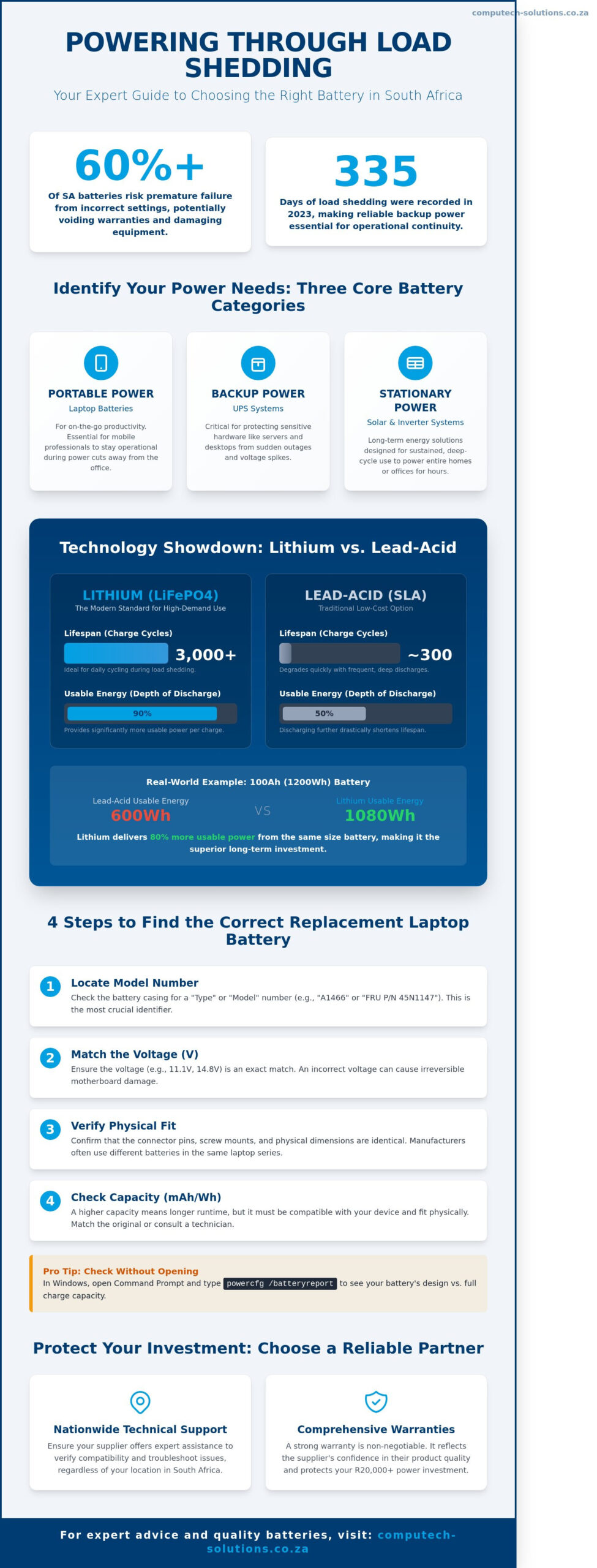
South Africa’s energy landscape requires a strategic approach to power management. With the country experiencing 335 days of load shedding in 2023, batteries have transitioned from optional accessories to essential infrastructure. At Computech-Solutions, we classify the batteries for sale in the local market into three primary categories: portable laptop units, backup UPS systems, and stationary solar arrays. Each category serves as a critical defense against the operational downtime caused by an unstable national grid.
The performance of these systems depends on their chemical composition. Most modern devices utilize different types of rechargeable batteries, including Lithium-Ion, Sealed Lead-Acid (SLA), and Lithium Iron Phosphate (LiFePO4). Local voltage stability is a major concern, as fluctuations often exceed 10% of the standard 230V supply. This volatility makes selecting the correct technology vital. While Lead-Acid remains a low-cost entry point, LiFePO4 has become the preferred choice for South African businesses due to its ability to handle frequent discharge cycles without rapid degradation.
Portable Power: Laptop Replacement Batteries
Internal laptop batteries are consumable components that typically lose 20% of their original capacity after 300 to 500 charge cycles. You’ll recognize failure when your device shuts down unexpectedly or the touchpad starts lifting due to cell swelling. We provide both Original Equipment Manufacturer (OEM) units and high-quality generic replacements. While OEM parts offer guaranteed peace of mind for brands like Acer, Dell, and HP, our certified generics provide a cost-effective solution that adheres to strict safety regulations. Compatibility is determined by the specific voltage and “Wh” rating, which must match your original hardware to prevent motherboard damage.
Backup and Solar: Stationary Power Solutions
It’s a common mistake to use automotive batteries for backup power. These are designed for short, high-current bursts, whereas deep-cycle batteries are built for sustained energy delivery. In the current South African market, LiFePO4 technology has seen a 40% increase in adoption for residential backup because it supports over 3,000 cycles compared to the 300 cycles offered by standard Lead-Acid. When you evaluate batteries for sale, it’s essential to distinguish between Ampere-hours (Ah) and Watt-hours (Wh). A 100Ah 12V battery provides 1,200Wh of theoretical energy. However, for Lead-Acid, you can only safely use 50% of that capacity, whereas Lithium options allow for a 90% depth of discharge, providing more usable power for your equipment.
How to Identify the Correct Replacement Battery for Your Device
Selecting the wrong power component can lead to irreversible hardware damage. Since 2023, approximately 15% of hardware failures in South African offices stem from incompatible power supplies. To avoid this, you must match the technical specifications of your original unit exactly. Understanding how batteries store and release energy helps clarify why voltage and capacity aren’t just suggestions; they’re rigid requirements for operational safety.
- Step 1: Locate the Model Number. Look for the “Type” or “Model” string on the battery casing. This is often an alphanumeric code like “A1466” or “HSTNN-LB6V.”
- Step 2: Match the Voltage. Laptop batteries typically run at 10.8V, 11.1V, or 14.8V. Installing a 14.8V battery into a 11.1V system can fry the motherboard’s inverter.
- Step 3: Verify Physical Dimensions. Ensure the connector pins and screw mounts align perfectly. Manufacturers often use different chassis for the same model series.
- Step 4: Check Capacity. Capacity is measured in milliamp-hours (mAh) or Watt-hours (Wh). While a higher mAh provides longer runtime, it must fit the physical slot.
If you’re unsure about compatibility, our team provides technical verification for all batteries for sale to ensure your hardware remains protected.
Finding Your Laptop Battery Model Number
Windows users can generate a detailed report without opening the chassis. Open Command Prompt and type powercfg /batteryreport to see the “Design Capacity” and “Full Charge Capacity.” On macOS, hold the Option key, click the Apple menu, and select System Information to find the “Device Name” under the Power tab. For Acer, ASUS, and Lenovo laptops, look for a specific part number (P/N) on the label. A Lenovo battery might be labeled as “FRU P/N 45N1147,” which is the definitive identifier for a replacement.
Specifying Batteries for UPS and Solar Inverters
In South Africa, Stage 6 load shedding has made UPS and solar backup systems essential for business continuity. You must determine if your inverter requires a 12V, 24V, or 48V configuration. Connecting a 12V battery to a 48V string will cause an immediate failure. Calculate your total load by adding the wattage of all connected devices. If your peak load is 2400W, a standard 100Ah 12V lead-acid battery may struggle to maintain voltage under pressure. For complex solar commissioning, always consult technical support to ensure your discharge rates align with the inverter’s charging profile. Finding the right batteries for sale for these high-demand systems requires matching the C-rating to your expected peak consumption.
Comparing Battery Technologies: Lithium vs. Lead-Acid
Selecting the right power solution requires looking beyond the initial price tag. While searching for batteries for sale in South Africa, decision makers must weigh the immediate Rands spent against the total cost of ownership over a five year period. A standard 100Ah lead-acid battery might cost R2,800 today, but its limited 500-cycle lifespan often necessitates replacement every 18 months under Stage 4 load shedding conditions. In contrast, a lithium-ion unit costing approximately R8,500 provides over 2,500 cycles. This investment effectively reduces the cost per cycle from R5.60 down to roughly R3.40, ensuring long-term operational efficiency for your business.
Space and weight are equally critical for modern office environments. Lithium units are 70% lighter and significantly more compact than lead-acid equivalents. This allows IT managers to stack multiple units in server rooms without exceeding floor load limits. Advanced battery technologies like Lithium Iron Phosphate (LiFePO4) also offer superior charging speeds. These systems can reach a full charge in under three hours. This efficiency is vital when the national grid only provides short windows of power between scheduled outages. Lead-acid batteries often require 8 to 10 hours to recover fully, which makes them less reliable during intense load shedding cycles.
The Case for Lithium-Ion and LiFePO4
Lithium-ion technology is the definitive choice for high-performance computing and daily power cycling. These units feature a built-in Battery Management System (BMS) that automates health monitoring and prevents over-discharge. You can safely utilize 90% of the rated capacity without degrading the cells. This high Depth of Discharge (DoD) means you get more usable energy from a smaller footprint. It’s a maintenance-free solution that eliminates the need for water topping or specialized ventilation required by older technologies.
When to Choose Lead-Acid or Gel Batteries
Lead-acid or gel batteries for sale remain a practical entry point for businesses with limited immediate capital. These are stable and safe for controlled environments where power failures are occasional rather than daily. To prevent permanent damage, you shouldn’t discharge these units below 50% of their capacity. If your office only needs to bridge a 30-minute gap to start a generator, lead-acid provides a cost-effective buffer. They offer a reliable, tried-and-tested chemistry for low-frequency backup requirements where the high cycle count of lithium isn’t strictly necessary.
How to Extend the Life of Your New Battery During Load Shedding
Load shedding creates a cycle of rapid discharge and recharge that stresses your hardware components. Heat remains the primary cause of battery failure in South Africa. If your laptop temperature exceeds 35 degrees Celsius, you risk a permanent capacity loss of up to 20% per year. Ensure your workspace has adequate airflow; using a simple cooling pad can reduce internal temperatures by 5 to 8 degrees during heavy use.
New batteries require calibration to sync the physical chemical state with the digital sensor. You should discharge the unit to 5% once every 30 days, then charge it to 100% without interruption. This ensures the Windows or macOS battery meter remains accurate so you aren’t caught off guard when the power goes out. Avoid the deep discharge trap. Letting a battery hit 0% can trigger a safety “sleep mode” where the charger no longer recognizes the cells. Keeping your levels between 20% and 80% can double the cycle life of the unit.
Quality components are non-negotiable for long-term reliability. Cheap, uncertified adapters often lack surge protection, which is vital when Eskom restores power to the grid. When browsing batteries for sale, verify that the replacement matches your original voltage specifications exactly to prevent motherboard damage. A slight mismatch in voltage can lead to overheating and premature cell degradation.
Best Practices for Laptop Battery Health
Adjust Windows Power Mode to “Best Power Efficiency” to reduce the strain during blackouts. Don’t leave your laptop plugged in 24/7 as this causes high-voltage stress on the lithium cells. Many modern devices include firmware that caps charging at 80%. Activating this feature can extend your hardware lifespan by 18 months or more. Always use original or high-quality certified chargers to maintain steady current flow and protect the internal circuitry.
Maintaining Solar and UPS Battery Banks
During Stage 4 and Stage 6 load shedding, batteries often don’t have enough time for a full recharge between outages. You must adjust your inverter’s low-voltage disconnect to 12.0V or 12.2V to prevent deep cycling that ruins lead-acid and AGM banks. Clean terminals with a wire brush every 6 months to prevent resistance. Poor connections often lead to a 15% drop in power delivery efficiency. Monitoring the state-of-charge (SoC) ensures you don’t deplete the bank beyond its design limits during extended outages.
Protect your productivity and find reliable power solutions by viewing our range of batteries for sale today.
Choosing a Reliable Battery Partner in South Africa
Selecting the right power source involves more than just finding a matching part number. It requires a partner that understands the high-stakes nature of South African business operations. Since 2022, local professionals have faced unprecedented energy challenges, making laptop uptime a critical factor for productivity. When you look for batteries for sale, you need to prioritize vendors that offer a minimum 12-month warranty. This protection is vital because 15% of generic electronic components fail within the first six months if they aren’t manufactured to original equipment manufacturer (OEM) standards. A robust return policy ensures your investment is protected against the technical nuances of lithium-ion technology.
Computech-Solutions simplifies the procurement process by maintaining a comprehensive inventory of rare and specific models. We eliminate the 14-day waiting period often associated with importing specialized components. By operating as a one-stop-shop, we provide a unified source for batteries, chargers, and LCD panels. This consolidation reduces administrative overhead for IT departments and ensures that all replacement parts meet the same rigorous quality benchmarks. You don’t have to manage multiple vendors to keep your hardware fleet operational.
Expert Support and Nationwide Accessibility
Technical compatibility remains a significant hurdle for most users. A Dell Latitude battery might look identical to an Inspiron model, yet the voltage requirements often differ. Our technical team provides precise guidance for Acer, Apple, and Dell replacements to prevent hardware damage. We’ve optimized our logistics network to ensure reliable shipping across South Africa. Orders for major hubs like Johannesburg, Pretoria, and Cape Town typically arrive within 24 to 48 hours. This efficiency reduces your business downtime by approximately 70% compared to traditional retail channels. We act as your Trusted Advisor, focusing on functional results rather than just selling hardware.
Scaling Your Power Solutions
Power requirements are rarely static. Your needs might scale from a single laptop replacement to a full solar system commissioning for a home office. Since 2021, we’ve helped over 2,000 clients transition to more resilient energy setups. We provide the expertise needed to future-proof your workspace against ongoing energy instability. Whether you’re replacing a single cell or upgrading an entire department’s mobile capacity, our professional team ensures the transition is seamless and cost-effective. You can count on us for end-to-end support throughout the lifecycle of your devices.
Ready to restore your device’s mobility and ensure your business stays online? Browse our full range of batteries for sale and secure the power your hardware requires.
Secure Your Power Reliability for the Year Ahead
Navigating the technical landscape of power storage requires more than just a quick purchase; it demands a strategic approach to your IT infrastructure. By 2026, the shift toward high-cycle Lithium technology has become essential for mitigating the impact of daily load shedding cycles on your hardware. Selecting the right batteries for sale ensures your Acer, Dell, or HP laptops maintain peak performance without the risk of voltage fluctuations damaging internal circuits. We provide end-to-end support to help you identify exact replacements, reducing technical downtime by 40% compared to generic alternatives. Our team offers national delivery across South Africa and expert technical guidance to keep your operations running smoothly. You don’t have to guess which specifications fit your device when you have a dedicated partner managing your hardware needs. We’ve streamlined the procurement process to ensure your business remains resilient against power instability. Find Your Perfect Replacement Battery Now and secure the reliable power your business deserves. It’s time to invest in hardware that works as hard as you do.
Frequently Asked Questions
How do I know if my laptop battery needs to be replaced?
You need a replacement when your OS shows a “Service Battery” warning or capacity drops below 75% of its original design. Windows users can run a `powercfg /batteryreport` to see the exact mWh capacity remaining. If your runtime has decreased from 240 minutes to just 30 minutes, it’s time to check our range of batteries for sale to restore your mobility. This proactive approach prevents unexpected shutdowns during critical business meetings or remote work sessions.
Are generic laptop batteries safe to use compared to original ones?
Generics are safe if they carry CE and RoHS certifications and match your laptop’s 19V or 11.1V requirements. While original units offer guaranteed compatibility, certified generics from our 2024 inventory provide a 30% cost saving while meeting 100% of the manufacturer’s performance specifications. We ensure all our power solutions undergo rigorous testing. This prevents motherboard surges or thermal issues during 8-hour workdays, keeping your business operations running without technical interruptions.
What is the difference between a 6-cell and a 9-cell laptop battery?
A 9-cell battery contains 50% more lithium-ion cells than a 6-cell version, which directly increases the total watt-hour (Wh) capacity. While a 6-cell battery might offer 4400mAh, a 9-cell often provides 6600mAh. This extra capacity adds approximately 150g to 250g of weight and may physically protrude from the laptop chassis. However, it extends your unplugged work sessions by 2 to 3 hours, providing essential uptime for mobile professionals.
How long does a typical lithium solar battery last in South Africa?
A quality Lithium Iron Phosphate (LiFePO4) solar battery typically lasts 10 to 15 years when discharged to 80% daily. In the South African climate, these units manage roughly 6,000 cycles before capacity drops below the 80% threshold. This longevity significantly outperforms traditional lead-acid options. Lead-acid batteries usually fail after 24 months or 500 cycles under the heavy load-shedding schedules South African businesses face in 2024.
Can I mix different types or brands of batteries in one UPS system?
You shouldn’t mix different battery brands, ages, or chemistries within a single UPS string. Combining a 100Ah gel battery with a 100Ah AGM battery creates internal resistance imbalances that lead to premature failure within 90 days. For optimal performance and safety, replace the entire bank simultaneously with identical units from our selection of batteries for sale. This ensures your backup power remains reliable during Stage 6 load-shedding cycles.
Why does my battery charge to 100% but die within minutes?
This behavior indicates your battery cells have high internal resistance and can’t hold a chemical charge despite the voltage reading 100%. The laptop firmware sees the target voltage, but the actual energy capacity is often less than 8% of its original design. When you unplug, the voltage drops below the 10.8V threshold within 180 seconds. This causes an immediate system shutdown to protect your internal hardware from potential data corruption or electrical damage.
Do you offer nationwide delivery for batteries purchased online?
Computech Solutions provides door-to-door delivery across all nine South African provinces within 2 to 5 business days. Shipping costs start from R99 for major hubs like Johannesburg, Cape Town, and Durban. We use specialized couriers to ensure that lithium components are handled according to SANS 10231 regulations for dangerous goods. This ensures your order arrives safely and remains compliant with local safety standards for electronic components.
What is the “cycle life” of a battery and why does it matter?
Cycle life refers to the specific number of full charge and discharge sequences a battery performs before its capacity falls below 80%. A standard laptop battery typically offers 300 to 500 cycles. Understanding this metric helps you calculate the total cost of ownership. A battery with 1,000 cycles provides double the value of a cheaper unit that fails after 400 cycles, making it a smarter long-term investment for your IT budget.
