
Why does a 5kVA backup system often fail to keep your lights on during a standard Stage 6 cycle? Most homeowners focus on total capacity, but the real secret to surviving 2026 power outages lies in recharge recovery speed and battery chemistry rather than just size. If you’ve ever dealt with a battery that loses its punch after just a few months of frequent cycling, you know that not all storage is created equal. Finding the best solar battery backup for home load shedding South Africa requires looking past the marketing jargon to find hardware that actually handles the relentless demand of the national grid.
We understand the stress of interrupted work and the confusion of trying to decipher VA versus Watt ratings. You need a system that transitions instantly so your desktop or server doesn’t skip a beat when the power drops. This article provides a clear roadmap to selecting a backup solution that survives Stage 6 cycles and keeps your home running reliably through every outage. We’ll examine the latest LiFePO4 technology, explain the R15,000 to R80,000 price landscape, and ensure your setup meets the March 2026 Eskom registration deadlines.
Key Takeaways
- Learn how to accurately convert VA to usable Watts and why applying the 80% rule prevents system overloads during sudden power transitions.
- Discover why LiFePO4 technology is now the national standard, offering over 3,000 cycles compared to the 300 cycles typical of traditional lead-acid batteries.
- Identify the best solar battery backup for home load shedding South Africa by matching specific inverter types to your hardware, from mini UPS units for routers to online double conversion for sensitive PCs.
- Understand the critical role of ventilation and regular calibration in extending your system’s lifespan through the heavy demands of Stage 6 schedules.
- Avoid the “death spiral” of premature battery failure by selecting a configuration designed for the rapid recharge recovery speeds required in 2026.
Why Standard UPS Systems Struggle with South African Load Shedding
Standard backup systems were never engineered for the South African grid of 2026. Most off-the-shelf units are designed for occasional, short-term outages where the primary goal is to provide enough time for a safe shutdown. In South Africa, however, we face a unique challenge where power is cut for two to four hours at a time, often multiple times within a single 24-hour cycle. This relentless cycling creates a “Death Spiral” for traditional hardware. When you’re searching for the best solar battery backup for home load shedding South Africa, you have to look beyond simple capacity. The real metric of success in a Stage 6 environment is recharge recovery speed.
An Uninterruptible Power Supply (UPS) serves a vital role in protecting sensitive electronics from surges and providing instantaneous switch-over. But there’s a massive difference between simple surge protection and active energy storage. A basic UPS often uses lead-acid or gel batteries that weren’t built for deep discharges. If your backup system doesn’t have the “intelligence” to manage its internal chemistry during rapid-fire outages, you’ll find yourself replacing expensive components every six months.
The Load Shedding Cycle Problem
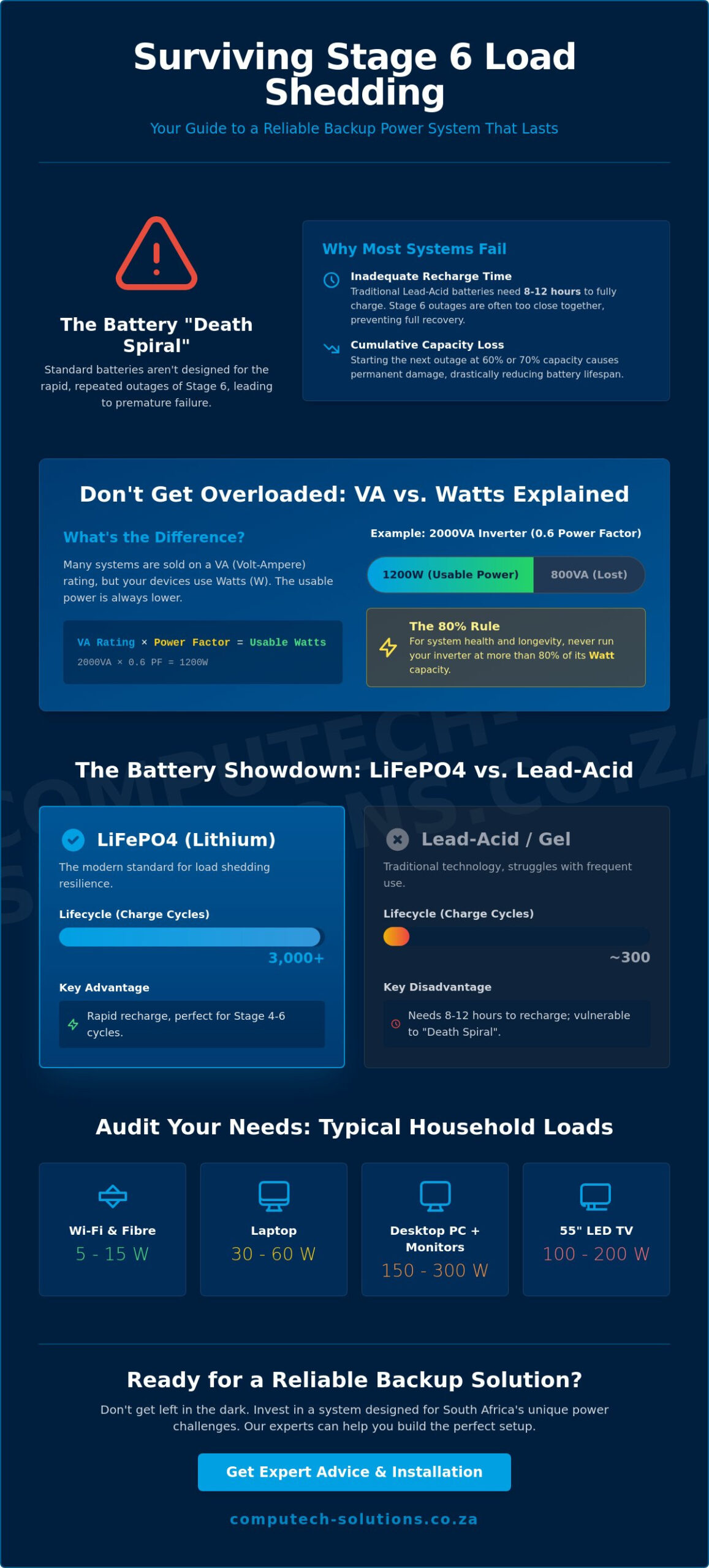
Batteries are chemical engines that require a “rest” period to fully recover. Under ideal conditions, a lead-acid battery needs 8 to 12 hours of continuous charging to reach a 100% state of charge. When Stage 4 or Stage 6 hits, the gap between outages is often shorter than the required recharge time. This means you’re starting your next load shedding slot at 60% or 70% capacity. Over time, this causes acid stratification and permanent plate damage. You’ll know your battery is failing if the runtime drops significantly or if the unit feels excessively hot during the charging phase.
UPS vs. Inverter vs. Solar Backup
Selecting the right hardware depends entirely on your home load profile. A dedicated UPS is essential for desktop computers and servers because it offers a switch-over speed of less than 10 milliseconds, preventing a system reboot. However, for long-term survival, an inverter or a solar-integrated system is superior. Solar panels provide a critical advantage by allowing your batteries to charge during the day even when Eskom is offline. This bypasses the recharge bottleneck and ensures you have the best solar battery backup for home load shedding South Africa. For those using high-end laptops, ensure your chargers and replacement laptop batteries are rated for the “dirty” power often seen when the grid first returns to avoid hardware degradation.
Sizing Your Backup: Understanding VA, Watts, and Runtime Calculations
Identifying the best solar battery backup for home load shedding South Africa begins with a precise audit of your power consumption. Many homeowners purchase a system based on the Volt-Ampere (VA) rating, only to find it shuts down when they plug in a standard desktop computer. This happens because VA and Watts are not the same thing. The Watt rating represents the actual “real power” the unit can deliver, while VA is “apparent power.” Most mid-range inverters and UPS units have a power factor between 0.6 and 0.8. If you buy a 2000VA unit with a 0.6 power factor, you only have 1200W of usable power.
Adhering to the 80% Rule is critical for system stability. You should never plan to use more than 80% of your inverter’s rated Watt capacity. Running a system at its absolute limit generates excessive heat and increases the risk of component failure during the high-voltage “inrush” that occurs when devices first turn on. If your calculated load is 800W, you need a system rated for at least 1000W to ensure a safety buffer. If you’re upgrading your home office to withstand outages, investing in high-efficiency desktop computers or laptops can significantly reduce your total backup load and extend your runtime.
Load Estimates for Common South African Households
- Wi-Fi Routers and Fibre ONT: These are the most efficient devices to back up, typically drawing between 5W and 15W. A small dedicated DC UPS can often keep these running for 8 hours.
- Home Office: A modern laptop draws roughly 30W to 60W, while a dual-monitor desktop setup can range from 150W to 300W.
- Entertainment: A 55-inch LED TV and a soundbar generally draw 150W to 250W. Adding a gaming console can push this toward 500W, which will deplete small batteries rapidly.
The Runtime Formula for 2026
To estimate your backup time, use this formula: (Battery Voltage x Amp Hours x Efficiency Factor) / Load Watts. For example, a 100Ah 12V Lithium battery provides 1200Wh of potential energy. With a standard 90% efficiency factor and a 200W load, you can expect roughly 5.4 hours of power. However, Stage 6 schedules require “Extended Run” models that utilize larger battery banks rather than just high-wattage inverters. Limiting your depth of discharge is the single most important factor in ensuring your battery bank survives the three-year mark without significant degradation. Systems that allow for modular expansion are often the best solar battery backup for home load shedding South Africa because they let you add capacity as your budget allows.
Lithium (LiFePO4) vs. Lead-Acid: The Battle for Battery Longevity
Choosing the best solar battery backup for home load shedding South Africa isn’t just about how much power you can store; it’s about how many times you can use it. In 2026, the chemistry of your battery bank determines whether your investment lasts ten years or ten months. While lead-acid options remain available, Lithium Iron Phosphate (LiFePO4) has emerged as the definitive standard for South African households. This shift is driven by cycle life. A cycle is one full discharge and recharge. Under the heavy demands of Stage 4 or Stage 6, your system may cycle twice daily. This makes the longevity of the battery chemistry the most critical factor in your total cost of ownership.
The performance gap between these technologies is staggering. Lead-acid batteries generally offer around 300 to 500 cycles before their capacity drops below usable levels. If you’re cycling twice a day during intense load shedding, a lead-acid battery could fail in less than a year. Conversely, modern LiFePO4 batteries are rated for 3,000 to 6,000 cycles. Even with frequent outages, a lithium system can reliably serve a home for over a decade. This durability is why lithium is widely considered the best solar battery backup for home load shedding South Africa, despite the higher initial price point.
Lead-Acid (AGM/Gel) Pros and Cons
Lead-acid and gel batteries are the most affordable entry point, with prices typically ranging from R2,000 to R15,000. They’re simple to install and widely available. However, they suffer from a limited Depth of Discharge (DoD). To prevent permanent damage, you should only use 50% of a lead-acid battery’s capacity. This means a 100Ah battery only provides 50Ah of usable power. They’re also sensitive to heat and require well-ventilated spaces to prevent the buildup of gasses. These units are best suited for occasional Stage 1 or 2 outages where the battery has ample time to recover between uses.
The Lithium Advantage for Stage 6
Lithium technology solves the two biggest headaches of the South African energy crisis: recharge time and usable capacity. LiFePO4 batteries support a 90% to 100% Depth of Discharge, meaning you get almost all the power you paid for without damaging the cells. More importantly, they support rapid charging. While lead-acid units need 8 to 12 hours to recover, a lithium battery can reach 80% capacity in under 2 hours. This quick turnaround is essential when the gap between load shedding slots is narrow. They’re also significantly lighter and safer, with internal Battery Management Systems (BMS) that prevent overheating and overcharging. For those who rely on consistent power for IT infrastructure or home offices, lithium is the only logical “buy once, cry once” solution.
Tailoring Your Backup Solution to Your Home Load Profile
A one-size-fits-all approach rarely works when building the best solar battery backup for home load shedding South Africa. Your specific hardware determines the level of sophistication required in your power management system. For instance, high-end electronics like iMacs or gaming PCs with Active PFC (Power Factor Correction) power supplies are notoriously sensitive. These devices require a Pure Sine Wave output. Using a cheaper “simulated” or “modified” sine wave unit can cause audible buzzing, overheating, or even permanent hardware failure. Ensuring your inverter produces a clean, consistent wave is non-negotiable for professional-grade IT equipment.
Beyond wave type, you must choose between Line-Interactive and Online Double Conversion systems. Most household backups are Line-Interactive; they wait for a power failure before switching to battery. This transition usually takes 4 to 10 milliseconds. While most desktop PCs handle this, ultra-sensitive servers or medical equipment might reboot. Online Double Conversion systems are the premium choice because they constantly run the load off the battery, providing zero transfer time and total isolation from grid fluctuations. Look for essential features like Automatic Voltage Regulation (AVR) to handle brownouts and “Cold Start” capabilities that allow you to turn the system on even when the grid is already down. Monitoring these stats via an LCD status display helps you manage your load in real-time to avoid accidental overloads.
Best Setup for Wi-Fi and Connectivity
Keeping your internet alive shouldn’t require a massive, noisy inverter. For routers and Fibre ONT units, DC-to-DC Mini UPS systems are the most efficient choice. These units bypass the energy-wasting process of converting battery DC power into AC and then back to DC for the router. By staying in the DC realm, these compact devices can provide up to 8 hours of runtime on a tiny footprint. They are silent, affordable, and offer a simple DIY installation that keeps your home office connected through the longest Stage 6 slots without the heat or fan noise of larger units.
Best Setup for Laptops and Workstations
Mobile professionals face the challenge of balancing battery health with portability. While a laptop has its own internal power, frequent deep discharges during load shedding will quickly degrade its lifespan. It’s often more cost-effective to use an external backup for the first two hours and only rely on the laptop’s internal cell for the remainder. If your current hardware is already showing signs of wear, you can find high-quality replacement laptop batteries for brands like Dell, HP, and Lenovo to restore your mobility. Combining a healthy internal battery with a properly sized external backup ensures you can complete a full 4-hour work session without the stress of a sudden shutdown. This multi-layered approach is often the most reliable way to maintain productivity during high-stage outages.
Installation, Maintenance, and Long-Term Power Reliability
Securing the best solar battery backup for home load shedding South Africa is only the first step toward energy independence. Long-term reliability depends heavily on where and how you install your equipment. Heat is the primary enemy of battery health. For every 10°C increase above the optimal operating temperature of 25°C, the service life of a lead-acid battery can be cut in half. Even robust Lithium (LiFePO4) systems require adequate ventilation to manage the heat generated during the rapid recharge cycles required between Stage 6 outages. Placing your inverter and battery bank in a cool, dust-free environment with at least 15cm of clearance around the cooling fans will prevent thermal throttling and premature component failure.
Regular maintenance is equally essential for system accuracy. Most high-end backup units feature management software that allows for automated “self-tests.” These tests help the system’s internal Battery Management System (BMS) calibrate the state of charge. Without occasional calibration, your UPS might report 40% power remaining, only to shut down unexpectedly because the voltage dropped faster than the software anticipated. You should also perform a manual visual inspection every quarter to check for cable corrosion or loose connections, especially in high-vibration areas or environments with high humidity.
Setup Best Practices for Longevity
One of the most common mistakes in South African households is “daisy-chaining” power strips. Plugging a high-draw multi-plug into your UPS, or worse, connecting one UPS into another, creates a significant fire risk and can interfere with the earth leakage protection of your home. It’s also vital to remember that a standard home UPS is designed for IT equipment. Never plug high-draw resistive loads like kettles, hair dryers, or heaters into your backup system. These appliances draw thousands of Watts instantly, which can blow the internal fuses or permanently damage the inverter’s power FETs. If you are integrating your backup with a permanent solar array, ensure your system is registered with Eskom or your local municipality before the March 2026 deadline to avoid potential fines and ensure compliance with the latest NERSA regulations.
Why Source Your Backup from Computech-Solutions?
Choosing the right hardware requires more than just looking at a price tag; it requires a partner who understands the specific pressures of the South African power grid. Computech-Solutions provides expert technical advice tailored to your specific load profile, ensuring you don’t overspend on capacity you don’t need or underspecify a system that will fail during Stage 6. We offer a comprehensive range of IT hardware, from desktop computers to specialized power solutions, making us the definitive one-stop-shop for your home office needs. With reliable nationwide delivery and a commitment to end-to-end support, we ensure your transition to backup power is seamless and professionally managed. View our range of reliable UPS systems and batteries to find the perfect fit for your home.
Securing Your Energy Independence Through 2026
Reliable power in the current South African landscape isn’t about finding the biggest battery; it’s about matching the right chemistry and capacity to your specific household needs. We’ve explored why LiFePO4 technology is the only sustainable choice for Stage 6 and how precise Watt calculations prevent system failure during critical work hours. By prioritizing recharge speed and proper ventilation, you protect your hardware investment from the relentless cycling of the national grid. Identifying the best solar battery backup for home load shedding South Africa ensures your home office remains functional regardless of the Eskom schedule.
Computech-Solutions has been a trusted IT hardware supplier since 2018, providing the expertise needed to navigate complex grid conditions. We offer nationwide delivery across South Africa and expert technical support to help you select the ideal configuration for your load profile. Don’t let power transitions disrupt your productivity or damage your sensitive electronics. Browse our curated selection of UPS systems for load shedding and take the first step toward a more resilient home setup. With the right technology in place, you can face future outages with total confidence.
Frequently Asked Questions
Can I use a UPS to run my fridge or microwave during load shedding?
No, standard IT UPS units aren’t designed to handle appliances like fridges or microwaves. These devices have inductive loads and high startup surges that can exceed a backup system’s capacity by five to seven times. Using them on a unit meant for a computer will likely cause an immediate shutdown or permanent internal damage. It’s best to stick to low-draw electronics like routers and PCs for these systems.
How long does a typical UPS battery last under Stage 4 load shedding?
A standard lead-acid battery often fails within six to twelve months under the heavy cycling of Stage 4. Frequent discharges prevent the battery from reaching a full state of charge between outages, leading to rapid degradation. For the best solar battery backup for home load shedding South Africa, we recommend Lithium (LiFePO4) chemistry. Lithium handles thousands of cycles and remains reliable even when the grid fails multiple times a day.
What is the difference between simulated sine wave and pure sine wave?
Pure sine wave output is an exact replica of the electricity provided by the utility grid. It is essential for sensitive equipment like iMacs, servers, and high-end desktop computers with Active PFC power supplies. Simulated sine wave units are more affordable but can cause electronic noise, overheating, or malfunctions in sophisticated hardware. You should always check your device requirements before choosing a cheaper modified sine wave inverter.
Why does my UPS beep constantly when the power goes out?
Constant beeping is an audible alert that the system has switched to battery power. If the beep becomes rapid or changes to a solid tone, it usually indicates a low battery warning or an overload condition. You can often mute standard alerts using the unit’s management software. However, if the beeping persists while the grid is active, it might signal that the internal battery has failed and needs replacement.
Can I replace my old UPS battery with a lithium LiFePO4 battery?
You can replace old batteries with lithium, but only if the UPS charging circuit is compatible with LiFePO4 voltage profiles. While “drop-in” lithium replacements are popular in South Africa, they must match the existing system’s charging parameters to avoid safety risks. Upgrading to lithium is often the best solar battery backup for home load shedding South Africa because it offers a lifespan ten times longer than traditional lead-acid cells.
How many hours will a 2000VA UPS last for a laptop and one monitor?
A 2000VA UPS will typically provide three to five hours of runtime for a standard laptop and one LED monitor. This calculation assumes the unit has a healthy battery bank and a power factor of at least 0.6. Actual duration depends on the laptop’s power settings and the monitor’s brightness. Using a dedicated laptop battery for the first portion of the outage can extend your total backup duration significantly.
Is it safe to leave my UPS plugged into the wall 24/7?
Yes, it is both safe and necessary to leave your UPS plugged in at all times. The system needs to stay connected to the grid to keep the internal batteries at an optimal state of charge and to provide continuous surge protection. Modern units feature smart charging technology that prevents overcharging. Unplugging the unit frequently can lead to deep discharges that shorten the battery’s overall service life.
What happens if I overload my UPS during a power transition?
If you exceed the rated Watt capacity during a power transition, the UPS will trigger an overload protection circuit. This results in an immediate shutdown of all connected equipment to prevent a fire or hardware failure. Some units will emit a continuous alarm or display an error code on the LCD. You should always ensure your total connected load stays below 80% of the unit’s maximum Watt rating to avoid this.
