
If the national grid has remained stable for over 315 days, why are South African homeowners still investing heavily in backup energy? You’ve likely realized that while national load shedding has paused, localized outages and the April 2026 electricity tariff hikes of up to 9.01% make grid reliance a risky strategy. When evaluating solar power for home vs generator South Africa solutions, the choice is no longer just about keeping the lights on. It’s about protecting your sensitive IT equipment and ensuring your household remains functional without the constant drone of a neighbor’s engine.
We understand the frustration of rising petrol prices, currently sitting around R28.06 per litre, which makes traditional backup methods increasingly expensive to maintain. This 2026 comparison guide promises to help you navigate these costs to find a permanent, quiet, and automated solution for your property. We’ll examine the total cost of ownership, compare initial setup fees against long term savings, and show you how to achieve true energy autonomy for your home through a detailed breakdown of current market options.
Key Takeaways
- Identify why localized grid outages require a different backup strategy than national load shedding.
- Evaluate the 5-year financial impact of solar power for home vs generator South Africa including fuel and maintenance costs.
- Assess the operational challenges of internal combustion units, such as noise pollution and manual fuel management.
- Explore how a hybrid inverter functions as the brain of your home to protect sensitive appliances and IT equipment.
- Learn how to implement a phased transition to solar by starting with an expandable inverter and battery backup solution.
The Load Shedding Reality: Choosing Your Defense Strategy
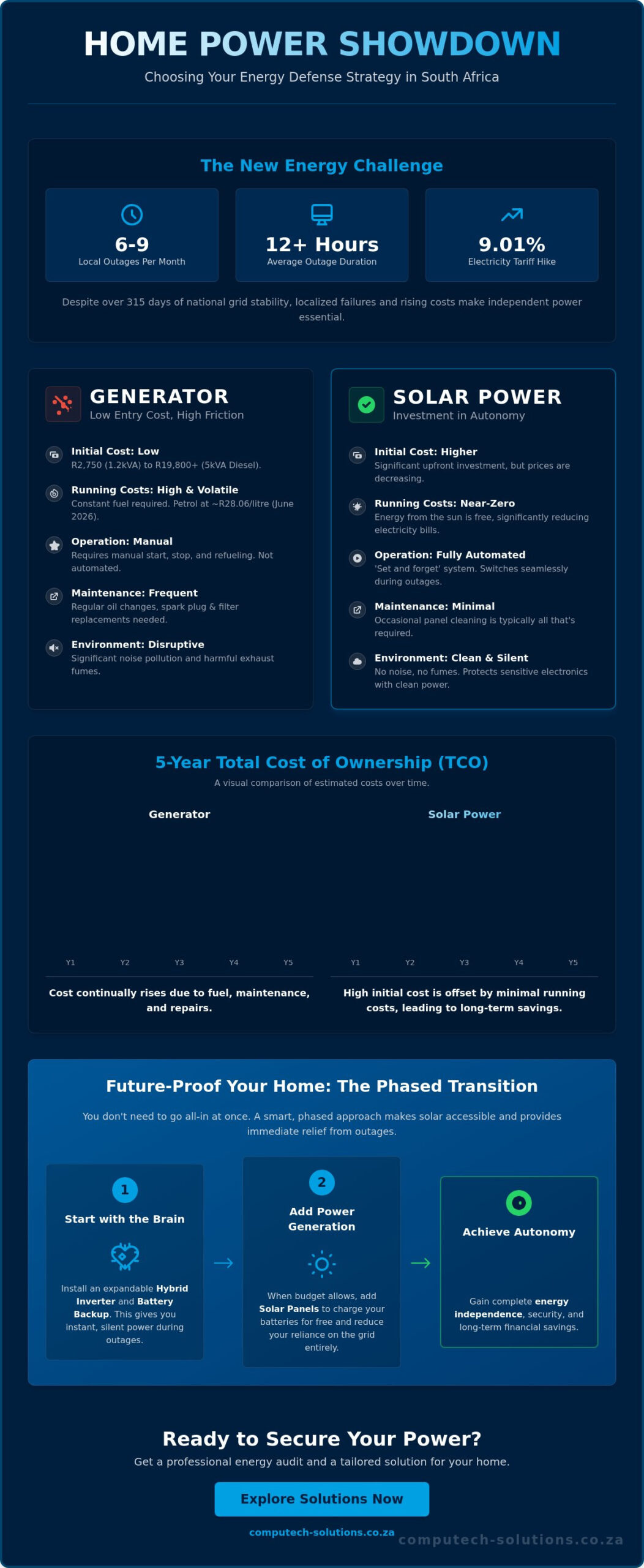
The South African energy landscape has entered a deceptive phase of stability. While national load shedding ceased for over 315 consecutive days by March 2026, households still average six to nine localized outages every month, often lasting over 12 hours. Choosing between solar power for home vs generator South Africa is no longer just a response to Eskom’s schedule; it’s a defense against aging local infrastructure and maintenance backlogs. You need a strategy that addresses these unpredictable interruptions while managing the 9.01% municipal electricity tariff hikes implemented in July 2026.
Homeowners face two primary contenders. Internal combustion systems provide immediate, high-output energy but require manual intervention and constant fuel refills. Photovoltaic (PV) systems offer a silent, automated alternative that integrates directly into your home’s distribution board. As the adoption of Solar power in South Africa continues to rise, the goal for most modern households is a ‘set and forget’ solution. This automation ensures that your home office remains online even when the local substation fails, protecting your workflow and your hardware.
The Immediate Impact of Power Instability
Frequent grid fluctuations do more than just turn off the lights. Sudden voltage spikes can degrade sensitive electronics, specifically affecting desktop power supplies and laptop batteries. For professionals, the hidden cost of downtime is often higher than the equipment itself. If your laptop’s internal battery is already failing, a sudden outage without a backup system means an immediate loss of unsaved work. Beyond IT risks, prolonged outages compromise residential security systems. Electric fences and alarm batteries often deplete during the 12 hour outages common in 2025 and 2026, leaving properties vulnerable.
Defining Your Power Requirements
Before investing, you must distinguish between your essential and luxury loads. Your essential load typically includes Wi-Fi routers, LED lighting, and refrigerators. Luxury loads include air conditioners, pool pumps, and electric ovens. A precise understanding of these requirements ensures your chosen solution handles the load without tripping when you need it most.
- Essential Load: Usually ranges from 0.5kW to 1.5kW for most South African homes.
- Peak Demand: Measured in kVA or Watts, this accounts for the ‘startup’ current of motor-driven appliances.
- Energy Audit: A professional audit prevents over-specifying your system, which can save you significant capital on battery capacity.
By identifying these needs early, you can decide if a small petrol unit is sufficient or if the long term benefits of a hybrid solar system better suit your lifestyle.
The Generator Option: Low Entry Cost but High Operational Friction
Generators remain the most common entry point for South Africans seeking immediate relief from power outages. These systems function by converting mechanical energy, generated through an internal combustion engine, into electrical backup power. The primary appeal lies in the accessibility of the hardware. A small 1.2kVA petrol unit can be purchased for as little as R2,750, while a more robust 8kVA unit typically costs around R16,500. When comparing solar power for home vs generator South Africa, the generator’s low upfront capital expenditure is its strongest selling point. However, this initial saving is often offset by high operational friction and ongoing maintenance requirements.
Operating a generator is a hands-on process. Unlike automated solar systems, most budget-friendly generators require manual starting and frequent refueling. Owners must also manage a strict maintenance schedule, including regular oil changes, spark plug replacements, and air filter cleaning. Neglecting these tasks leads to long term reliability issues, often resulting in a unit that fails to start during a critical outage. As noted in this analysis of Solar and battery backup versus generators, the convenience of solar often outweighs the mechanical burden of a generator over time.
Petrol vs. Diesel vs. Gas Generators
Petrol units are the most affordable but carry high running costs. With 95 Unleaded petrol prices at approximately R28.06 per litre as of June 2026, a single night of backup power can become a significant expense. Diesel units are more durable and suited for longer runtimes, though they are more expensive to purchase. A static 5kVA silent diesel unit costs roughly R19,800, excluding installation. Gas (LPG) generators are gaining popularity as a cleaner-burning alternative. They offer easier fuel storage than liquid fuels, though the availability of large-scale LPG refills can be a logistical challenge in some residential areas.
The Hidden Downsides of Generator Use
Noise pollution is a primary concern in high-density South African suburbs. Open-frame petrol units can produce noise levels exceeding 75 decibels, often leading to friction with neighbors. Beyond the sound, there is the risk of “dirty power.” Inexpensive generators often have high Total Harmonic Distortion (THD), which produces unstable voltage. This instability can easily damage sensitive electronics, such as desktop computers or high-end appliances. If your hardware has already suffered from power fluctuations, you may need to source laptop chargers or replacement components to restore your productivity. Additionally, the logistical burden of transporting and storing flammable fuel in jerry cans creates both a safety risk and a time-consuming chore for the homeowner.
The Solar Power Solution: Investing in Energy Autonomy
A comprehensive solar solution comprises three critical pillars: photovoltaic (PV) panels, a hybrid inverter, and a dedicated battery bank. While the previous section highlighted the manual effort and mechanical risks of combustion engines, solar systems operate as a fully integrated, autonomous ecosystem. In the comparison of solar power for home vs generator South Africa, the primary advantage is the hybrid inverter. This component acts as the system’s brain, managing the flow of electricity between the grid, your panels, and your storage. By 2026, Lithium Iron Phosphate (LiFePO4) has become the industry standard for home storage due to its safety profile and ability to handle thousands of charge cycles without significant degradation.
For professionals working from home, the most valuable technical feature is the Uninterruptible Power Supply (UPS) functionality. Most high-quality hybrid inverters provide a switchover time of less than 10 milliseconds. This speed is critical for maintaining the uptime of desktop computers and home servers that would otherwise reboot during a standard grid failure. Even for those using mobile devices, this seamless transition prevents the constant, aggressive cycling of internal batteries. Maintaining a stable power environment is the most effective way to protect your hardware and avoid the early failure of laptops or laptop chargers.
Components of a Reliable Solar System
Investing in Tier 1 PV panels is essential for the South African climate. These panels offer superior efficiency ratings and are engineered to withstand extreme UV exposure and hail. However, the inverter’s output quality is equally vital. You must insist on a Pure Sine Wave inverter for your installation. Modified sine wave alternatives, which are often found in budget-friendly portable units, can cause overheating or permanent damage to the delicate circuitry in modern computer hardware and smart appliance control boards. When sizing your system, matching your battery capacity (measured in Amp-hours or kilowatt-hours) to your specific outage duration ensures you never face a mid-workday shutdown.
Environmental and Lifestyle Benefits
Solar installations offer a level of residential harmony that generators cannot match. There are zero emissions and, perhaps more importantly for suburban living, zero noise pollution. This makes solar the only viable choice for high-density complexes or estates with strict noise bylaws. Beyond immediate comfort, a professionally installed solar system is a significant capital improvement. In the 2026 South African property market, homes with certified energy autonomy command higher valuations and attract more buyers than those reliant solely on the grid. The true value is the psychological relief. Knowing your home will remain powered regardless of local infrastructure failures provides a level of stability that fuel-based systems simply cannot replicate.
Total Cost of Ownership (TCO): A 5-Year Financial Comparison
A superficial look at price tags often leads homeowners to choose the lower entry cost of a generator. A robust 8kVA petrol unit costs approximately R16,500, while a 5kW hybrid solar system typically requires an investment between R115,000 and R120,000. However, when evaluating solar power for home vs generator South Africa, the initial capital expenditure (Capex) is only the starting point. Over a five-year horizon, the operational expenditure (Opex) of a generator often exceeds the total cost of a premium solar installation. Fuel, oil, and mechanical parts represent a recurring drain on your finances that solar simply eliminates.
The financial math shifts rapidly when you calculate fuel consumption. Running a mid-sized petrol generator for just four hours during a local outage can consume eight litres of fuel. At the June 2026 price of R28.06 per litre, this results in a daily cost of R224. If localized grid failures persist at the current average of nine times per month, your monthly fuel bill reaches R2,016. Over five years, you’ll spend over R120,000 just on petrol. This figure doesn’t include the 9.01% municipal electricity tariff hikes that solar users largely avoid by maximizing self-consumption during daylight hours.
Fuel Price Volatility vs. Free Sunshine
South African fuel prices remain highly volatile, tied to global oil markets and the Rand’s performance. While diesel prices saw a slight decrease in June 2026, petrol remains a significant overhead for residential backup. Solar energy provides a fixed-cost alternative where the “fuel” is free once the panels are installed. By shifting heavy loads like laundry or pool pumps to peak sunlight hours, you effectively hedge against future Eskom price increases. At current Eskom tariffs and an annual 9.01% increase, a residential solar investment typically achieves a full return on investment within five to seven years.
Longevity and Warranty Comparison
Mechanical engines have a finite lifespan measured in running hours. A standard residential generator may require a complete overhaul or replacement after 2,000 to 3,000 hours of use. In contrast, Tier 1 solar panels carry 25-year linear power warranties. Modern LiFePO4 batteries are rated for 6,000 cycles, which translates to roughly 10 to 15 years of daily use before capacity drops below 80%. When choosing a system, ensure you select hardware with local technical backup to simplify future maintenance. If your previous backup attempts have already caused hardware failure, you can find high-quality replacement laptop batteries and components to restore your mobile workstations.
Annual maintenance for a solar system is minimal, usually involving a simple panel cleaning and a software check. A generator requires oil changes every 50 to 100 hours, along with spark plug and filter replacements. When these mechanical costs are aggregated over five years, the “cheap” generator often becomes the most expensive power solution you can own.
Future-Proofing Your Home: The Phased Transition Strategy
Many homeowners view the solar power for home vs generator South Africa decision as a binary choice between a high-cost solar array or a noisy generator. This is a misconception. You can secure your home through a phased transition that manages both your budget and your immediate power needs. By starting small and scaling as your resources allow, you avoid the heavy upfront capital expenditure of a full system while immediately solving the problem of localized outages.
The most effective first step involves installing a high-quality hybrid inverter and a lithium battery bank. This setup acts as a massive UPS for your home. It provides an automated switchover that keeps your Wi-Fi, laptops, and security systems online without the need for solar panels. Since the grid is still available most of the time, you can charge your batteries during stable periods. This protects your desktop computers and sensitive electronics from the voltage fluctuations common during local infrastructure failures.
Once your primary backup is stable, the second phase is adding PV panels. This step transitions your system from a simple backup into a cost-saving asset. By generating your own power, you directly reduce your monthly electricity bill and mitigate the impact of the 9.01% municipal tariff increases. The final stage involves scaling your battery bank. As your energy consumption grows or you add more appliances, modular lithium systems allow you to increase your storage capacity without replacing your existing hardware.
Selecting the Right Hardware for Scalability
Selecting hardware for scalability is vital. You should choose an inverter that supports parallel expansion. This allows you to add a second or third unit later if your power demands increase. Modular battery systems are equally important; they let you add capacity incrementally as your budget permits. Before you begin, ensure your roof structure is assessed to confirm it can handle the additional weight of a full panel array in the future. A professional assessment ensures that your long term investment remains structurally sound.
How Computech-Solutions Secures Your Power Future
Computech-Solutions helps you secure your power future by providing expert technical support for selecting compatible inverter and battery combinations. We offer nationwide delivery of specialized power backup components across South Africa, ensuring you have access to reliable hardware regardless of your location. Our professional installation services ensure that your system is fully compliant and safe for long term use. To start your journey toward energy independence, View our range of solar inverters and battery solutions and protect your home’s productivity today.
Securing Your Energy Independence
Deciding on solar power for home vs generator South Africa requires looking beyond the initial price tag. While generators offer a quick fix, they bring ongoing fuel expenses and mechanical risks that can damage your sensitive electronics. Solar systems provide a silent, automated alternative that safeguards your productivity. You’ll find that a phased implementation allows you to immediately protect your workstations with high-quality battery backups before expanding into a full PV array to eliminate grid costs.
We specialize in protecting your sensitive IT equipment with reliable power components. Our team provides expert technical support for all South African power needs, ensuring your home remains operational during any local grid failure. With nationwide delivery on all backup hardware, you can access the professional solutions required to stabilize your energy future. Secure your home power with Computech-Solutions Solar Solutions and take the first step toward a quiet, maintenance-free environment. Investing in energy autonomy today ensures your home stays powered and your equipment stays protected for years to come.
Frequently Asked Questions
Is solar power really better than a generator for load shedding?
Solar is generally superior for residential use because it provides an automated, silent, and emission-free solution. While generators have a lower purchase price, they require manual refueling and expensive petrol or diesel to operate. Solar systems offer a seamless transition during outages, ensuring your home stays powered without the noise or ongoing fuel logistics associated with combustion engines.
Can a generator power my whole house including sensitive IT equipment?
High-end generators can support a whole house, but budget-friendly units often produce “dirty power” with significant voltage fluctuations. These spikes can damage the delicate circuitry in desktop computers and laptop motherboards. To safely run sensitive IT hardware, you would need an inverter-generator or a dedicated UPS, whereas a hybrid solar system provides this protection automatically through its pure sine wave output.
How much does a basic solar backup system cost in South Africa?
A small backup system designed to power essential appliances typically costs between R30,000 and R50,000 in the current 2026 market. When evaluating solar power for home vs generator South Africa, remember this investment includes the inverter and battery storage. Larger 5kW hybrid systems for full household support range from R115,000 to R120,000, excluding the professional installation fees and electrical compliance certificates.
Do I need permission from the municipality to install solar or a generator?
Yes, most South African municipalities require you to register your solar system to ensure it meets safety standards and prevents illegal feedback into the grid. Generators don’t usually require registration unless they’re large static units. You should always check your local bylaws regarding noise levels and fuel storage limits, as some residential estates have strict regulations to prevent neighborhood disturbances.
Which is quieter: a gas generator or a solar system?
A solar system is completely silent since it has no moving parts. Even the most advanced “silent” diesel or gas generators produce between 50 and 65 decibels of noise. While gas units are cleaner and slightly quieter than petrol versions, they still create a consistent drone. This makes solar the only truly neighbor-friendly choice for high-density South African suburbs or townhouse complexes.
How long do solar batteries last compared to a generator engine?
Modern LiFePO4 solar batteries are rated for roughly 6,000 cycles, which translates to 10 to 15 years of daily use. In contrast, a generator engine’s lifespan is measured in running hours. Most residential units require major overhauls or replacement after 2,000 to 3,000 hours. Solar offers much better long-term reliability, especially when you consider that a failing generator can also degrade your laptop batteries through unstable charging.
Can I use a generator and solar together in one system?
Yes, many high-end hybrid inverters allow you to connect a generator as a secondary backup source. This is an excellent way to manage solar power for home vs generator South Africa strategies during extended rainy periods. The generator can charge the batteries or power the house when solar production is low, providing a redundant layer of security for your energy independence.
What maintenance is required for a home solar power system?
Solar systems require minimal maintenance compared to the frequent oil changes and spark plug replacements needed for generators. You should clean your panels twice a year to remove dust and bird droppings that can reduce efficiency. It’s also good practice to have a technician check the cable connections and inverter software every eighteen months to ensure the system continues to operate at peak performance.
