
Did you know that failing to register your home power system by the September 30, 2026, deadline could result in a penalty of up to R50,000? It’s a sobering reality for many homeowners who initially installed systems just to survive load shedding. You’ve likely felt the sting of NERSA-approved tariff increases and the confusion of choosing between hybrid or off-grid inverters while trying to avoid unreliable grey market hardware. Finding the right solar panel kits for home use South Africa is no longer just about keeping the lights on; it’s about strategic operational continuity for your home office and digital life.
We understand that you need a reliable partner to help you achieve true energy independence and lower monthly utility bills. This guide provides the technical clarity you need to make an informed investment that protects your laptops and essential IT equipment from sudden disruptions. You’ll learn the essential steps of the mandatory six-step application process, the importance of a valid Certificate of Compliance, and how to select a system that delivers a definitive, total solution for your energy needs.
Key Takeaways
- Identify the specific energy footprint of your home by categorizing appliances into essential and non-essential loads for accurate system sizing.
- Understand the technical differences between inverter types and panel efficiencies to choose the most effective solar panel kits for home use South Africa.
- Master the regulatory requirements of NERSA and local municipalities to ensure your grid-tied installation is fully legal and avoids costly penalties.
- Discover how to protect your digital infrastructure, including laptops and desktop computers, from the voltage risks associated with frequent grid switching.
- Explore the scalability of pre-configured bundles, ranging from entry-level 3kW systems for apartments to comprehensive solutions for total energy independence.
What is a Solar Panel Kit and Why Does Your Home Need One?
A solar panel kit is much more than a collection of hardware. It’s a synchronized energy ecosystem designed to capture, convert, and store power for your specific needs. When we discuss What is a Solar Panel Kit, we’re referring to a pre-configured bundle that typically includes solar panels, a power inverter, and a battery storage unit. Buying these components as a unified kit ensures that every part is technically compatible. This compatibility is vital for protecting the sensitive circuitry in your desktop computers and laptops from the voltage fluctuations common in mismatched systems.
In the South African context, the motivation for installing solar has evolved. While Eskom achieved a milestone of 365 consecutive days without load shedding in May 2026, the grid remains under pressure. Above-inflation tariff increases, such as the 12.74% hike for the 2025/26 period, have made energy costs a significant monthly burden. Investing in solar panel kits for home use South Africa has shifted from a crisis-response tactic to a long-term strategy for financial stability and operational continuity for home-based professionals.
Grid-Tied vs. Hybrid vs. Off-Grid Kits
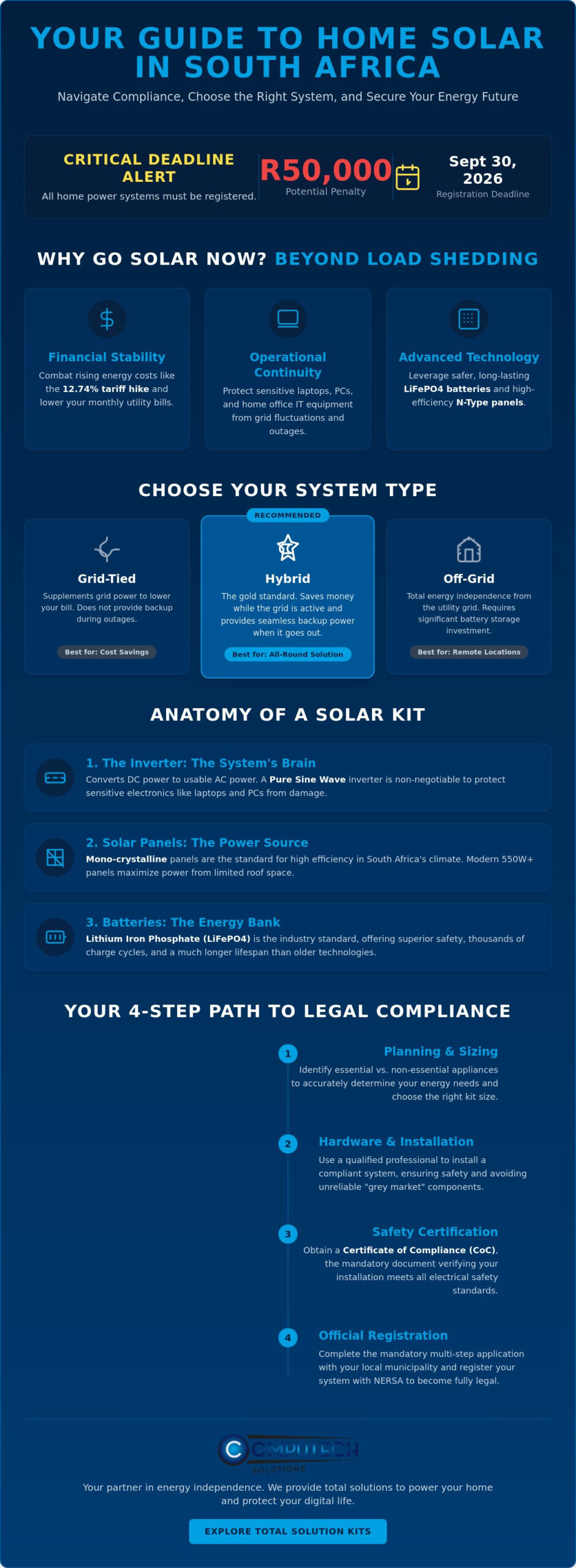
Grid-tied kits are designed primarily to lower your electricity bill by supplementing your usage with solar power. However, they’re programmed to shut down during load shedding to prevent “islanding,” which makes them unsuitable for backup power. Off-grid kits offer total independence but require a massive investment in battery storage to keep your home running during extended cloudy periods. Hybrid systems are the gold standard for most households. They offer the best of both worlds, allowing you to save money while the grid is active and providing seamless backup power the moment the lights go out.
Why 2026 is the Year to Go Solar
The technological landscape has reached a point of high efficiency and lower entry costs. Lithium Iron Phosphate (LiFePO4) batteries have become the industry standard, offering thousands of cycles and much higher safety ratings than older lead-acid alternatives. At the same time, the adoption of N-Type solar panel technology means you can generate more electricity from a smaller roof area. For anyone relying on high-performance IT hardware, having a reliable power source is no longer a luxury. It’s a requirement for maintaining a professional home office environment.
Choosing a pre-configured “Total Solution” kit is safer for beginners than sourcing individual parts. A bundled kit eliminates the risk of buying poor-quality “grey market” components that might fail under the strain of South Africa’s climate. It provides a streamlined path to energy independence, ensuring that your transition to renewable power is stable, professional, and efficient.
Core Components: Understanding What’s Inside Your Kit
Selecting solar panel kits for home use South Africa requires a focus on how individual parts work as a single, resilient unit. While many buyers focus solely on the number of panels, the internal synergy between your power source and your household electronics determines the system’s long-term value. A high-quality kit acts as a shield for your digital infrastructure, ensuring that sudden grid fluctuations don’t compromise the lifespan of your desktop computers or sensitive networking gear.
The Inverter: Choosing the Right Brain
The inverter is the most critical component in any solar setup. It converts the Direct Current (DC) from your panels and batteries into the Alternating Current (AC) used by your home. For any household running IT equipment, a Pure Sine Wave inverter is a non-negotiable requirement. Unlike cheaper modified sine wave alternatives, which produce “choppy” power that can overheat laptop chargers and damage internal components, a Pure Sine Wave unit provides a clean, stable signal. This stability is essential for maintaining the operational health of your hardware. You must also ensure the inverter matches your home’s electrical phase setup, as a single-phase inverter cannot power a three-phase property without significant modification.
Solar Panels and Batteries: The Powerhouse
In the South African climate, mono-crystalline panels have become the standard due to their superior efficiency in high-heat conditions. Modern 550W panels allow you to generate more power with fewer units, which is a major advantage for homes with limited roof space. When calculating your needs, don’t just look at peak sun hours; consider your baseline load during the evening. This is where battery storage becomes vital. By 2026, Lithium Iron Phosphate (LiFePO4) has completely replaced lead-acid technology for residential use. These batteries offer a 10-year lifespan and can handle thousands of charge cycles, making them a far more stable investment for long-term energy independence.
Beyond the primary components, your kit must include professional-grade protection gear. This includes a dedicated DC distribution board, surge arrestors, and UV-resistant cabling. These safety features prevent lightning strikes or grid surges from traveling through your system and destroying your connected devices. If you’re concerned about how your current power setup affects your electronics, you can find specialized advice and reliable hardware at Computech-Solutions to ensure your IT investment remains protected.
Finally, the mounting system is the often-overlooked hero of a solar installation. Whether your home features tiled, corrugated, or flat concrete roofing, the mounting hardware must be corrosion-resistant and wind-rated. A failure in the mounting system can lead to roof leaks or physical damage to the panels during summer storms, undermining the entire “Total Solution” approach of your solar kit.
Sizing Your System: How to Choose the Right Kit
Choosing the correct capacity for your energy needs is the difference between a high-performing investment and a frustrating technical bottleneck. Sizing isn’t about buying the largest system you can afford; it’s about matching generation and storage to your household’s specific consumption patterns. When evaluating solar panel kits for home use South Africa, you must begin with a comprehensive load audit to determine which appliances are critical for your operational continuity and which can be managed differently.
Essential Load vs. Non-Essential Load
In a professional solar installation, your electrical distribution board is split into two categories. Essential loads include your Wi-Fi router, security systems, fridge, and IT infrastructure such as laptops and desktop computers. These items receive power from the battery bank the moment the grid fails. Non-essential loads, like geysers, stoves, and pool pumps, are usually excluded from the backup circuit to prevent rapid battery depletion. Modern hybrid inverters now offer “Smart Load” management, allowing you to toggle these heavy appliances automatically based on your current solar production or battery state of charge.
Comparison of Popular Kit Sizes
The following table outlines how different kit capacities perform during typical Stage 4 load shedding scenarios, assuming a standard battery configuration.
| Kit Size | Typical Appliances Supported | Estimated Backup Time (Stage 4) |
|---|---|---|
| 3kW (Small) | Wi-Fi, LED lights, TV, 2x Laptops, Fridge | 4 to 6 hours |
| 5kW – 8kW (Medium) | All Small Kit items + Microwave, Dishwasher, Alarm | 8 to 12 hours |
| 10kW+ (Large) | Whole home support including Aircon and Pool Pump | 15+ hours |
A 5kW hybrid system has emerged as the most popular ROI-positive choice for the average South African family home in 2026. This size provides enough overhead to run a productive home office while maintaining a comfortable lifestyle during extended power disruptions. It strikes the perfect balance between initial capital outlay and long-term utility savings.
Scalability is a vital factor to consider during the purchase phase. You should prioritize inverters that allow for parallel expansion. This means you can start with a modest battery bank and add more storage units as your budget allows or as your energy needs grow. By choosing a kit that supports future expansion, you protect your initial investment and ensure your home remains energy-independent even if your power requirements increase in the coming years.
Installation, Compliance, and Financial Incentives
Purchasing solar panel kits for home use South Africa is only the first step. The real value is locked in through professional installation and strict regulatory compliance. As of June 2026, the legal landscape has become significantly more structured. Homeowners must register their Small-Scale Embedded Generation (SSEG) systems with Eskom or their local municipality by the September 30, 2026, deadline. Failure to meet this requirement can lead to heavy penalties ranging from R27,000 to R50,000 and the risk of being disconnected from the grid. Fortunately, Eskom has waived all registration and connection fees for systems up to 50kW until this deadline, potentially saving you up to R10,000 in administrative costs.
The Professional Installation Workflow
A reliable setup follows a disciplined sequence to ensure safety and system longevity. First, a site survey assesses your roof’s structural integrity to ensure it can handle the weight of modern N-Type panels. Second, a qualified electrician performs a DB board audit to configure the split-load setup discussed in the previous section. The physical installation and commissioning of the inverter and battery storage follow. Finally, the system undergoes rigorous testing before a Department of Employment and Labour (DoEL) registered person issues a Certificate of Compliance (CoC). This document is essential for insurance validity and future property resale.
Attempting a DIY installation is a high-risk gamble. Modern inverters require a Letter of Authority (LOA) from the NRCS and must comply with the NRS 097-2-1 grid-tie standard. Unprofessional wiring can void your product warranties and pose a fire risk to your home. Beyond safety, professional commissioning ensures that the power delivery to your desktop computers and networking gear is perfectly stable. If you are looking to secure your home office with the best hardware, visit Computech-Solutions to explore reliable computing solutions that thrive on clean, solar-backed power.
Maximizing Your ROI
While the residential solar tax credit expired in 2024, businesses can still claim a 100% tax deduction on solar assets in the first year under Section 12B of the Income Tax Act. For residential users, the return on investment comes from immediate utility savings and an estimated 4% to 8% increase in property value. To maintain peak efficiency, you should clean your panels at least twice a year. Dust and bird droppings in the South African climate can reduce your energy yield by up to 15% if left unmanaged. Regular maintenance ensures your kit continues to produce maximum power, protecting both your pocket and your digital lifestyle.
Computech-Solutions: Your Partner in Energy Independence
Achieving true energy independence requires a partner that understands the technical nuances of both generation and consumption. At Computech-Solutions, we bridge the gap between high-performance solar panel kits for home use South Africa and the sensitive digital hardware they power. Our expertise isn’t limited to the panels on your roof. We possess a deep understanding of the laptops, desktops, and servers that rely on that energy. This dual perspective ensures your entire ecosystem remains stable, productive, and protected from the risks of grid instability.
Protecting Your Digital Life
A home office is only as reliable as its power source. Our solar configurations prioritize the protection of high-end IT setups by focusing on systems that offer zero-millisecond switchover times. This speed is vital for preventing data loss on desktop computers or sudden shutdowns that can damage internal components. By linking professional-grade power backup with our extensive range of laptops and desktop solutions, we provide a definitive, total solution for remote workers and business owners alike. If your current setup has already suffered from power surges, we provide critical replacement parts, such as laptop LCD panels and chargers, to restore your operational efficiency quickly.
Nationwide Reliability
Reliability should not be limited by geography. From our base in Pretoria, we’ve developed a robust delivery and installation network that reaches every corner of South Africa. We don’t just ship hardware; we ensure your system is professionally commissioned to meet the strict standards discussed earlier in this guide. This includes ensuring your installation is ready for the mandatory September 2026 registration deadline and that every component is optimized for your specific load profile. Our technical support team remains available to guide you through configuration changes as your home office expands.
Our commitment to quality means we only supply Tier-1 components and reliable replacement parts. Whether you need a new battery for your Dell, HP, or Lenovo laptop to extend your mobility or a complete solar kit to eliminate the threat of load shedding, we provide the hardware required for lasting peace of mind. We position ourselves as a long-term partner in your growth, moving quickly to identify challenges and present streamlined solutions. View our range of Solar Solutions and Kits today and secure your home’s energy future with a team that understands the full scope of your technical needs.
Securing Your Energy Future Today
Transitioning to a resilient power ecosystem is the most strategic move for your home and professional life in 2026. The path to energy independence involves more than just buying panels. It requires navigating the September 30 registration deadline, meeting NRS 097-2-1 standards, and selecting components that shield your IT infrastructure. Choosing the right solar panel kits for home use South Africa ensures your laptops, desktop computers, and essential appliances remain operational regardless of grid instability or rising tariffs.
Computech-Solutions provides a total solution that integrates technical power expertise with a deep understanding of the computing hardware you rely on. With our nationwide South African delivery, professional commissioning, and expert support for both IT and power systems, we eliminate the stress of complex installations. Don’t leave your digital life to chance or settle for sub-standard components that could fail when you need them most.
Browse Our Professional Solar Power Kits & Backup Systems to start your journey toward a stable energy future. It’s time to take control of your power and enjoy the peace of mind you deserve with a system built for long-term performance.
Frequently Asked Questions
How much does a basic solar kit for a home cost in South Africa?
The investment required for solar panel kits for home use South Africa depends entirely on your energy requirements and the quality of the components. While entry-level systems for small apartments are accessible, medium-sized kits for family homes involve higher costs due to the need for larger battery banks and more panels. You should focus on the long-term savings on utility bills and the protection of your IT hardware rather than just the initial capital outlay.
Can I run my whole house on a 5kW solar kit?
A 5kW system typically supports all essential loads but won’t power a whole house if it includes heavy appliances like geysers or electric stoves. It’s the ideal size for a standard family home to run lights, refrigerators, and a professional home office including desktop computers and networking gear. To manage heavier loads, you’ll need to use the smart load features of your hybrid inverter to prioritize power distribution during sunlight hours.
Do I need a special permit to install solar panels in South Africa?
Yes, you must register your system with Eskom or your local municipality as part of the Small-Scale Embedded Generation (SSEG) requirements. The national deadline for this registration is September 30, 2026. If you’re in Johannesburg, City Power requires a mandatory six-step application process that includes pre-approval before any work begins. Eskom has currently waived registration fees for systems under 50kW to encourage compliance before the final deadline.
How long do solar batteries typically last before needing replacement?
Modern Lithium Iron Phosphate (LiFePO4) batteries generally last about 10 years under normal residential use. These units are rated for approximately 6,000 cycles at a high depth of discharge, which is a significant improvement over older lead-acid technology. Proper configuration of your inverter’s charging parameters is essential to ensure you reach this decade-long lifespan without premature capacity loss in your storage cells.
Is it possible to add more panels to my kit later on?
You can expand your solar array if your inverter has unused MPPT capacity and you have physical roof space available. It’s often more efficient to buy an inverter that’s slightly larger than your initial needs to allow for this future scalability. When adding panels later, it’s vital to match the specifications of the new panels with your existing ones to maintain the efficiency and safety of the entire system.
What happens to my solar power during a cloudy day?
Solar generation continues during cloudy weather, but the output drops to roughly 10% to 25% of the system’s rated capacity. Your hybrid inverter will automatically compensate by drawing the remaining power needed from your battery storage or the national grid. This seamless transition ensures that your laptops and other sensitive electronics don’t experience any voltage drops or interruptions during sudden changes in weather conditions.
Does a solar installation void my home insurance?
A professional installation shouldn’t void your insurance as long as you have a valid Certificate of Compliance (CoC) issued by a registered electrician. You’re required to notify your insurance provider once the installation is complete to update your household sum insured. Many insurers now require proof of professional commissioning and municipal registration to cover any potential claims related to fire or lightning damage involving your solar hardware.
What is the difference between a solar-ready kit and a complete system?
A solar-ready kit usually consists of an inverter and a battery storage unit without the solar panels. This setup functions as a high-end UPS to keep your home running during load shedding. A complete system includes the solar panels, allowing you to generate your own electricity and achieve true energy independence. Choosing complete solar panel kits for home use South Africa is the most effective way to hedge against rising electricity tariffs over the next decade.
