
Did you know that the cost of a standard 16GB RAM kit in South Africa skyrocketed by over 220% in just one year? This staggering jump in component costs directly impacts the average computer price across the country, driven by global memory shortages and a 12% depreciation of the Rand. It’s frustrating to plan a hardware upgrade only to find that market shifts have pushed your budget to the limit. You want a reliable machine that meets your professional needs without overpaying, especially when local factors like load shedding make protecting your electronics a top priority.
We recognize that technical jargon and fluctuating costs make hardware decisions stressful. This guide simplifies the process by breaking down 2026 price tiers and identifying which specifications truly impact your daily productivity. You’ll learn how to safeguard your investment against power surges and why choosing a comprehensive hardware partner is the best way to ensure long-term value. We’ll explore everything from entry-level essentials to professional-grade workstations to help you secure a stable, efficient setup for the future.
Key Takeaways
- Understand how the ZAR exchange rate and import duties influence the local computer price to help you time your purchase effectively.
- Identify the 2026 price tiers for entry-level and mid-range machines so you don’t overspend on hardware that exceeds your needs.
- Learn why 16GB of RAM and specific processor choices are now the baseline for maintaining professional productivity.
- Account for essential power protection, including surge protectors and solar backups, to prevent load shedding from damaging your investment.
- See how local technical support and access to replacement parts ensure your hardware remains operational for years to come.
What Determines a Computer Price in South Africa?
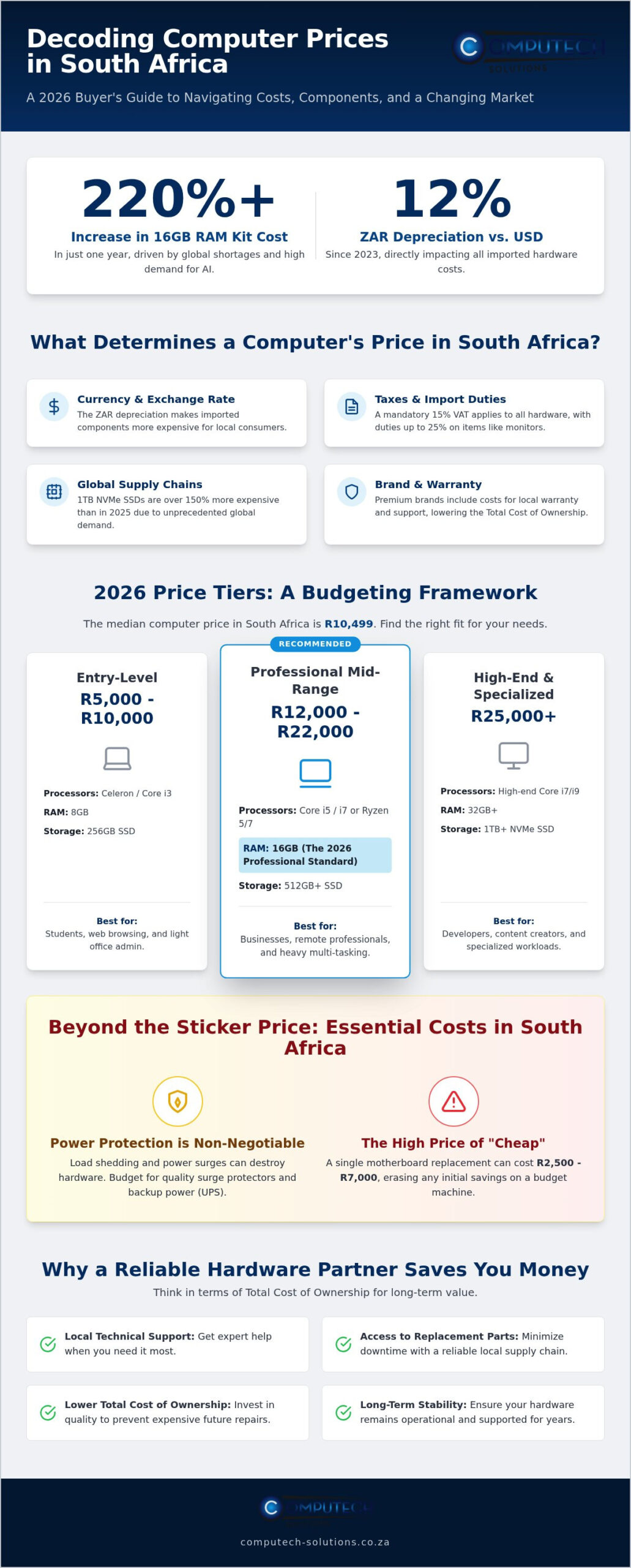
The South African Rand is the primary driver of local hardware costs. Since 2023, the ZAR has depreciated by approximately 12% against the US Dollar. Because the physical parts of a computer are almost entirely imported, this currency volatility hits local retail shelves almost immediately. Retailers must adjust to these shifts to maintain sustainable stock levels; this means the computer price you see today could fluctuate significantly within a single month.
Taxation and logistics also play a critical role. You’ll pay a mandatory 15% VAT on all hardware. Customs calculations typically apply this to the customs value plus an additional 10%, along with potential duties. While many individual components are exempt from luxury taxes, fully assembled monitors carry a 25% duty. These administrative costs ensure that the price you pay at a local retailer reflects the reality of bringing high-end technology across international borders.
Premium brands like Dell, HP, or Lenovo often command higher initial costs than generic or locally assembled alternatives. This gap represents more than just a brand name; it covers local warranty fulfillment and technical support networks. We view hardware through the lens of Total Cost of Ownership. If a budget machine requires a motherboard replacement, which can cost between R2,500 and R7,000, the initial savings vanish. Investing in quality from the start prevents these disruptive technical failures.
The Impact of Global Supply Chains on Local Costs
Global demand for AI and cloud computing has triggered a structural transformation in the semiconductor industry. In 2026, RAM and SSD costs remain elevated because supply hasn’t kept pace with the tech sector’s appetite. For example, some 1TB NVMe SSDs are over 150% more expensive now than they were in 2025. This makes the distinction between consumer and business hardware vital for your budget. Business grade hardware is a standard for durability and long-term support designed to survive 40-hour work weeks for several years.
Software and Licensing Considerations
Software licensing is a frequently overlooked factor in the final computer price. Most laptops include a version of Windows, but the difference between Home and Pro editions affects both cost and functionality. Professional environments often require Pro for advanced security features and domain joining. While subscription-based software adds to your monthly overhead, getting the right operating system pre-installed ensures your hardware is ready for business operations from day one.
South African Computer Price Tiers: A 2026 Budgeting Framework
Selecting the right hardware requires more than just looking at a sticker. As of early 2026, the median computer price in South Africa reached R10,499. This figure represents the middle ground, but your actual spend depends on the intensity of your workload and your need for longevity. When budgeting, it’s vital to consider the Total Cost of Ownership (TCO). A cheaper unit might save money today, but frequent repairs or early obsolescence will inflate your long-term expenses. We prioritize helping you find a balance between immediate affordability and long-term operational stability.
Entry-Level Expectations (ZAR 5,000 – ZAR 10,000)
While basic models start as low as R2,999, the R5,000 to R10,000 computer price bracket is where you find reliable tools for students and light office administration. These machines typically feature Celeron or i3 processors, 8GB of RAM, and a 256GB SSD. They handle word processing, web browsing, and streaming with ease. However, they lack the overhead for heavy multi-tasking. If you plan to keep a device for more than three years, be aware that these entry-level components may struggle with future software updates and security patches.
Professional Mid-Range (ZAR 12,000 – ZAR 22,000)
For creative professionals and engineers, costs scale quickly. Professional-grade laptops and workstations now start around R34,000 and can exceed R170,000 for specialized data processing units. Gaming hardware has seen a similar sharp rise. A build that cost R10,000 in late 2025 now requires approximately R25,000 due to component shortages and the massive 229% increase in RAM kit prices. These specialized rigs require high-performance cooling and dedicated GPUs that drive up the initial investment. If you’re unsure which tier fits your specific operational goals, you can chat with our technical team for a personalized recommendation.
The Anatomy of Hardware Costs: Which Components Drive the Price?
The internal configuration of a machine determines its longevity and performance capacity. The processor, or CPU, acts as the primary cost driver. With Intel holding roughly 70% of the market share as of March 2026, their pricing strategies set the tone for the entire industry. For example, mid-range chips like the Ryzen 5 5600 saw price hikes from R2,999 in 2025 to R3,649 in August 2026. Choosing a higher-tier CPU allows for better multi-tasking, but it accounts for a significant portion of the total computer price.
Memory and graphics also play major roles in budgeting. A global shortage of memory chips, driven by the AI sector, has transformed RAM from an affordable upgrade into a major investment. A 16GB DDR4 kit that cost R699 in 2025 reached R2,299 by August 2026. Despite this 229% increase, 16GB is now the absolute minimum standard for professional workstations. Graphics cards further divide the market. Integrated graphics are sufficient for administrative work, while dedicated GPUs are essential for engineering and design, often adding several thousand Rand to the build cost.
The Shift to SSD Technology
Solid State Drives (SSDs) have revolutionized performance by eliminating the bottlenecks found in older technology. While capacity is important, the speed of the drive is what defines the user experience. NVMe drives are now the preferred choice for their superior data transfer rates, even though a 1TB NVMe SSD for a mid-range PC became over 150% more expensive between 2025 and 2026. Mechanical HDDs are now obsolete for primary drives. They lack the speed required to run modern operating systems efficiently, though they still offer value as secondary storage for large, infrequently accessed files.
Display and Build Materials
External features and chassis materials also influence the final computer price. An IPS panel is a worthwhile investment for professionals because it offers better color accuracy and wide viewing angles compared to budget-friendly TN panels. High refresh rates further reduce eye strain during long workdays. The materials used for the body also matter. An aluminum chassis provides superior durability and heat dissipation compared to plastic, which helps protect internal components from thermal stress. Premium additions like biometric security and backlit keyboards provide essential functionality for modern remote work environments.
Hidden Costs: Power Protection and Maintenance in South Africa
Purchasing hardware in South Africa requires a budget that extends beyond the sticker price. Load shedding and frequent power grid fluctuations represent the single greatest threat to your electronics. Sudden power cuts cause immediate data loss, but the high-voltage surges that follow restoration are what typically destroy internal components. A motherboard replacement can cost anywhere from R2,500 to R7,000; this makes preventative protection a mandatory part of your initial computer price calculation. We recommend factoring in at least R265 for an 8-way surge protector or between R800 and R1,200 for a basic UPS to safeguard your machine.
High-quality peripherals also play a role in maintaining hardware health. Using generic, low-quality chargers can lead to unstable power delivery, which degrades your motherboard over time. We provide brand-specific laptop chargers and adapters to ensure your device receives the exact voltage it requires. These protective measures don’t just prevent failure; they ensure your system operates at peak efficiency without the risk of thermal throttling or circuit damage caused by inconsistent current.
Solar and Inverter Solutions for Uninterrupted Work
For professionals working from home, a standard UPS might only provide enough time to save work and shut down. Integrating a solar inverter or a dedicated battery backup into your office setup is a superior long-term strategy. Laptops are inherently more efficient in these scenarios because they draw significantly less power than a desktop with multiple monitors. Maintaining a stable power supply extends the lifespan of your Power Supply Unit (PSU) and sensitive capacitors. Professional solar solutions mitigate the operational risks of higher load shedding stages, allowing you to remain productive regardless of the national grid’s status.
The Value of Replacement Parts
All laptop owners should view replacement batteries as a planned maintenance cost. Most lithium-ion batteries begin to lose significant capacity after 2 to 3 years of daily use. Sourcing high-quality replacement batteries for brands like Acer, Apple, ASUS, Dell, HP, Lenovo, Samsung, Sony, and Toshiba is a cost-effective way to restore your device’s mobility without buying a completely new unit. Similarly, replacing a cracked screen with a new laptop LCD replacement panel is often far cheaper than a full hardware upgrade. Maintaining your current machine with genuine parts ensures it remains a reliable partner for years. If you need assistance choosing the right backup power or replacement part for your setup, contact our technical support team today.
Why Choosing a Reliable Hardware Partner Saves You Money
Securing a competitive computer price is only the initial step in a successful long-term hardware strategy. True value emerges through the support and technical continuity a professional partner provides after the transaction. In a volatile market where currency shifts and global component shortages are common, having a stable local entity ensures you aren’t left vulnerable to technical disruptions or the high costs of international logistics. We vet every piece of hardware to ensure it meets the specific durability standards required for the South African environment. When you consider the initial computer price alongside the cost of replacement parts and technical support, the benefits of a local partner become clear.
Nationwide Support and Reliable Delivery
We prioritize the safe transit of sensitive electronics across the country, ensuring that every machine arrives in peak condition. Choosing a South African partner is essential for managing warranty claims efficiently. If a component fails, resolving the issue through a local support team is significantly faster than dealing with international returns that involve complex customs clearances and unexpected duties. This local presence alleviates the stress of technical failures, providing a direct line to experts who understand your operational needs. You can Browse our range of Desktop Computers to find systems backed by our national technical network.
Comprehensive Hardware Ecosystem
Our service model extends beyond the initial sale to cover the entire lifecycle of your equipment. We provide high-quality replacement batteries for all major brands, including Acer, Apple, ASUS, Dell, HP, Lenovo, Samsung, Sony, and Toshiba. Access to these parts allows you to restore a laptop’s mobility for a fraction of the cost of a new unit. This total-solution approach reduces technical downtime by providing immediate access to laptop chargers, LCD panels, and solar backups in one place. By integrating power protection with your initial purchase, you avoid the high costs of emergency repairs caused by power instability. A streamlined procurement process benefits both individual users and business fleets, ensuring that every hardware investment is protected by a reliable maintenance path. View our latest laptop and desktop price list to see how we combine performance with long-term operational stability.
Securing Your Digital Future with Confidence
Navigating the hardware market requires a strategic approach that balances initial costs with long-term reliability. You now understand that the true computer price includes essential surge protection and the capacity to handle modern workloads with at least 16GB of RAM. By accounting for the unique challenges of the South African power grid and the necessity of high-quality replacement parts, you can avoid the common pitfalls of underpowered or unprotected hardware.
We specialize in providing brand-name desktops, laptops, and a comprehensive range of replacement parts for Acer, Dell, HP, and Apple. Our team also offers integrated solar power solutions to keep your operations running through every stage of load shedding with reliable nationwide delivery. Explore Reliable Desktop and Laptop Solutions at Computech-Solutions and build a technical setup that grows with your professional needs. You don’t have to face technical disruptions alone when you have a dedicated hardware partner by your side.
Frequently Asked Questions
How much does a decent laptop cost in South Africa in 2026?
A decent laptop for mainstream work currently costs between R7,000 and R15,000. As of March 2026, the median transaction price for a laptop in South Africa was R10,499. This budget typically secures a machine with enough performance for remote work and multi-tasking. If you require professional-grade specs for heavy data processing, expect the computer price to start from R34,499.
Why are computer prices higher in South Africa compared to overseas?
Local costs are primarily driven by the Rand’s 12% depreciation against the US Dollar since late 2023. Additionally, a mandatory 15% VAT applies to all hardware. While most components are exempt from duties, fully assembled monitors carry a 25% duty. Hidden costs like international shipping and local logistics also inflate the final retail price compared to overseas markets where these factors are less volatile.
Is it better to buy a desktop or a laptop for a home office?
Laptops offer superior versatility for home offices because their built-in batteries act as a temporary UPS during power cuts. They also consume significantly less power, making them easier to run on solar backup systems. However, desktops often provide better performance per Rand and are easier to upgrade. Your choice should depend on whether you prioritize portability and power efficiency or raw processing power for static workstations.
Does load shedding affect the price of computers?
Load shedding increases the total computer price by making protection hardware essential. A basic UPS costs between R800 and R1,200, while mid-range units for gaming or professional PCs range from R2,000 to R3,500. Adding an 8-way surge protector for approximately R265 is also a mandatory expense to prevent voltage spikes from damaging sensitive internal components during grid restoration.
How long should a R15,000 laptop last?
A mid-range laptop in this price bracket should remain functionally relevant for three to five years. While the internal components stay capable, you’ll likely need a replacement battery after two or three years of daily use. Maintaining the device through professional technical support and ensuring it’s protected from power surges will help you reach the upper end of that lifespan without needing a full hardware upgrade.
Are refurbished computers worth the lower price?
Refurbished business-grade computers can be 18-25% cheaper than new retail units. Statistics show that high-quality refurbished models often have lower failure rates than new consumer-grade machines. They’re an excellent way to access premium build quality on a budget. Just ensure you buy from a reliable partner that provides a local warranty to safeguard your investment against technical disruptions.
Can I upgrade my computer later to save on the initial price?
Upgrading later is possible for most desktops and some laptops, but it’s becoming more expensive. In August 2026, RAM and SSD prices saw massive increases due to global shortages. A 16GB RAM kit that cost R699 in 2025 reached R2,299 by mid-2026. It’s often more cost-effective to buy a machine with the correct specifications initially rather than paying inflated component prices for later additions.
Why is a replacement battery so expensive?
High-quality replacement batteries are precision-engineered components that must meet strict safety and voltage standards. Using generic alternatives risks damaging your motherboard or causing thermal issues. We provide brand-specific batteries for Acer, Dell, HP, and Apple to ensure technical compatibility. While the initial cost seems high, it’s a fraction of the price of a new laptop and restores your device’s mobility for several more years.
