
Buying a high-end battery won’t save your office from Stage 6 blackouts if your inverter lacks the precision to manage the specific electronic load. Many businesses and homeowners find that solar inverters for load shedding are often marketed as plug-and-play gadgets, yet this oversimplification leads to underpowered equipment and costly operational downtime. You don’t just need a backup; you need a sophisticated power management system that safeguards your hardware and maintains your productivity without interruption.
At Computech-Solutions, we recognize the stress that comes with technical disruptions and the confusion surrounding battery compatibility. It’s a common challenge, but success in power backup is a technical calculation rather than a simple retail purchase. This guide promises to help you master the essentials of inverter specifications so your home or office remains powered through every stage of load shedding. We’ll preview the critical factors of system scaling, professional commissioning, and how to integrate these solutions into your existing IT infrastructure. With national delivery and expert support available across South Africa, you can transition from uncertainty to total operational stability.
Key Takeaways
- Learn how to select the right solar inverters for load shedding pretoria by matching technical precision to your home or office’s specific electronic load.
- Understand the difference between kVA and kW to accurately calculate your power needs so you don’t invest in underpowered equipment.
- Identify why hybrid inverters are the gold standard for residential backup and how they integrate with your existing IT infrastructure.
- Discover why lithium-ion batteries and Battery Management Systems (BMS) offer superior longevity and reliability compared to older gel alternatives.
- Gain insights into why professional commissioning is vital for warranty compliance and how to access expert technical support across South Africa.
The Role of Solar Inverters in Beating Load Shedding
The solar inverter acts as the central intelligence of your backup power system, orchestrating every watt that enters or leaves your property. While many consumers view batteries as the primary component, the inverter does the complex work of converting direct current (DC) from your battery bank into the alternating current (AC) required by your appliances. Selecting effective solar inverters for load shedding pretoria involves more than just picking a brand. It’s about choosing a unit that manages the transition between grid power and backup energy with surgical precision.
There’s a distinct difference between a simple standby backup and active solar integration. A standby system waits for a blackout to kick in, while a hybrid inverter actively manages energy flows in real-time, even when the grid is stable. For businesses and home offices, this component is critical for protecting sensitive IT hardware. A high-quality inverter ensures that voltage spikes and frequency fluctuations don’t reach your expensive desktop computers or servers. By acting as a buffer, the inverter extends the lifespan of your electronics during the constant cycling of the national grid.
How Inverters Manage Power During Outages
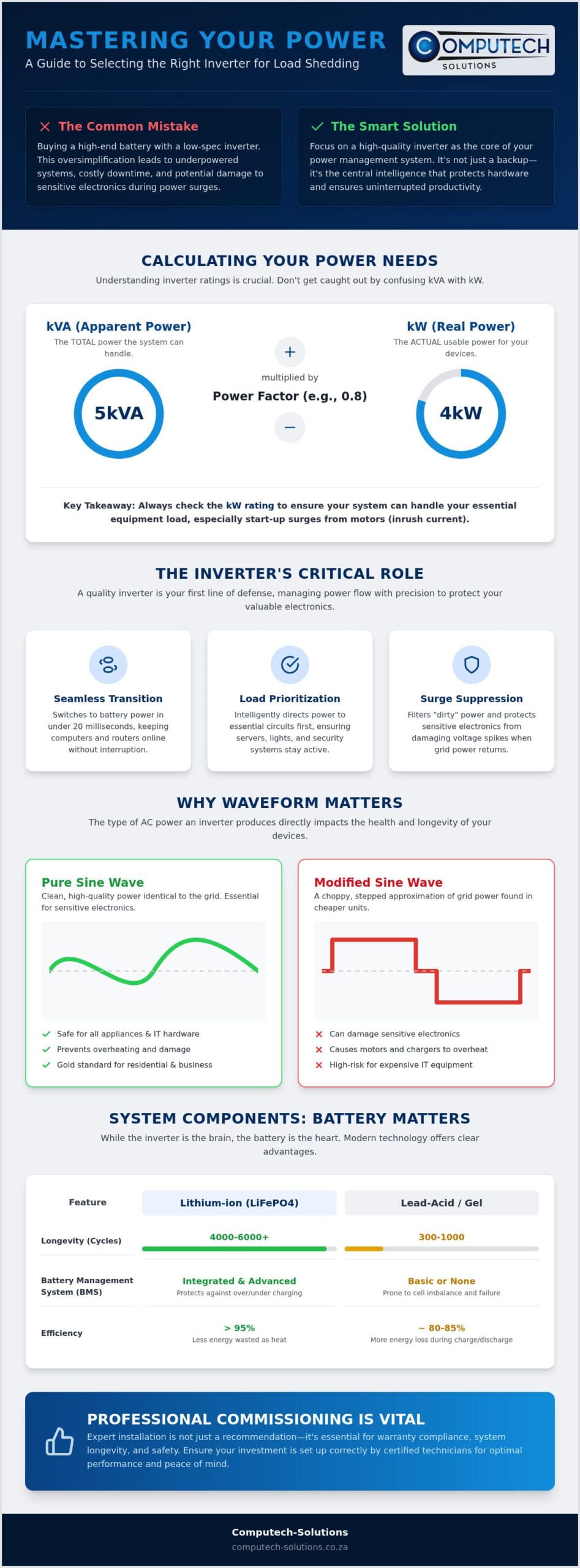
In the context of South African power instability, switch-over time is a non-negotiable metric. Most professional-grade inverters offer a transition speed of less than 20 milliseconds. This is fast enough to ensure your computers don’t reboot and your internet connection stays live during the switch to battery power. Beyond the switch, the inverter manages the flow between solar panels, batteries, and the grid to optimize efficiency. It also serves as a first line of defense against the aggressive surges often experienced when the grid returns after a scheduled outage.
- Automatic Transition: Seamlessly switches to battery power without interrupting active work sessions.
- Load Prioritization: Directs power to essential circuits like servers and lights first.
- Surge Suppression: Filters “dirty” power coming from the grid to protect delicate circuitry.
Why Quality Hardware Matters for Longevity
Using low-grade inverters with expensive electronics is a high-risk strategy. Cheap units often produce “modified sine waves” which can overheat motors and damage the delicate circuitry in laptop chargers or LCD panels. When sourcing solar inverters for load shedding pretoria, prioritizing thermal efficiency is vital. Since heat is the primary enemy of electronic longevity, high-quality cooling fans and heat sinks are essential technical specs to look for. Investing in a robust unit now also provides a path for future-proofing; you can add solar panels later without replacing the core of your system. Our expert technical support ensures that these systems are integrated correctly into your existing IT infrastructure, with professional commissioning and national delivery available across South Africa.
Calculating Your Power Needs: kVA and kW Explained
Understanding the technical rating of solar inverters for load shedding pretoria is the first step toward a stable backup system. Many buyers confuse kVA with kW. In simple terms, kVA (kilovolt-amps) represents the total amount of power in the system, while kW (kilowatts) is the actual power used to do work. The difference between them is the power factor, usually around 0.8 or 1.0 in modern units. If you have an inverter rated at 5kVA with a 0.8 power factor, it only provides 4kW of usable power. Always check the kW rating first to ensure your equipment doesn’t overload the system.
To calculate your requirements, you must read the wattage labels on your office equipment and appliances. You’ll usually find these on a sticker near the power cable. It’s vital to account for “inrush current.” This is the surge of power needed when motors or compressors, like those in refrigerators or air conditioners, start up. This surge can be three to five times higher than the running wattage. If your inverter isn’t sized to handle these peaks, the system will trip the moment a heavy appliance engages.
The Essential Load Checklist
To build a reliable system, you must distinguish between essential and non-essential loads. Essential loads include your WiFi router, LED lighting, security systems, and office equipment. A standard laptop consumes roughly 60W to 100W, while a router uses about 10W to 20W. Refrigerators and security systems should be prioritized to maintain food safety and property protection. When estimating runtime, you must factor in both battery capacity and inverter efficiency. Most high-quality units operate at about 90% to 95% efficiency, meaning a small portion of power is always lost during the conversion process.
Sizing the Inverter for Your Specific Environment
Choosing the right capacity depends on your simultaneous load. A 3kW system is generally sufficient for small home offices or apartments where you only need to keep the lights, internet, and a few laptops running. For a standard residential property with a fridge, television, and multiple computers, a 5kW to 8kW system is the industry benchmark. Oversizing your inverter provides a safety margin for technical stability. It prevents the unit from running at 100% capacity, which reduces heat and extends the lifespan of the internal components. If you’re unsure about your specific load calculations, contact our technical team for a professional assessment to ensure your system is perfectly sized. We provide national delivery and service across all provinces, ensuring your hardware is commissioned correctly for long-term reliability.
Comparing Inverter Types: Hybrid, Off-Grid, and Pure Sine Wave
Choosing the right architecture for solar inverters for load shedding pretoria is a decision that dictates your long-term operational costs. Hybrid inverters represent the gold standard for urban environments because they bridge the gap between grid reliability and energy independence. Unlike basic backup units, hybrids manage multiple power sources simultaneously. They can prioritize solar energy during the day, supplement it with the grid if needed, and keep batteries charged for the next scheduled blackout. This flexibility ensures that your office remains productive regardless of the load shedding stage.
Off-grid inverters are excellent for remote locations where no municipal connection exists. However, for most residential or office setups, they lack the flexibility to “blend” power sources efficiently. The most critical technical distinction you’ll face is between Pure Sine Wave and Modified Sine Wave technology. For any environment containing laptops, desktop computers, or servers, a Pure Sine Wave inverter is non-negotiable for system health.
The Advantages of Hybrid Systems
Hybrid systems offer a sophisticated way to reduce monthly electricity costs while ensuring total uptime. These units can export excess solar power to the grid where local regulations allow, though most users prefer to store that energy in lithium-ion batteries for night use. Because hybrid inverters are designed with modern communication protocols, they integrate seamlessly with advanced battery management systems. This ensures that your storage bank is never overcharged or drained too deeply, which preserves your investment.
Technical Standards for Electronic Safety
The internal circuitry of your IT equipment is designed to receive a smooth, consistent electrical wave. Modified sine wave inverters produce a “stair-step” wave that creates significant harmonic distortion. This distortion causes laptop chargers and LCD panels to run hotter than intended, which significantly shortens their lifespan. Using a pure sine wave unit ensures that your sensitive hardware receives power that is often cleaner than what comes directly from the national grid.
When selecting solar inverters for load shedding pretoria, you aren’t just buying hardware; you’re investing in the safety of your digital infrastructure. Ensure your chosen hardware meets South African national safety and grid-tie standards. Substandard equipment poses a fire risk and may invalidate your insurance policy in the event of an electrical failure. We provide professional commissioning to ensure your system meets these rigorous standards, backed by national delivery and expert technical support across South Africa.
Essential Components for a Reliable Power Backup System
Integrating solar inverters for load shedding pretoria requires a holistic ecosystem where every component communicates flawlessly. While the inverter manages the power, the storage bank determines your duration of independence. Lithium-ion technology has superseded deep cycle gel because it handles the aggressive cycling of Stage 6 load shedding far better. A gel battery typically offers a 50% Depth of Discharge (DoD), whereas lithium-ion allows you to use up to 95% of the stored energy without damaging the cells. This higher efficiency means you get more usable power from a physically smaller footprint.
Digital communication is the secret to a long-lasting system. A dedicated Battery Management System (BMS) must link directly to your inverter via a communication cable. This allows the battery to tell the inverter exactly how much current it can handle based on internal temperature and cell health. Without this data link, the inverter simply “guesses” the battery state. This leads to inefficient charging and can lead to premature hardware failure. For those adding panels, an MPPT (Maximum Power Point Tracking) charge controller is essential to maximize the harvest from your solar array, even during overcast conditions.
System safety is a non-negotiable requirement for any professional installation. Every setup must include DC disconnects to isolate the battery bank and change-over switches to safely toggle between grid and backup power. These components protect both the hardware and the technicians during maintenance. We ensure that every system we commission includes these vital safety layers to protect your investment and your property.
Selecting the Right Battery Partner
When choosing a battery, prioritize cycle life over the initial purchase price. Technical hardware specialists like SM Solar emphasize that lithium iron phosphate cells rated for 6,000 cycles will last significantly longer than cheaper units rated for 2,000 cycles. Scalability is another vital factor for growth. Ensure your chosen system allows you to add more battery modules in parallel as your power needs grow. This modular approach lets you start with a baseline backup and expand as your budget or energy requirements increase.
Monitoring and Smart Features
Modern systems offer WiFi logging and mobile apps that provide real-time consumption data. You can see exactly how many watts your desktop computers are drawing and how much runtime remains. Smart load management can even be configured to automatically shed non-essential loads, like printers or non-LED lighting, when the battery drops below a specific percentage. This level of control ensures your core IT systems stay live until the grid returns. For a total solution tailored to your specific office requirements, chat with our technical specialists about professional solar commissioning and national delivery options across South Africa.
Nationwide Solar Solutions and Technical Support
Hardware acquisition is just the baseline. For solar inverters for load shedding pretoria, the real value lies in professional commissioning. Many manufacturers invalidate warranties if the unit isn’t installed by a certified professional. We provide a total solution model that moves beyond simple delivery. This includes the final configuration of your inverter settings to match your specific battery chemistry and IT environment. Results depend on precision. Our team ensures your system is tuned for the unique demands of the South African grid.
Our expertise in brand-name hardware like desktop computers and laptops allows us to integrate power solutions into your existing IT infrastructure flawlessly. We don’t just drop a box at your door. We ensure power delivery is stable enough for high-demand industries and specialized components. Stability is the goal. With national delivery and service across all South African provinces, we bridge the gap between retail sales and technical engineering. Your operational uptime is our priority.
Expert Support for Complex Setups
Technical labor for professional integration into your DB board is a core part of our service model. Complex environments require more than basic wiring. Integrating an inverter involves ensuring your essential circuits are isolated correctly. Whether you’re managing a small office or high-density loads, custom configuration is necessary to prevent system trips. We provide ongoing assistance and reliable after-sales service to ensure your system evolves with your power needs. We deliver nationwide. This ensures that even the most specialized setups receive expert attention.
Getting Started with Your Backup Strategy
Avoiding common sizing mistakes starts with expert consultation. A system that’s too small will fail under load, while an oversized system without proper configuration is a waste of capital. Our team helps you plan for national delivery and professional setup. We ensure that heavy inverter units arrive safely and are commissioned for peak efficiency. Don’t leave your operational continuity to chance. You can get a professional quote for your load shedding setup via WhatsApp to begin securing your power independence today. Professional support makes the difference.
Securing Your Power Independence with Technical Precision
Transitioning to a resilient backup setup requires more than just hardware; it demands a strategic alignment of technical specifications with your operational needs. By accurately calculating your load in kW and prioritizing pure sine wave technology, you safeguard your sensitive desktop computers and laptop chargers from the volatility of the national grid. Choosing high-performance solar inverters for load shedding pretoria ensures that your transition to backup power remains seamless and efficient during the most demanding stages of blackouts. You don’t have to leave your operational continuity to chance when you have access to specialized engineering expertise.
We provide a total solution that includes expert technical support for IT and power integration, ensuring your system is configured for long-term stability. With nationwide delivery across South Africa and comprehensive commissioning services, we handle the technical complexities for you. Our sophisticated approach guarantees that your investment is protected and your productivity remains uninterrupted. Chat with our technical team on WhatsApp for a custom power solution tailored to your specific requirements. Achieving energy independence is a calculated step toward a more secure and predictable future.
Frequently Asked Questions
What is the difference between a hybrid and an off-grid inverter for load shedding?
Hybrid inverters are the preferred choice for urban environments because they can blend power from the grid, solar panels, and batteries simultaneously. An off-grid inverter operates in isolation and cannot mix grid power with other sources to reduce your monthly bill. Hybrids offer greater flexibility for those looking for solar inverters for load shedding pretoria as they manage energy flows dynamically. This ensures your home or office remains powered while optimizing your total electricity consumption.
Can I run my entire house on a 5kW solar inverter during blackouts?
Running an entire house on a 5kW inverter is possible only if you manage your high-demand appliances carefully. A 5kW system easily handles essential loads like LED lighting, refrigerators, and your desktop computers or laptops. However, it won’t support heavy heating elements like geysers, stoves, or air conditioners without tripping. You must split your distribution board into essential and non-essential circuits to ensure technical stability during every stage of load shedding across South Africa.
Do I need solar panels to use a solar inverter for load shedding?
You don’t need solar panels to benefit from a solar inverter system immediately. Many South Africans start with an inverter and battery bank to act as a high-capacity UPS during blackouts. The system charges from the national grid when power is available and discharges during outages. This modular approach allows you to add solar panels later when your budget allows. It’s an effective way to secure solar inverters for load shedding pretoria without a large upfront investment in panels.
How long will a 5kWh battery last during Stage 4 or Stage 6 load shedding?
A 5kWh lithium-ion battery typically provides between two and four hours of backup power depending on your specific load. If you’re running a standard home office with a few laptops, a router, and basic lighting, you’ll comfortably navigate a four-hour Stage 6 slot. However, if you add heavy appliances like a kettle or microwave, the runtime will drop significantly. For maximum longevity, you should avoid draining the battery below its recommended depth of discharge during frequent cycling.
Is it safe to charge my laptop and UPS from a modified sine wave inverter?
It’s not safe to charge sensitive IT equipment or laptop chargers from a modified sine wave inverter. These units produce a jagged electrical wave that causes excessive heat in power adapters and can lead to permanent hardware failure. Always insist on a pure sine wave inverter to protect your desktop computers and LCD panels. Using high-quality power components ensures your expensive electronics survive the frequent cycling of the national grid without internal damage or operational downtime.
What does ‘commissioning’ mean in a solar installation context?
Commissioning refers to the professional setup, configuration, and safety testing of your power system after physical installation. It involves programming the inverter to communicate correctly with your battery’s management system and verifying that all safety disconnects function as intended. Professional commissioning is often a mandatory requirement for maintaining your hardware warranty. It ensures that the technical labor and configuration meet national electrical standards for long-term reliability and insurance compliance within your specific property.
Can I add more batteries to my inverter system later on?
You can add more batteries to your system later, provided your inverter and existing battery management system support parallel expansion. Most modern lithium-ion batteries are modular, allowing you to increase your storage capacity as your energy needs grow. It’s vital to use the same brand and model of battery to ensure balanced charging and communication. This scalability is a key advantage for small offices that need to expand their backup duration without replacing their entire core inverter unit.
How do I know if my DB board is ready for a solar inverter installation?
Your distribution board is ready for installation if it has enough physical space for additional breakers and a manual or automatic change-over switch. A qualified technician must inspect your board to identify which circuits can be moved to the essential backup side. If your board is outdated or overcrowded, it might require an extension or a sub-board to house the new components. Proper preparation prevents technical disruptions and ensures that your solar hardware integrates seamlessly with your existing electrical infrastructure.
