
The most expensive backup unit on the shelf might still leave you in the dark after just six months of high-stage power cycles. While national load shedding has seen long suspensions recently, localized load reduction and the threat of Stage 6 schedules mean your hardware remains at risk. Finding the best uninterruptible power supply (UPS) for load shedding in 2026 is no longer about chasing the highest VA rating. It is about choosing a battery chemistry that can actually survive the daily grind of South Africa’s energy landscape.
It is exhausting to deal with a unit that beeps constantly but cannot keep your router and laptop powered through a four-hour block. You deserve a reliable power backup that eliminates technical disruptions and protects your equipment. We recognize that stability is the foundation of your productivity, especially as municipal tariff increases of 9.01% make efficient energy management more critical for every professional.
This guide provides a clear path to selecting a UPS that handles high-frequency cycles without failing. You will learn how to match battery types to your specific runtime needs and understand exactly what size system your home office requires. We are here to help you secure a total solution that brings confidence back to your workspace.
Key Takeaways
- Learn why shifting to Lithium Iron Phosphate (LiFePO4) technology is essential for surviving the high-frequency discharge cycles of Stage 6 outages.
- Master the technical difference between VA and Watts to ensure your backup unit provides sufficient power for your specific hardware without technical failure.
- Identify your critical load requirements to select the best uninterruptible power supply (UPS) for load shedding and guarantee a 4-hour runtime for your essential devices.
- Understand the critical trade-offs between the rapid switch-over speed of a dedicated UPS and the extended energy capacity of hybrid inverter trolleys.
- Explore how expert technical support and a comprehensive power strategy provide total independence from grid disruptions, keeping your desktops and laptops operational.
Understanding UPS Technology in the Era of South African Load Shedding
The traditional role of an Uninterruptible Power Supply (UPS) has undergone a radical transformation in South Africa. In most global markets, these devices serve as a five-minute safety net, allowing users to save their work and shut down during rare outages. Locally, the best uninterruptible power supply (UPS) for load shedding must act as a sustained power source capable of supporting hardware through four-hour Stage 6 blocks. This shift from a temporary buffer to a primary energy bridge demands a more sophisticated approach to hardware selection.
South Africa’s grid instability creates a “dirty” power environment that differs significantly from the stable utility feeds found in Europe or North America. Our infrastructure faces frequent physical switching and massive demand surges when entire suburbs reconnect simultaneously. These conditions place immense stress on internal capacitors and inverters. Without the right technology, a standard backup unit will degrade rapidly, often failing within months of purchase.
Standby vs. Online UPS: Which do you need?
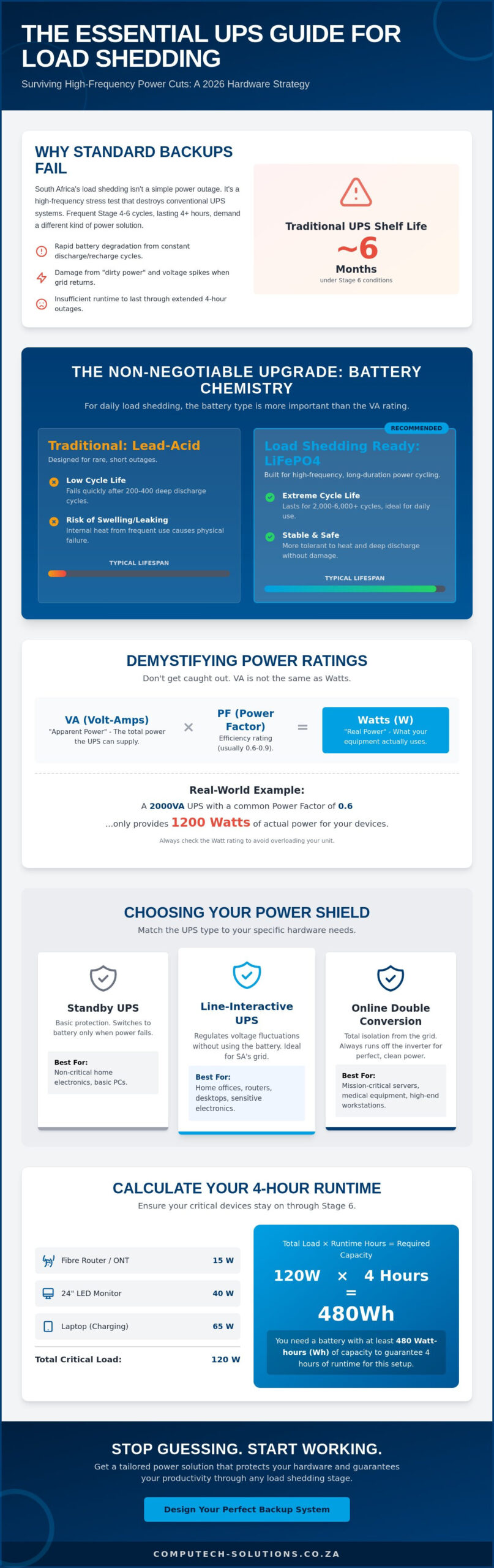
Choosing the right architecture is the first step toward operational stability. Standby UPS systems are budget-friendly options that switch to battery power only when the main grid fails. They are suitable for basic home electronics but offer minimal protection against voltage fluctuations. Line-Interactive units are more robust, using a multi-tap transformer to regulate voltage without depleting the battery. This makes them ideal for maintaining sensitive internet routers during Stage 2 or 4 schedules.
For high-end servers or specialized medical equipment, Online Double Conversion is the definitive choice. These systems convert incoming AC to DC and back to AC again, ensuring the output is always a perfect sine wave. This isolation protects your most valuable assets from every possible grid anomaly, providing the total solution required for mission-critical operations.
The impact of Stage 6 on hardware longevity
Stage 6 load shedding represents the ultimate stress test for any backup system. Frequent discharge cycles generate significant internal heat, which can cause inferior lead-acid batteries to swell or leak. When the power returns, the resulting voltage spike can bypass the basic filters found in cheap units. It’s vital to check the surge protection rating, measured in Joules. A higher rating ensures the unit can absorb these spikes without passing the damage to your connected devices. Investing in a system with high-quality internal components isn’t just about runtime; it’s about protecting the lifespan of your desktops and laptops. Reliable power management alleviates the stress of technical disruptions and ensures your hardware survives the 2026 energy landscape.
Key Specifications: Calculating VA, Watts, and Battery Cycle Life
Choosing the best uninterruptible power supply (UPS) for load shedding requires looking past the large numbers printed on the box. Many South Africans purchase a 2000VA unit assuming it provides 2000 Watts of power, only to find their system shuts down during a heavy task. This confusion stems from the Power Factor (PF), a numerical value that represents the efficiency of power transfer. For a deeper look at how these systems manage electricity, the Appliance Science: The uninterruptible power supply report explains the fundamental physics of these devices. VA represents the apparent power provided by a UPS, while Watts measures the real power used by your equipment, with the two related by the unit’s Power Factor.
A “Deep Cycle” label doesn’t automatically mean a unit is load shedding ready. In the 2026 energy market, we distinguish between systems designed for occasional outages and those built for the daily grind of localized load reduction. If your battery cannot recharge fully between four-hour blocks, it will fail prematurely. This is why understanding battery chemistry is the most critical part of your investment.
Battery Chemistry: Why Lithium (LiFePO4) is non-negotiable in 2026
In the past, Sealed Lead-Acid (SLA) batteries were the standard. However, they typically only offer 300 to 500 charge cycles and a 50% Depth of Discharge (DoD). If you drain an SLA battery completely during a Stage 6 slot, you’ve permanently damaged its capacity. Lithium Iron Phosphate (LiFePO4) batteries provide 3,000 to 6,000 cycles and can be discharged to 80% or 100% without damage. They also charge up to four times faster, ensuring your backup is ready for the next scheduled outage. This efficiency is vital when protecting high-value desktop computers from sudden power loss.
The “Real Wattage” Formula for South African Homes
To calculate the size you need, list the wattage of every device you intend to connect. A standard laptop uses roughly 65W, a 24-inch monitor uses 30W, and a router uses 15W. Totaling these gives you 110W. We recommend adding a 20% safety margin to prevent the inverter from running at its absolute limit, which extends the life of internal components. To find the required VA rating, divide your total wattage by the UPS Power Factor (usually 0.6 or 0.7 for consumer units). For a 110W load on a 0.6 PF unit, you need at least a 183VA rating, though you’ll likely choose a larger unit to secure the necessary runtime.
- Identify Critical Load: Total Watts of all connected hardware.
- Apply Safety Margin: Multiply total Watts by 1.2.
- Check Power Factor: Ensure the VA rating supports the adjusted Wattage.
- Verify Cycle Life: Prioritize LiFePO4 for Stage 4-6 resilience.
UPS vs. Inverter Trolleys: Choosing the Right Backup Strategy
Selecting the right backup hardware involves more than just picking a battery; it requires choosing a delivery method that matches your equipment’s sensitivity. While inverter trolleys excel at powering multiple appliances like TVs and floor lamps for extended periods, they often lack the rapid response time required for a workstation. Finding the best uninterruptible power supply (UPS) for load shedding depends on whether you need to bridge a 10-millisecond gap or provide energy for a six-hour entertainment session. A dedicated UPS is designed for precision, whereas an inverter trolley is built for volume.
Pure Sine Wave technology is a non-negotiable requirement for modern electronics. Many budget-friendly inverter trolleys produce a “modified sine wave” which can cause audible buzzing in speakers, overheating in motors, and potential long-term damage to sensitive power supplies. High-end desktops and gaming consoles require the clean, stable signal provided by a Pure Sine Wave UPS. This ensures that your hardware receives the same quality of power as it would from a stable grid, alleviating the risk of operational failure during frequent switching events.
Switch-over Times: Why milliseconds matter
A desktop computer is sensitive to even the slightest interruption in current. If a backup system takes 20 milliseconds to engage, the capacitors in a PC power supply may drain, causing the system to reboot instantly. A dedicated UPS offers a “seamless” transition, typically switching in under 10 milliseconds. This rapid response is why a dedicated unit remains the best uninterruptible power supply (UPS) for load shedding when protecting unsaved work on a desktop. Laptops are more resilient due to their internal batteries, but using a UPS still protects the external charger and internal circuitry from the initial surge of a power cut.
Noise and Aesthetics: UPS in the living room
Managing the acoustic profile of your backup system is essential for a comfortable home environment. High-capacity inverter trolleys often utilize large, active cooling fans that run constantly while the battery recharges or discharges. In contrast, compact UPS units are generally quieter, though they are known for the persistent “beep” that signals a power loss. Most modern units allow you to manage these alerts through software settings, enabling a silent mode that won’t disrupt your focus. For those living in smaller apartments, the vertical footprint of a sleek UPS is often more practical than a bulky trolley system.
- UPS: Best for desktops, servers, and sensitive networking gear.
- Inverter Trolley: Ideal for TVs, lamps, and medium-sized appliances.
- Pure Sine Wave: Essential for protecting modern PC power supplies.
- Switch-over Speed: Look for < 10ms for total workstation stability.
Step-by-Step Selection: Matching Your Backup to Load Shedding Stages
Selecting the best uninterruptible power supply (UPS) for load shedding requires a structured approach rather than simply purchasing the largest capacity unit available. Your strategy must begin with identifying your critical load, which includes only the devices essential for your immediate operational needs. By isolating your router, laptop, and primary monitor from non-essential peripherals, you can significantly extend your available runtime during an outage. Efficiency is the key to surviving long-duration blocks without total battery depletion.
The intensity of the load shedding stage dictates your specific battery requirements. While Stage 2 usually involves two-hour slots, Stage 6 demands a system capable of providing over four hours of continuous power. Beyond capacity, you must verify the unit’s charging rate. In high-frequency scenarios where outages occur multiple times a day, a slow-charging unit won’t reach 100% capacity before the next block begins. Always prioritize units with local technical support and comprehensive warranties to ensure long-term reliability in South African conditions.
Scenario A: The 4-Hour Remote Work Survival Kit
For a standard remote setup consisting of a router, two monitors, and a laptop, a medium-capacity LiFePO4 unit is ideal. However, if you only need to keep your internet active, a dedicated DC-to-DC UPS for your fibre ONT and router is often a more efficient choice. It avoids the energy loss of converting DC to AC and back again. For the laptop itself, the most cost-effective way to ensure full-day productivity is to browse replacement laptop batteries for brands like Dell, HP, or Lenovo. This allows your machine to run independently of the main UPS for several hours, saving the UPS capacity for your external monitors.
Scenario B: Protecting Your Desktop Gaming Rig
High-end gaming desktops present a unique challenge due to the massive power draw of modern GPUs, which can spike significantly during intensive tasks. These systems require a Pure Sine Wave UPS to protect sensitive power supplies and prevent the system from tripping. A sudden loss of power doesn’t just end your session; it risks severe data corruption on SSDs and can damage internal components. Ensuring your UPS is rated for the peak wattage of your rig provides the stability needed to navigate Stage 6 schedules without technical failure.
- Calculate Watts: List every essential device to find your real load.
- Match Stages: Plan for 4.5 hours of runtime to survive Stage 6 safely.
- Check Recovery: Ensure the unit recharges fully in under 4 hours.
- Secure Support: Verify local warranty availability for rapid hardware replacement.
Implementing a Robust Power Strategy with Computech-Solutions
Achieving total operational stability requires looking beyond a single plug-and-play unit. While finding the best uninterruptible power supply (UPS) for load shedding addresses immediate hardware protection, a multi-layered system ensures you remain productive through localized load reduction or unexpected infrastructure failure. We specialize in providing the technical expertise and high-quality components needed to build these resilient environments. A tiered backup plan, combining a dedicated UPS for sensitive electronics with a broader inverter strategy, offers the most reliable path to energy independence.
Our approach centers on providing a total solution that alleviates the stress of technical disruptions. By matching specialized industry hardware to your specific business outcomes, we ensure that your power strategy scales as your energy needs grow. Whether you are maintaining a single home office or managing a fleet of remote workstations, the goal is to create a seamless transition that keeps your critical systems online regardless of the national grid status.
Solar System Integration and Commissioning
Transitioning from a standalone UPS to a professional solar inverter setup provides a higher level of energy autonomy. As of June 2026, municipalities across South Africa have implemented stricter regulations for grid-tied systems. For example, the City of Cape Town requires all new installations to use approved inverters and be signed off by a professional. Professional commissioning is essential to ensure compatibility with your existing distribution board. This integrated approach allows the solar system to handle long-term energy loads while the UPS provides the millisecond switch-over speed needed to protect your desktop computer and servers.
Maintaining Your Hardware During Load Shedding
Maintaining your hardware is just as critical as the initial installation. Frequent discharge cycles during high-stage outages put immense strain on internal components. To extend the life of your replacement laptop batteries, avoid letting the charge drop below 20 percent during frequent outages. Regularly monitor your UPS health; if the unit takes significantly longer to reach full capacity between scheduled blocks, the internal cells likely require attention. We focus on supplying premium replacement parts, including laptop LCD panels and high-capacity chargers, to keep your mobile workstations in peak condition despite the challenging energy landscape.
View our full range of power solutions and laptop batteries at Computech-Solutions to secure a reliable backup for your Dell, HP, Lenovo, or Apple devices. Our team provides the authoritative support and national delivery needed to implement a comprehensive power strategy that protects your professional growth.
Securing Your Professional Stability in 2026
Navigating the complexities of South Africa’s energy landscape requires a shift from temporary fixes to long-term reliability. By prioritizing Lithium Iron Phosphate battery chemistry and accurately calculating your hardware’s real wattage, you ensure your workstation remains operational through Stage 6 schedules. Identifying the best uninterruptible power supply (UPS) for load shedding is the foundation of a strategy that protects your high-value desktop computers and sensitive networking gear from operational failure.
Computech-Solutions provides the technical expertise and specialized components needed to maintain your productivity during grid instability. We offer nationwide delivery across South Africa and expert support for local power conditions, specializing in high-quality replacement batteries and integrated solar solutions. Whether you need a dedicated UPS for your desk or a total home backup plan, we are your reliable partner in technical resilience.
Secure your power backup today at Computech-Solutions and regain the peace of mind you need to focus on growth. You don’t have to let power cuts dictate your professional schedule.
Frequently Asked Questions
How long will a 2000VA UPS last during load shedding?
The runtime of a 2000VA unit depends entirely on the total wattage of your connected devices and the battery capacity. For a standard home office drawing 100W, a unit equipped with two 100AH batteries can provide over four hours of power, which is sufficient for a Stage 6 block. However, if you connect a high-end gaming desktop drawing 500W, that same unit may only last about 45 to 60 minutes.
Can I plug my fridge or kettle into a standard computer UPS?
No, you should never connect high-wattage heating or cooling appliances to a standard office UPS. A kettle typically draws over 2000W, which will immediately overload and potentially damage the internal inverter of most consumer units. These systems are specifically designed for low-draw electronics like laptops, desktops, and networking equipment that require stable, continuous power.
Why does my UPS battery only last a few months in South Africa?
Standard lead-acid batteries fail quickly in South Africa because they aren’t designed for the high-frequency discharge cycles of Stage 4 to 6 schedules. These batteries typically only survive 300 to 500 cycles at a 50% depth of discharge. When load shedding occurs multiple times a day, the battery chemistry reaches its end of life within six months. Switching to Lithium (LiFePO4) technology is the most effective way to ensure your system lasts for years.
What is the difference between a Pure Sine Wave and a Modified Sine Wave UPS?
A Pure Sine Wave UPS produces a smooth, clean electrical signal that matches the quality of the utility grid, which is essential for sensitive PC power supplies. Modified Sine Wave units produce a blocky, simulated signal that can cause audible buzzing in speakers and excessive heat in motors. Selecting a Pure Sine Wave unit is a critical step in finding the best uninterruptible power supply (UPS) for load shedding to protect high-value hardware.
Is it better to leave my UPS plugged in all the time?
It is best to keep your UPS plugged into a wall socket continuously. This allows the internal management system to maintain the battery at an optimal charge level and provides constant surge protection for your devices. Modern units are designed to prevent overcharging, so leaving them connected won’t damage the battery and ensures you are always prepared for the next scheduled outage or localized load reduction.
Can I replace the internal batteries of my UPS with Lithium cells?
You cannot simply drop Lithium cells into a standard lead-acid UPS unless the unit is specifically rated for Lithium chemistry. Lithium batteries require a specialized charging profile and a Battery Management System (BMS) to operate safely. Attempting to charge Lithium cells with a lead-acid charger can lead to permanent hardware failure or significant safety risks. It is always safer to purchase a dedicated Lithium-ready system.
How much does a reliable UPS for a home office cost in 2026?
As of June 2026, prices for reliable backup systems vary significantly based on battery technology and capacity. A 1200VA inverter trolley with lead-acid batteries is priced at approximately R8,795, while a more resilient 2400VA unit featuring Lithium batteries costs around R14,995. While the initial investment for the best uninterruptible power supply (UPS) for load shedding is higher with Lithium, the lower replacement frequency provides better long-term value.
Does a UPS protect my computer from lightning and surges?
A UPS provides a primary layer of protection against voltage spikes and the surges that occur when power returns after an outage. Its effectiveness is determined by its surge protection rating, measured in Joules. While it handles standard grid fluctuations well, it may not survive a direct lightning strike. For total peace of mind, we recommend using a high-quality dedicated surge protector in conjunction with your UPS system.
