
Oversizing your renewable energy setup is the fastest way to waste capital on power you will never consume. As electricity tariffs continue their steady upward march, calculating the realistic cost of solar installation for a small house in South Africa 2026 comes down to matching critical daytime consumption rather than overpaying for unnecessary commercial capacity. With smart planning, compact residential properties can achieve genuine energy resilience without excessive hardware.
Between rising utility rates and persistent grid instability, figuring out how to pair a compact inverter with the right lithium battery storage is undeniably daunting. Many homeowners also worry about hidden expenses, such as distribution board integration, structural roof fittings, and statutory compliance sign-offs. You’ll discover the precise hardware specifications, component tiers, and genuine cost drivers required to power your living space reliably. We explore the balance between hybrid and off-grid investments, while detailing the exact regulatory standards and certificates needed to safeguard your household insurance coverage.
Key Takeaways
- Daily kilowatt-hour usage and critical load profiles dictate your system dimensions far more effectively than overall property square footage.
- Understanding the total cost of solar installation for a small house in South Africa 2026 requires balancing panel generation capacity with hybrid inverters and expandable lithium storage tiers.
- Compact living spaces achieve maximum reliability using balanced 3kW or 5kW hybrid architectures rather than paying for capital-heavy, fully off-grid configurations.
- Dedicated distribution board reconfiguration and mandatory statutory compliance sign-offs are non-negotiable requirements for preserving your household insurance policy.
- Active load-shifting of energy-intensive appliances into peak sunlight hours accelerates your financial payback period against rising municipal grid tariffs.
Key Cost Determinants for Small House Solar Systems in 2026
Every square metre of rooftop real estate matters in compact residential architecture. While commercial marketing often frames solar as a one-size-fits-all 5kW package, realistic sizing depends on your exact operational profile. The total Solar power in South Africa landscape demonstrates that residential adoption thrives when homeowners tailor hardware to genuine load demands rather than floor area alone.
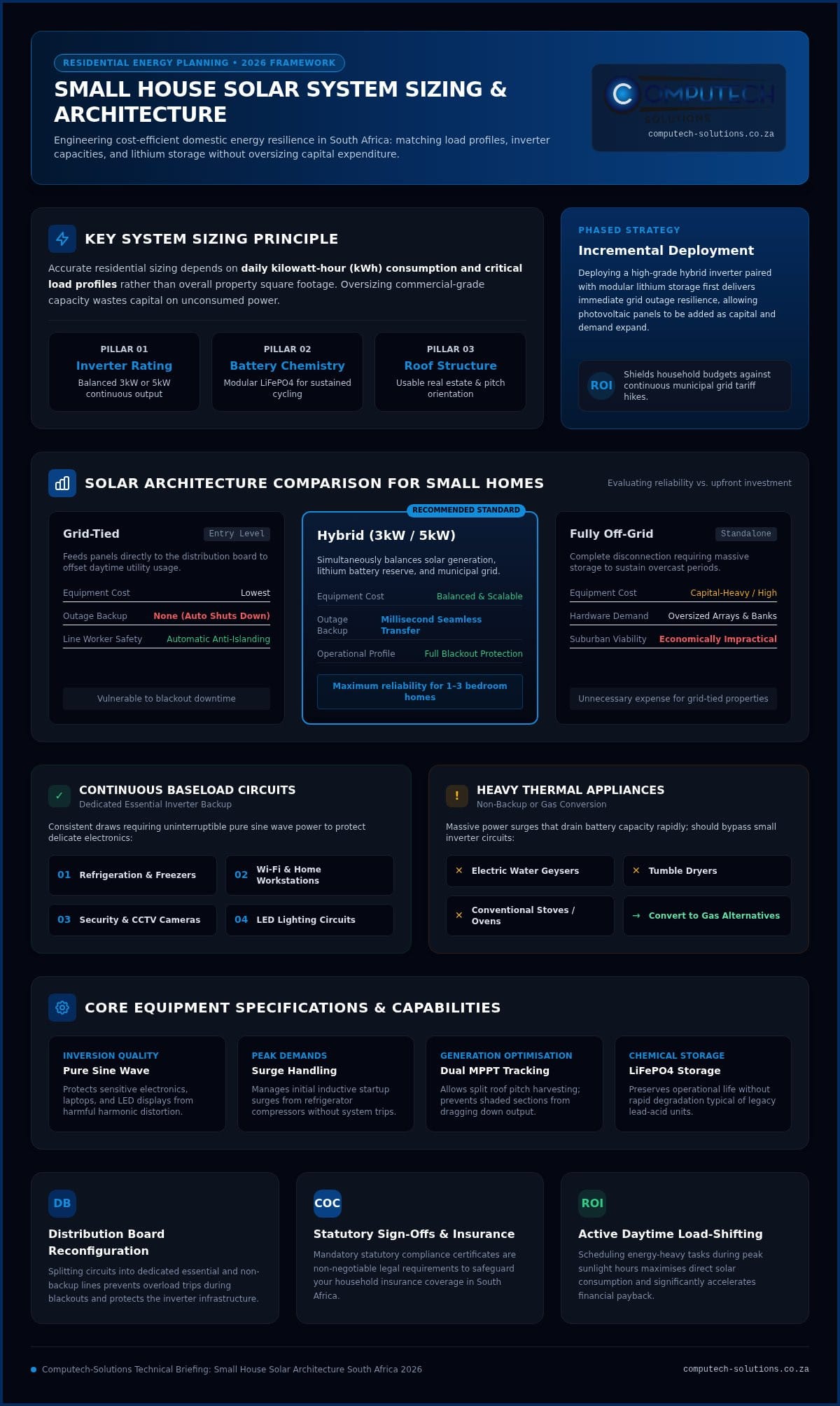
Calculating the true cost of solar installation for a small house in South Africa 2026 hinges on three core physical factors: your inverter output rating, battery chemistry specifications, and usable roof structural capacity. Many property owners benefit from an incremental deployment strategy. By commissioning a high-grade hybrid inverter paired with modular lithium storage first, you establish immediate grid resilience. You can then add photovoltaic panels as energy demands and capital reserves expand, shielding your domestic budget against steep annual utility tariff hikes without unnecessary financial strain.
Assessing Daily Kilowatt-Hour Consumption in Compact Homes
Accurate system sizing begins with a practical electrical audit rather than square footage estimates. Categorising household draws clarifies baseline requirements:
- Continuous baseloads: Refrigerators, Wi-Fi routers, security cameras, and LED lighting draw consistent current and require dedicated inverter support.
- Heavy thermal appliances: Electric geysers, tumble dryers, and conventional stoves create massive surges. These belong on non-backup circuits or should be converted to alternative sources like gas.
- Seasonal generation shifts: Winter sunlight yields fewer daily generation hours than summer. Planning around these seasonal variations prevents frustrating battery cut-offs during prolonged overcast spells.
Grid-Tied, Off-Grid, and Hybrid System Profiles
Selecting an architecture dictates both your upfront investment and your daily operational independence. Standard grid-tied inverters keep equipment expenses low by feeding panels directly to your distribution board, but they automatically shut down during outages to protect municipal line workers.
Hybrid inverters represent the standard for dependable residential backup. These systems balance rooftop solar generation, stored battery reserves, and grid power simultaneously. Off-grid configurations, by contrast, demand massive battery banks and oversized panel arrays to survive consecutive cloudy days. For compact suburban residences connected to the national network, complete off-grid isolation remains economically impractical. A flexible hybrid system provides full protection against blackouts while controlling overall capital outlay.
Core Equipment Breakdown: Where Your Solar Investment Goes
Every rand invested in a domestic backup architecture should directly enhance reliability and hardware longevity. When evaluating the cost of solar installation for a small house in South Africa 2026, equipment expenditures fall into three distinct functional categories: energy generation, intelligent power inversion, and chemical storage. Real-world validation from CSIR solar cost-saving experiments confirms that pairing the right component tiers yields tangible operational returns while preventing premature hardware failure.
Selecting balanced components prevents costly bottlenecks. Pure sine wave hybrid inverters safeguard delicate electronics like laptops, routers, and LED displays from harmonic distortion. Meanwhile, modern Lithium Iron Phosphate (LiFePO4) storage preserves your operational baseline without the rapid degradation typical of legacy lead-acid units.
Hybrid Inverters: Sizing for Essential Small Household Circuits
Hybrid inverters serve as the operational hub of your energy infrastructure. Key considerations include:
- Surge Handling: Choose an inverter capable of managing initial startup surges from inductive loads, like compressor cycles in modern domestic refrigerators.
- Dual MPPT Tracking: Dual Maximum Power Point Trackers allow panels on split roof pitches to harvest sunlight independently, preventing shaded sections from dragging down overall production.
- Seamless Transfer: Integrated automatic bypass switches transition from municipal supply to stored power in milliseconds, keeping home workstations fully online during outages.
Lithium Battery Storage: Balancing Capacity and Lifecycle Value
Nominal capacity ratings can be misleading. Always evaluate storage based on standard Depth of Discharge (DoD), where quality lithium units deliver between 80% and 90% usable capacity without cell degradation. Premium LiFePO4 batteries routinely deliver upwards of 6,000 operational cycles, even in warm South African ambient conditions. Native communication between the internal battery management system (BMS) and your inverter ensures regulated charge rates and thermal safety.
Tier-1 Photovoltaic Panels: Efficiency on Limited Roof Spaces
Compact rooftops require high power density. Monocrystalline photovoltaic modules deliver superior conversion efficiency, producing maximum watt-peak performance across restricted surface footprints. Look for linear degradation warranties guaranteeing at least 80% power retention after twenty-five years. Mounting hardware must also suit your exact roof substrate, whether securing to corrugated iron, concrete tile, or standing-seam profiles.
If you’re unsure which hardware combination matches your daily household usage, you can consult a technical specialist via WhatsApp to review your component configurations.
Comparing Solar Configurations for 1 to 3 Bedroom Properties
Mainstream providers routinely force compact households into oversized, commercial-grade equipment packages. This marketing approach pushes consumers toward 8kW systems that demand roof space smaller properties simply don’t have. Assessing the realistic cost of solar installation for a small house in South Africa 2026 requires sizing hardware directly to your occupant count and critical consumption habits rather than arbitrary floor-plan assumptions.
Adhering to guidelines from the South African Photovoltaic Industry Association ensures that your chosen equipment meets strict local technical standards while remaining cost-effective. Selecting the right setup comes down to choosing between an agile 3kW entry-level layout and an expandable 5kW family system.
Entry-Level 3kW Inverter and Storage Setups
Single occupants, garden cottages, and compact lock-up-and-go townhouses thrive on streamlined 3kW hybrid platforms. These setups require modest infrastructure while keeping upfront investment manageable:
- Load Capacity: Sustains continuous operation of essential home work setups, Fibre modems, LED illumination, and primary refrigeration without overload faults.
- Roof Footprint: Functions efficiently with four to six high-output solar modules, making it ideal for restricted roof orientations.
- Target Profile: Serves as the most practical entry point for energy-conscious single professionals who cook primarily with gas and require basic uninterrupted power.
Versatile 5kW Hybrid Configurations for Small Families
For standard two-to-three-bedroom residences with higher concurrent power demands, a 5kW hybrid configuration represents the industry sweet spot. This setup delivers enough inverter headroom to run intermittent domestic loads, such as a microwave or dishwasher, alongside persistent background baseloads.
These configurations pair effectively with eight to ten photovoltaic modules to offset daytime municipal consumption entirely. Connected to a 5kWh lithium storage module, a 5kW hybrid inverter provides comprehensive overnight resilience during scheduled grid outages. Modular battery architectures allow you to add storage capacity as household energy usage expands over time, protecting your property against long-term operational disruption.
Installation, Electrical Compliance, and Hidden Labour Factors
Hardware procurement accounts for only part of your overall capital commitment. Overlooking installation craftsmanship and regulatory sign-offs distorts the true cost of solar installation for a small house in South Africa 2026. Skimping on technical labour or skipping legal certifications puts your household at risk of equipment failure, municipal penalties, and invalidated insurance policies.
Professional commissioning ensures that high-voltage direct current generated by your rooftop array safely integrates with existing domestic alternating current circuits. Factoring in qualified technical labour from the start guarantees reliable long-term operation, a benchmark seen across established solar specialists such as apsquaretech.com.au that focus on quality design, installation, and ongoing maintenance.
Distribution Board Rewiring and Critical Load Segregation
Safe operation requires physically splitting your main distribution board (DB) into essential and non-essential circuits:
- Bypass switches: Electricians install manual or automatic changeover switches alongside dedicated bypass breakers, allowing you to service the inverter without cutting utility grid access to the home.
- Circuit separation: Heavy thermal elements like geysers, ovens, and pool pumps remain connected to the primary grid feed, preventing catastrophic inverter overload. Essential plugs and lighting transfer to a sub-DB.
- Surge suppression: Integrating Type 2 surge protection devices directly into the sub-DB shields sensitive appliances, desktop computers, and inverter circuits from destructive lightning spikes and grid switching transients.
Statutory Certification, SANS Compliance, and Municipal SSEG
Every domestic solar installation must adhere strictly to SANS 10142-1 regulations governing low-voltage electrical installations. After testing, an accredited electrical contractor registered with the Department of Labour must issue an updated Electrical Certificate of Compliance (CoC). Short-term insurers mandate this certificate; operating an unregistered or uncertified installation provides legal grounds to reject household fire and damage claims.
Homeowners must also complete municipal Small Scale Embedded Generation (SSEG) registration. This administrative process verifies that your inverter utilizes certified anti-islanding technology, which halts power export during grid failures to protect utility technicians working on local infrastructure.
To ensure your distribution board reconfiguration and safety protections comply with national standards, speak with our technical installation team on WhatsApp to arrange safe, certified commissioning.
Maximising System ROI and Ensuring Dependable Hardware Support
Achieving a swift return on investment requires viewing your energy setup as an active utility asset rather than a passive backup box. When modelling the long-term cost of solar installation for a small house in South Africa 2026, financial payback accelerates dramatically against compounded municipal electricity tariff increases. By aligning household operating habits with daily production peaks, small households often reduce grid dependency by upwards of 70%, recovering upfront capital years ahead of schedule.
True equipment value depends on dependable supply chains and correct installation parameters. Internationally, tailored photovoltaic specialists like Sonalis demonstrate how bespoke residential planning and quality engineering maximize long-term yields. Procuring certified components backed by nationwide hardware support guarantees that your system delivers its expected lifecycle without unbudgeted downtime or replacement expenses.
Operational Habits that Shorten Capital Payback Periods
Simple operational adjustments yield significant financial savings over time:
- Strategic Load-Shifting: Run energy-intensive appliances, such as washing machines, dishwashers, and pool filtration pumps, strictly between 10:00 and 14:00 when rooftop solar irradiance reaches its maximum.
- Dynamic Reserve Margins: Configure inverter firmware to preserve a 20% to 30% battery buffer for unscheduled grid shedding, allowing the remaining capacity to handle evening residential self-consumption.
- Active Telemetry Monitoring: Use integrated mobile applications to track real-time power generation and consumption anomalies, catching phantom draws before they inflate utility costs.
Securing Quality Backup Systems with Computech-Solutions
Reliable power infrastructure requires pairing proven hardware with technical competence. Homeowners must avoid grey-market imports that lack certified local service backplates and firmware compatibility. Sourcing robust power backup systems, inverters, and battery storage solutions through established providers safeguards your investment through standardized warranty channels and dedicated technical support.
Working alongside an established national hardware distribution network ensures you receive genuine, Tier-1 engineered components anywhere across the country. Experienced technical personnel handle system configuration and professional commissioning, guaranteeing seamless integration with domestic distribution boards while adhering strictly to national electrical safety mandates. Explore robust residential power backup solutions at Computech-Solutions to secure dependable energy independence for your home.
Take Control of Your Household Energy Independence Today
Accurately determining the cost of solar installation for a small house in South Africa 2026 doesn’t mean compromising on engineering quality or paying for commercial-scale capacity you’ll never use. Tailoring an agile 3kW or 5kW hybrid architecture around your genuine consumption ensures immediate protection against load shedding while controlling capital expenditure. When paired with safe distribution board segregation and mandatory statutory compliance, a balanced setup delivers decades of energy security and predictable utility savings.
Securing genuine energy independence requires dependable equipment backed by certified technical integration. With nationwide delivery across South Africa, access to robust power components engineered to withstand ongoing grid disruptions, and professional commissioning services, establishing a safe, resilient home setup is within reach. Ready to configure the ideal backup system for your compact property? Connect directly with our technical team on WhatsApp to discuss your power requirements today.
Frequently Asked Questions
How much does it cost to install solar for a small house in South Africa in 2026?
Total expenditure depends directly on your daily kilowatt-hour demand, inverter capacity, and battery storage volume. When evaluating the cost of solar installation for a small house in South Africa 2026, compact residences typically select entry-level 3kW or standard 5kW hybrid systems. Overall investment varies based on component tiers, roof structural fittings, mandatory distribution board reconfiguration, and qualified electrical certification.
Can a 3kW or 5kW solar system run an entire small house?
Yes, provided you separate heavy thermal heating elements from your backup distribution circuits. A 3kW setup easily runs home computers, Wi-Fi routers, television media, and primary refrigeration. A 5kW configuration offers additional headroom, allowing small families to use intermittent appliances like microwaves alongside daily baseloads. High-draw elements like electric geysers and conventional ovens should remain connected to utility power or convert to gas.
Is an Electrical Certificate of Compliance mandatory for home solar systems?
An updated Electrical Certificate of Compliance (CoC) is legally required under national SANS 10142-1 wiring regulations. A registered electrical contractor must inspect your installation, test earth leakage mechanisms, and certify that direct current lines and distribution board connections are safe. Operating without a valid CoC exposes homeowners to municipal penalties and gives short-term insurers grounds to repudiate domestic fire damage claims.
What happens if my solar panels produce more energy than my small home uses?
Excess daytime generation automatically routes to recharge your lithium battery bank first. Once batteries reach full capacity, intelligent hybrid inverters throttle panel production to match your immediate household consumption. If your local municipality supports registered bi-directional feed-in metering, excess power can export back to the municipal grid, yielding energy credits on your monthly municipal utility account.
How long will a 5kWh lithium battery keep a small house running during load shedding?
A 5kWh lithium battery with an 80% to 90% usable depth of discharge provides approximately 4kWh to 4.5kWh of real-world energy. For a small home drawing an average continuous baseload of 400 to 500 watts for lighting, refrigeration, and desktop computers, the battery comfortably delivers eight to ten hours of uninterrupted backup during extended grid outages.
Can I install a battery backup first and add solar panels later?
Deploying a hybrid inverter and lithium battery bank first is a proven, cost-effective way to secure immediate blackout protection. This phased installation strategy reduces initial capital outlay while keeping home circuits fully operational during utility outages. As budget allows, you can seamlessly connect photovoltaic panels to the existing hybrid inverter to begin offsetting daily municipal electricity consumption.
Does home insurance cover newly installed residential solar systems in South Africa?
Most short-term household insurers cover rooftop solar installations, but you must formally add the hardware to your building insurance policy. Underwriters require proof of certified professional commissioning, an updated Electrical Certificate of Compliance, and municipal registration approval. Failing to declare the system or using uncertified installers risks complete claim repudiation in the event of electrical fires or storm damage.
