
The lowest upfront price isn’t always the lowest-cost solar choice. DIY may appear to cut labour, but the DIY vs professional solar installation costs SA comparison also involves equipment, safe system integration, compliance, and the risk of costly rework. The right decision depends on more than what you save on installation day.
It’s reasonable to question whether professional labour will push a solar system beyond your budget. Some tasks, such as researching options and comparing system components, may suit a capable homeowner. Electrical connections and commissioning, however, carry safety and compliance responsibilities. In South Africa, grid-connected systems must be registered with the relevant electricity distributor, and a Certificate of Compliance must be issued by a qualified, registered electrician.
This comparison explains how cost categories differ between DIY and professional installation, where electrical expertise and documentation matter, and how system complexity can affect long-term value. You’ll also see how professional setup and commissioning can integrate an inverter and battery backup with existing electrical infrastructure to support operation during load shedding.
Key Takeaways
- The DIY vs professional solar installation costs SA comparison involves more than labour: equipment, technical responsibility, compliance, and potential rework all shape overall value.
- Separate lower-risk planning and monitoring from electrical installation and connection work, which require appropriate expertise and documentation.
- Compare DIY and professional options by time, responsibility, system complexity, and the support needed to configure and commission the system.
- Prepare a clear record of your energy needs, site conditions, and backup priorities before comparing equipment, project scope, testing, and handover.
- Professional installation can bring technical labour, configuration, and commissioning together to support compatibility with existing electrical infrastructure.
DIY vs professional solar installation costs in South Africa: what you are comparing
Doing some of the work yourself can look like a straightforward way to reduce labour costs. To compare the options fairly, account for the full project scope: equipment, electrical work, configuration, testing, documentation, and any corrections or troubleshooting that may follow. A useful DIY vs professional solar installation costs SA comparison separates these categories rather than focusing only on the installation charge.
DIY means the owner manages or performs some installation tasks. A professional installation brings technical labour and system configuration together, followed by testing and commissioning. The choice isn’t always all-or-nothing: you may handle research and planning while using qualified expertise for technical electrical work. The residential rooftop systems covered here differ from utility-scale solar projects, as outlined in Solar power in South Africa.
Which costs appear in both installation approaches?
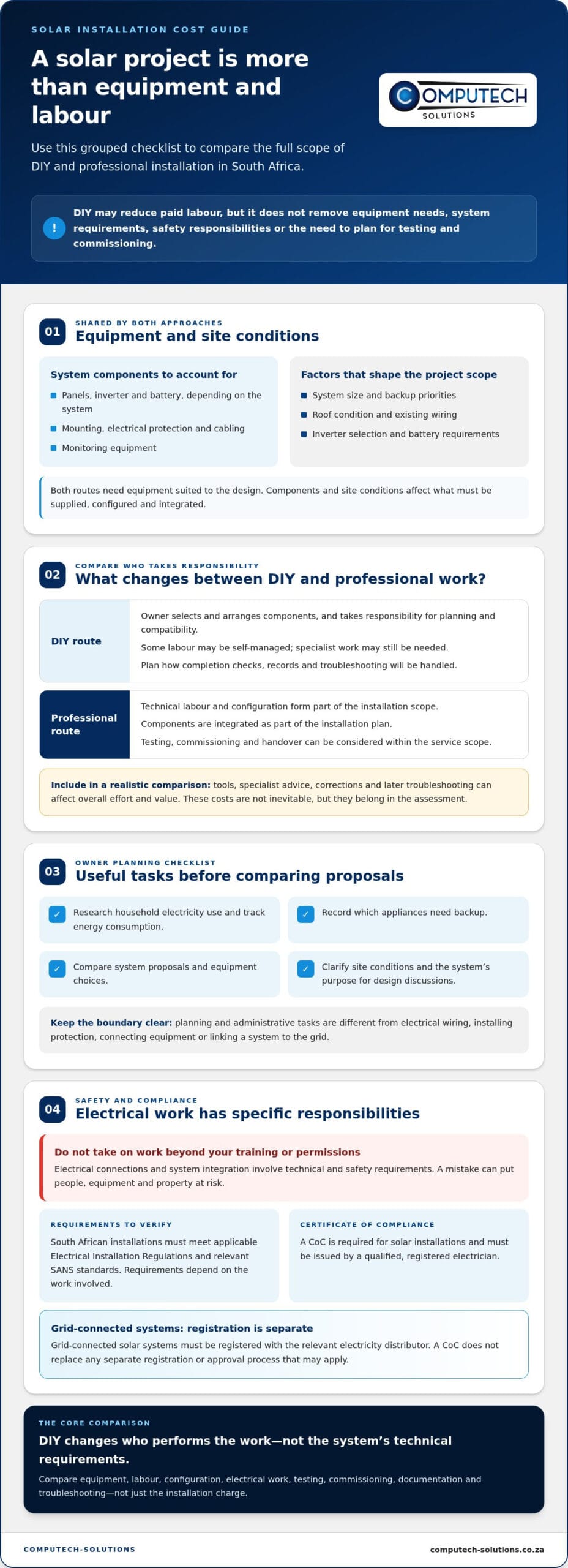
Both approaches require equipment suited to the design. Depending on the system, this may include panels, an inverter, a battery, mounting, electrical protection, cabling, and monitoring. System size, backup priorities, and equipment choices determine what needs to be supplied and integrated. Roof condition, existing wiring, inverter selection, battery requirements, and other site conditions can also affect the project scope.
Equipment is only one part of the comparison. Consider labour, configuration, electrical work, testing, commissioning, documentation, and future troubleshooting separately. A professionally installed and commissioned system includes technical labour and configuration. A DIY plan should also account for how those requirements will be handled.
| Cost category | DIY approach | Professional approach |
|---|---|---|
| Equipment and materials | Owner selects and arranges system components. | Components are integrated as part of the installation plan. |
| Design and configuration | Owner takes responsibility for planning and compatibility. | Technical configuration forms part of the installation and commissioning work. |
| Labour and electrical work | Some labour may be self-managed; specialist work may still be needed. | Technical labour is included in the installation scope. |
| Testing, documentation, and support | Owner must plan for completion checks, records, and troubleshooting. | Testing, commissioning, and handover can be considered within the service scope. |
What does DIY change, and what does it not remove?
Managing some work yourself may reduce paid labour, but it doesn’t remove equipment requirements or the need for a safe, compatible system. Tools, specialist advice, corrections, and later troubleshooting can also affect the project’s total effort and value. These costs aren’t inevitable, but they belong in a realistic comparison alongside the time and technical responsibility you’re prepared to take on.
DIY changes who performs the work, not the system’s technical requirements. Compare the complete scope, including setup and commissioning, before treating labour savings as the final cost difference.
Solar installation safety and South African compliance: the DIY question
A solar system involves more than panels on a roof. It brings together electrical connections, roof mounting and structural considerations, and, where batteries are used, equipment that must be integrated and configured correctly. The DIY vs professional solar installation costs SA decision should account for safety and compliance responsibilities, not just who supplies the labour.
Which solar tasks may be suitable for an owner to manage?
Homeowners can contribute without taking on technical installation work. Research household electricity use, record which appliances need backup, compare system proposals, and track energy consumption. These practical planning tasks clarify the system’s purpose and support more informed design discussions.
Keep planning and administrative tasks distinct from electrical wiring, installing protection, connecting equipment, or linking a system to the grid. Those activities involve technical and safety requirements. Don’t attempt work beyond your training or the permissions that apply to the specific task. A mistake can put people, equipment, and property at risk.
What South African requirements should homeowners verify?
South African solar installations must meet applicable electrical requirements, including the Electrical Installation Regulations and relevant SANS standards. Requirements depend on the work involved, so don’t assume every owner-performed task is either permitted or prohibited without considering its scope and the rules that apply.
A Certificate of Compliance (CoC) is a legal requirement for solar installations. It must be issued by a qualified, registered electrician. A CoC is formal electrical installation documentation; it doesn’t replace any separate registration or approval process that may apply to a grid-connected system.
Grid-connected solar systems must be registered with the relevant electricity distributor, whether that is Eskom or a municipality. The process can vary by distributor, so establish the applicable requirements for the property before work begins. Registration-related charges may be waived for some Eskom direct customers, but the registration requirement remains. For industry guidance, the South African Photovoltaic Industry Association describes voluntary installer initiatives such as the PV GreenCard. Voluntary recognition is distinct from the legal CoC requirement.
For homeowners weighing safety, configuration, and technical responsibility, professional solar installation and commissioning brings setup and system integration into one coordinated scope.
DIY or professional solar installation: compare the real trade-offs
DIY can reduce paid labour, but it also places more planning, coordination, and troubleshooting on the owner. Professional installation includes technical labour and configuration, while the project scope and system complexity influence how much value that support provides. Errors or rework can affect overall value, although they aren’t inevitable with a DIY-led approach.
| Consideration | DIY-led approach | Professional installation |
|---|---|---|
| Labour and time | Project-dependent: May reduce paid labour, but the owner takes on more tasks and coordination. | Service scope: Technical labour and configuration are part of the installation and commissioning service. |
| Technical responsibility | Project-dependent: The owner must understand the system and keep tasks within their competence and permitted scope. | Service scope: Technical setup is handled as part of an integrated installation. |
| Complexity and integration | Project-dependent: Battery integration, existing wiring, and system design can increase the demands on the owner. | Practical value: Configuration can support compatibility with existing electrical infrastructure. |
| Follow-up | Project-dependent: The owner may need to organise troubleshooting or corrections. | Project-dependent: The available support depends on the agreed project scope. |
When might a DIY-led approach be realistic?
A DIY-led approach may suit someone with relevant skills, a manageable scope, and a clear boundary between owner-managed planning and technical work. Taking an active role doesn’t automatically mean performing regulated electrical work. Before proceeding, use this checklist:
- Do I have the training and competence for each task I plan to perform?
- Which tasks require qualified electrical expertise or formal documentation?
- How will the completed system be tested and commissioned?
- Can I troubleshoot the system later, or coordinate the support it may need?
When can professional installation add practical value?
Professional installation can be especially useful when a system must work with existing wiring, or when an inverter and battery backup need coordinated setup and configuration. Correct integration can support dependable operation during load shedding. The PV GreenCard programme is a voluntary industry initiative that provides a reference point for installer quality and skills development. It doesn’t replace required electrical documentation.
Total project cost includes equipment, labour, compliance, and future support, not just the upfront installation charge. Choose the route that matches your skills, system complexity, and willingness to carry technical responsibility.
How to compare solar installation quotes and plan your project
Comparable proposals start with a clear brief. Before reviewing equipment or labour, record how you use electricity and what you want the system to do. Backup priorities during load shedding matter: keeping selected essentials running calls for different design considerations from powering more of the property. There’s no universal inverter or battery size that suits every home or small office.
- 1. Document energy needs. List key appliances, how you use them, and which need backup during an outage.
- 2. Note site conditions. Record roof characteristics, available installation space, and any known limits in the existing electrical infrastructure.
- 3. Set backup priorities. Identify what must keep operating and for how long, if you have a specific requirement.
- 4. Compare proposals on the same basis. Check that each covers a comparable system purpose and clearly describes its assumptions and scope.
- 5. Review completion and handover. Look for details on testing, commissioning, documentation, and any applicable distributor registration steps.
What should a solar installation proposal make clear?
A useful proposal identifies the system components and their specifications, explains the design assumptions, and describes how the inverter and battery, where included, are configured for the intended backup use. It should outline the installation tasks and explain how the design accounts for the property’s existing electrical infrastructure. Check what testing and commissioning include, who handles handover, and how the required Certificate of Compliance will be addressed. For a grid-connected system, clarify how registration with the relevant electricity distributor is covered, as requirements can vary.
How can you assess cost beyond the headline figure?
For the DIY vs professional solar installation costs SA comparison, evaluate like for like. A lower headline figure may reflect different equipment, system capacity, labour, configuration, or exclusions. Compare listed components, installation scope, commissioning, documentation, and support arrangements. Note whether existing wiring or site conditions are assumed to be suitable, and what happens if adjustments are needed. This doesn’t mean corrections will be required; it makes the scope clearer before you choose.
Professional installation and commissioning combine technical labour and configuration to support compatibility with existing electrical infrastructure. If you’re planning around your energy use and backup priorities, solar system installation and commissioning can form part of your project plan.
Choosing a professional solar installation in South Africa: a practical next step
The right route depends on your practical skills, the system’s complexity, and how much technical responsibility you’re prepared to carry. A confident, hands-on owner may take on planning, while integrating an inverter and battery backup with existing electrical infrastructure calls for careful configuration and commissioning. The DIY vs professional solar installation costs SA decision is stronger when it weighs these factors alongside the upfront labour difference.
A final checklist before committing to an installation route
Before proceeding, make sure the plan reflects how the property uses electricity and what you need during load shedding. A clear scope helps prevent mismatched expectations and makes it easier to compare owner-managed tasks with professional work.
- Have you listed the appliances and loads the system is intended to support?
- Are your backup priorities clear, including which essentials should remain powered?
- Have roof conditions and the existing electrical setup been considered?
- Have you separated planning tasks you can manage from technical work requiring qualified expertise?
- Does the plan include testing, commissioning, required documentation, and arrangements for ongoing operation?
For a grid-connected system, account for registration with the relevant electricity distributor. A solar installation also requires a Certificate of Compliance issued by a qualified, registered electrician. Keep these obligations in view as you define who will carry out each part of the work.
How Computech-Solutions supports solar system setup
Computech-Solutions provides professional solar system installation and commissioning for residential and small-office use. The service brings technical labour and configuration together, including integration of solar inverters and battery backup systems with existing electrical infrastructure. This coordinated setup supports compatibility with the property’s electrical system and configures equipment for its intended use.
Choose a professional route if you want technical installation work, configuration, and commissioning managed as an integrated project, or if the system’s complexity exceeds your skills or comfort level. A DIY-led approach may still have a role in research and planning, but take responsibility for technical tasks only where you have the competence and permissions to do so.
To discuss residential or small-office requirements, message Computech-Solutions on WhatsApp about solar installation. Share your backup priorities and existing setup to start a focused conversation about system configuration and commissioning.
Choose the solar installation approach that fits your project
The DIY vs professional solar installation costs SA comparison comes down to more than labour. Consider your practical skills, system complexity, compliance needs, and willingness to manage technical work over time. Owner-led planning can clarify your energy use and backup priorities, while electrical installation, configuration, testing, and commissioning need careful attention to safety and documentation.
If you want technical labour and system setup handled as an integrated project, Computech-Solutions provides professional installation and commissioning for residential and small-office solar systems. The work includes configuration designed to support compatibility with existing electrical infrastructure, including integration of solar inverters and battery backup systems.
Use your requirements and site details to shape the next step. Discuss your solar installation requirements with Computech-Solutions to move forward with a clearer plan for your system. With the right scope and expertise in place, you can make a considered choice for your household or small office.
Frequently Asked Questions
How much does DIY solar installation cost in South Africa?
There’s no single reliable figure for DIY vs professional solar installation costs SA because the total depends on system size, equipment, roof and wiring conditions, battery requirements, and which tasks you handle. Build a complete equipment list, then account separately for labour, configuration, testing, documentation, and specialist work. Compare equivalent scopes: a DIY equipment list isn’t directly comparable to a professional proposal that also includes installation and commissioning.
Is DIY solar installation legal in South Africa?
It depends on the work involved and the electrical requirements that apply to the installation. Owning the equipment doesn’t automatically make every connection or modification permissible. Before starting, check current South African electrical installation regulations, relevant standards, and documentation requirements. Electrical work and grid-connected systems may involve qualified professionals, a Certificate of Compliance, or distributor registration. Confirm the requirements for the specific work rather than relying on a general rule about all DIY installations.
Can I install solar panels myself and hire an electrician for the connection?
Some owners may manage planning or other suitable tasks while qualified professionals handle electrical work, but the appropriate division depends on the system and applicable requirements. Agree in advance who is responsible for installation tasks, testing, commissioning, and documentation. Don’t assume an electrician can certify or accept work they haven’t inspected. Clarify the requirements for your specific installation and ensure the finished system is assessed and documented appropriately.
What costs are included in a professional solar installation?
A professional proposal may cover equipment, system design, mounting, cabling, electrical protection, technical labour, configuration, testing, and commissioning. The exact scope depends on the property and system design. Check which tasks and components are included or excluded, and whether battery backup and integration with existing electrical infrastructure are covered. Compare proposals only when their equipment specifications, design assumptions, and installation scope are genuinely like for like.
Does DIY solar installation save money in the long term?
It can reduce paid labour if you have suitable expertise and keep your work within permitted task boundaries, but savings aren’t automatic. Include tools, specialist input, your time, potential corrections, compliance, and future support in the comparison. A lower initial outlay may not offer better overall value if configuration is incomplete or required work remains. Consider the complete project scope, not just the equipment bill or labour avoided.
Do I need a Certificate of Compliance for a solar installation in South Africa?
Yes. A Certificate of Compliance (CoC) is a legal requirement for solar installations in South Africa and must be issued by a qualified, registered electrician. Include the certificate, testing, and related documentation in your project plan. Grid-connected systems must also be registered with the relevant electricity distributor, Eskom or the municipality, and processes can differ. Confirm the current requirements that apply to your installation before work begins.
What should I compare when choosing between DIY and professional solar installation?
Compare equivalent system components and design assumptions, then assess labour, configuration, testing, documentation, safety responsibilities, and future support. Factor in your technical experience, roof and wiring conditions, battery integration, and backup priorities. Check that each plan addresses applicable compliance requirements and commissioning. The right choice depends on the full project scope and the technical responsibility you’re prepared to take on, not simply the initial equipment bill.
