
Buying a brand-new laptop in South Africa might actually be the most expensive mistake you make this year. You’re likely staring at a spider-webbed display and wondering if your device has reached the end of its life, especially with new mid-range models now costing up to 40% more than they did in 2024. The central question you need to answer is: is it worth fixing a laptop screen 2026, or should you just cut your losses? We understand the frustration of technical downtime and the anxiety that comes with unpredictable repair quotes in a volatile market.
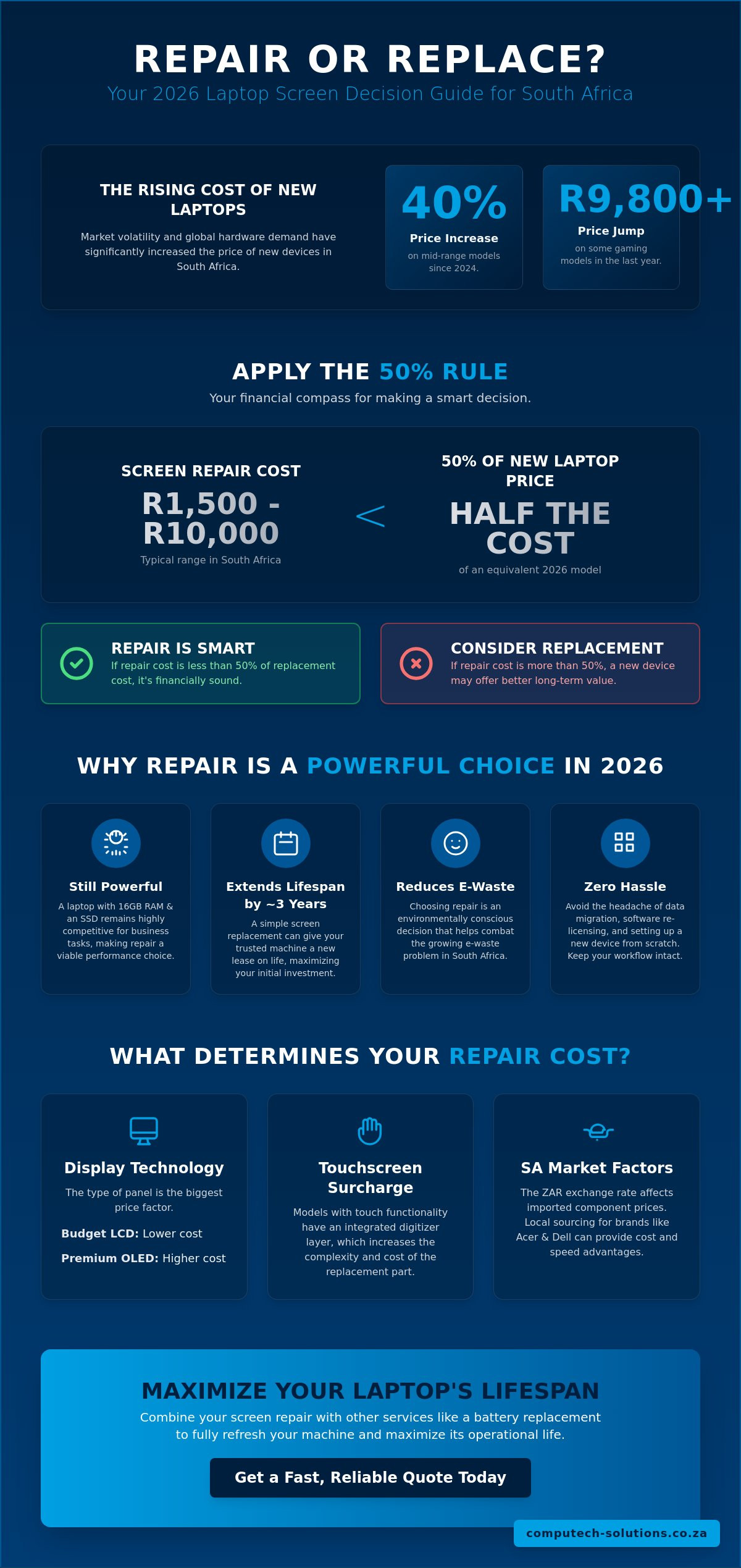
This guide provides the financial clarity you need to make a confident choice for your business or personal use. We’ll compare the current R1,500 to R10,000 repair price range against the rising costs of new hardware, which has seen some gaming models jump by over R9,800 in the last twelve months. You’ll learn how to distinguish between budget LCD and premium OLED panels while discovering why a simple screen replacement often extends your machine’s life for another three years. We’ll outline exactly when to invest in a new panel and when it’s time to browse our latest laptop inventory instead.
Key Takeaways
- Apply the 50% Rule to the 2026 South African market to determine if your device remains a financial asset or has become a liability.
- Learn why the modern tech baseline of 16GB RAM and SSDs makes repairing existing hardware a more sustainable choice than buying new.
- Identify how different display technologies and the touchscreen repair surcharge help you decide is it worth fixing a laptop screen 2026 for your specific model.
- Understand the impact of ZAR exchange rates on component pricing and the benefits of sourcing local replacement panels for brands like Acer and Dell.
- Discover the operational advantages of a one-stop-shop approach by combining screen repairs with battery replacements to maximize your laptop’s lifespan.
Understanding the Laptop Screen Repair Landscape in 2026
The hardware landscape has shifted significantly over the last few years. By May 2026, the performance gap between a three-year-old laptop and a brand-new entry-level model has narrowed for most business applications. If your current device features at least 16GB of RAM and a Solid State Drive (SSD), its core architecture remains highly competitive. This makes the question of is it worth fixing a laptop screen 2026 a matter of evaluating specific hardware health rather than just the age of the machine. Most users face common display failures like hairline cracks, dead pixel clusters, or backlight bleeding that obscures work without actually compromising the processor’s speed. Repairing these issues allows you to maintain a high-performing machine without the steep cost of a total replacement.
Choosing repair over replacement is also the most sustainable path. Every laptop saved from the scrap heap reduces e-waste, which is a growing concern in the South African tech sector. There is a significant psychological benefit too. You avoid the massive headache of data migration, software re-licensing, and the “new device” setup process that can steal a full day of productivity. Keeping your existing machine means your files, shortcuts, and settings stay exactly where you left them.
The True Cost of a Broken Screen
A cracked display is rarely just a cosmetic issue. Over time, pressure from a fractured glass layer can damage delicate internal ribbon cables or put undue stress on the hinges. In the South African business environment, downtime is expensive. Waiting several days for a new laptop delivery often outweighs the rapid turnaround of a professional screen replacement. Minor visual impairments can quickly escalate into total display failure, leaving you without a functional workstation at a critical moment. Acting early preserves the integrity of the internal components and prevents a simple fix from turning into a complex hardware failure.
Repair vs. Replace: The 2026 Tech Gap
While manufacturers continue to iterate on display technologies, the functional requirements for office productivity have plateaued. A high-end laptop from 2023 often outperforms a 2026 budget model in build quality and thermal management. If your device was a premium purchase, spending R3,000 on a new panel is objectively wiser than spending R15,000 on a lower-tier replacement that feels like a downgrade. While an external monitor serves as a temporary workaround, it lacks the mobility that South African professionals require. Choosing a repair ensures you keep the premium chassis and keyboard you already trust while significantly lowering your total cost of ownership.
The Financial Equation: When Fixing Makes Economic Sense
Deciding is it worth fixing a laptop screen 2026 requires a objective look at your device’s residual value versus the current South African retail market. With mid-range laptop prices expected to climb by 40% this year, a machine that cost R12,000 in 2024 might require a R19,000 investment to replace with an equivalent model today. This price surge, driven by the global AI hardware boom and volatile exchange rates, shifts the economic favor toward repair. Beyond the hardware cost, you must factor in hidden expenses like software license transfers and new peripherals. If your current setup relies on specific port configurations or legacy software, a screen repair preserves that entire ecosystem without additional spend.
The return on investment for a screen repair is often realized within six months of continued use. By extending the life of a capable machine for another 24 months, you effectively reduce your annual technology spend. Choosing to repair also aligns with corporate sustainability goals. Research from the University of Oxford highlights the massive environmental impact of manufacturing new laptops, noting that the majority of a device’s carbon footprint is generated before it even reaches the consumer. Repairing an existing asset is a fiscally responsible and environmentally conscious business decision.
The 50% Rule Explained for South Africans
The standard benchmark for IT departments is the 50% Rule. If a professional screen replacement costs less than half the price of a brand-new equivalent model, the repair is financially sound. In South Africa, budget screen repairs typically range from R1,500 to R3,000, while high-end gaming panels can reach R10,000 or more. For a premium gaming rig that retails for R45,000, even a R10,000 repair is a bargain. If you are unsure of your model’s current market value, you can consult with a technical advisor to get an accurate comparison of repair costs versus replacement stock.
Laptop Age and Component Health
Before committing to a fix, evaluate the secondary “wear” components of your device. A common strategy in 2026 is the “Battery and Screen” refresh; replacing a degraded battery alongside the LCD panel can make a three-year-old laptop feel brand new for a fraction of the cost of a replacement. As long as the motherboard shows no signs of thermal damage and the CPU meets the 16GB RAM baseline discussed earlier, the machine remains a viable asset. The sweet spot for screen repairs is generally for laptops between 2 and 5 years old, as these devices still possess enough processing power to handle modern operating systems efficiently.
Technical Complexity: LCD, OLED, and Touchscreen Factors
Technical specifications are the primary driver of repair costs and complexity in the current market. When asking is it worth fixing a laptop screen 2026, you must first identify whether you are dealing with a standard LED-backlit LCD or a premium OLED panel. Most business-grade laptops utilize IPS (In-Plane Switching) technology, which offers excellent color accuracy and viewing angles. These panels are generally affordable and widely stocked in South Africa. However, the hardware environment has become more segmented. Sourcing a standard 1080p (FHD) replacement is straightforward, but moving into 4K territory or specialized aspect ratios requires precise part matching to ensure the mounting brackets and connector pins align perfectly with your chassis.
The “Touchscreen Tax” remains a significant factor for modern ultrabooks. Unlike standard displays, touchscreen units often fuse the LCD and the digitizer glass into a single component. If you crack the outer glass, you usually have to replace the entire assembly. This complexity is why a repair for an HP Chromebook might sit around R1,500 to R2,500, while a high-end HP Spectre x360 with a 4K OLED touch display can range from R3,500 to R4,500. Understanding these hardware tiers helps you avoid overpaying for a panel that exceeds your device’s original specifications.
Identifying Your Screen Specifications
You don’t need to disassemble your laptop to find the correct parts. Tools like HWiNFO or checking the “Display” settings in Windows provide the resolution and refresh rate, but the most reliable method is looking up your specific model number on the manufacturer’s support page. Pay close attention to the pin configuration; most modern screens use either a 30-pin or a 40-pin eDP connector. A 40-pin connector is typically required for touchscreens or high-resolution displays. Choosing between a matte finish for glare reduction or a glossy finish for vibrant colors is often a matter of personal preference, provided the underlying technical specs match.
High-Refresh and Premium Displays
Gaming laptops have pushed display technology forward with refresh rates of 144Hz, 240Hz, or even higher. These panels require specialized controllers and are not interchangeable with standard 60Hz screens. Similarly, OLED displays offer unmatched contrast but are susceptible to burn-in over several years of heavy use. If your OLED screen shows permanent ghost images, a full replacement is the only solution. Because these premium panels are more sensitive to shipping damage, we rely on established national suppliers to ensure every replacement panel meets strict quality control standards before installation.
South African Market Realities: Exchange Rates and Stock
The South African economic climate dictates much of our technology strategy. With the Rand (ZAR) experiencing significant volatility against major currencies, the landed cost of new hardware has reached record highs in 2026. When you ask is it worth fixing a laptop screen 2026, you aren’t just looking at a repair bill; you’re looking at a hedge against inflation. Every imported component is subject to fluctuating exchange rates and high import duties, making the local price of a new laptop far more expensive than it was just twenty-four months ago. Repairing your current device allows you to bypass the massive retail markup on new units while retaining a machine that is already configured for your workflow.
Relying on local stock is the only way to ensure a secure and timely repair. International ordering often results in three-week delays and a high risk of receiving a damaged panel after multiple customs handovers. Local providers offer the benefit of technical support in your own time zone and provide nationwide delivery to ensure users in remote areas receive the same level of service as those in major population centers. This local supply chain stability is essential for businesses that cannot afford extended technical downtime.
Why New Laptops Are Getting More Expensive
In 2026, the hardware landscape is dominated by the high cost of AI-integrated components. These specialized chips have pushed the average price of a mainstream laptop to over R10,800. Many budget models released this year have sacrificed build quality to keep prices under the R10,000 mark, often featuring flimsy plastic chassis and fewer ports. Your 2023 or 2024 high-end unit likely possesses superior thermal management and a more durable frame than a 2026 budget replacement. Keeping your existing chassis means you don’t have to invest in new dongles or adapters to maintain your current peripheral setup.
The Benefit of National Sourcing
Sourcing your replacement panel from a reputable South African retailer protects you from the “Grey Market.” Unverified screens often lack the correct brightness levels and can even cause electrical shorts on your motherboard. By choosing a local partner, you ensure your repair is backed by a valid warranty and expert technical advice. If you are ready to restore your device’s display, browse our professional laptop LCD replacement panels to find a guaranteed match for your Acer, Dell, or HP model. This approach guarantees that the part you receive meets the exact electrical specifications of your original hardware, providing peace of mind and long-term reliability.
Choosing Your Path: How Computech-Solutions Streamlines Repairs
Computech-Solutions provides the hardware infrastructure necessary to act on your financial decision. If you’ve determined that is it worth fixing a laptop screen 2026 for your specific device, the next step is securing a high-quality, compatible component. We specialize in sourcing exact LCD replacement panels for the South African market, catering to both corporate IT departments and individual users. Unlike service-only providers, we offer a direct ecommerce solution for those who prefer DIY installation or have a trusted local technician. This approach reduces your total cost by removing the middleman and allowing you to pay only for the hardware you need.
Relying on a local supplier eliminates the risks associated with international shipping and customs delays. We maintain a robust inventory of panels and parts, ensuring that your technical downtime is measured in days rather than weeks. Our team understands the urgency of business operations and prioritizes rhythmic efficiency in our order fulfillment process. Whether you’re managing a fleet of corporate laptops or a single personal workstation, we provide the authoritative support needed to restore your display to its original factory standards.
Finding Your Replacement Panel
Our catalog includes specialized displays for major brands including Acer, Apple, ASUS, Dell, HP, and Lenovo. Finding the correct part number is critical for a successful repair. Using the Computech-Solutions search function for specific part numbers allows you to find an exact match for your hardware without guesswork. Our technical support team assists in identifying specific screen models based on your laptop’s serial number or original panel stickers. We provide high-grade generic replacement panels that undergo rigorous quality assurance testing. These panels offer a reliable, cost-effective alternative to expensive OEM-branded parts while maintaining the same resolution, brightness, and color accuracy standards required for professional work.
Beyond the Screen: Optimizing Your Device
A screen replacement is the ideal time to evaluate the secondary health of your machine. To truly maximize your investment in a new display, consider a “One-Stop-Shop” refresh. Pairing a new screen with one of our replacement batteries ensures your laptop regains its original mobility and performance. We stock batteries for Sony, Samsung, Toshiba, and other leading manufacturers to ensure your device remains unplugged for longer. This comprehensive approach transforms a simple repair into a complete hardware overhaul.
Stable power delivery is equally vital for the longevity of your new hardware. Using a damaged or low-quality charger can cause electrical spikes that damage your new LCD panel. We supply dedicated laptop chargers and adapters to provide the consistent voltage your hardware requires. With our nationwide delivery service, we ship these critical components to your door anywhere in South Africa, from major urban centers to rural outposts. Browse our full range of Laptop LCD Replacement Panels to start your restoration today.
Secure Your Hardware Investment for the Future
Navigating the current tech market requires a balance between performance and fiscal responsibility. You’ve seen how the 50% rule and rising hardware costs make repair a superior choice for devices with modern specifications. Whether you’re managing a fleet of business machines or a single gaming rig, the decision on is it worth fixing a laptop screen 2026 ultimately comes down to extending the life of a capable asset. By choosing a high-quality replacement panel, you bypass the inflation-driven price spikes of new inventory while maintaining your existing software environment.
Computech-Solutions acts as your trusted advisor in this process. We are specialists in Acer, Dell, and HP replacement parts, providing the expert technical support needed for precise hardware matching. Our infrastructure supports nationwide delivery across South Africa, ensuring your parts arrive safely regardless of your location. Find the perfect replacement screen for your laptop today and restore your device to peak performance. Your hardware still has years of productive life ahead.
Frequently Asked Questions
How much does it cost to fix a laptop screen in South Africa in 2026?
Repair costs in the current market generally range from R1,500 for entry-level models to over R10,000 for premium workstations. Most mid-range business laptops fall within the R2,500 to R5,000 bracket for a standard LED panel. These prices fluctuate based on the Rand’s performance and the specific display technology, such as OLED or high-refresh-rate gaming panels.
Is it worth fixing a laptop screen on an old laptop?
Repairing an older device is a sound investment if the machine is between 2 and 5 years old and features at least 16GB of RAM. If the repair cost is less than 50% of a new equivalent model, the fix is financially viable. When asking is it worth fixing a laptop screen 2026, remember that older premium chassis often offer better durability than the budget models currently retailing for under R10,000.
Can I replace my own laptop screen to save money?
You can replace your own screen to save approximately 50% on professional labor fees. This DIY approach is feasible for standard LCD panels but requires specialized plastic pry tools and precision screwdrivers. It’s important to disconnect the battery first to prevent short-circuiting the motherboard, a mistake that accounts for 20% of failed home repair attempts.
How long does a typical laptop screen replacement take?
A professional screen replacement usually takes between 24 and 48 hours if the part is locally available. The physical installation itself often requires less than 60 minutes of technical labor. Sourcing your panel from a national supplier ensures you avoid the three-week shipping delays associated with international imports.
Will a replacement screen look as good as the original?
A high-grade replacement panel will match the original’s color accuracy and brightness provided the specifications are identical. We provide panels that meet the exact NITs and contrast ratios required by manufacturers like Dell and HP. Using a panel with the wrong resolution or refresh rate will result in a noticeable downgrade in visual quality.
What happens if I don’t fix a cracked laptop screen?
Ignoring a cracked screen often leads to total display failure or damage to the internal video cables. Over time, the glass shards can shift and pierce the delicate layers of the LCD, causing permanent black spots. Small cracks also compromise the structural integrity of the lid, leading to hinge failure in roughly 15% of neglected cases.
Does fixing the screen void my laptop’s warranty?
Performing a screen replacement yourself will typically void the manufacturer’s warranty. Most screen damage occurs after the initial 12-month coverage has expired, making this less of a concern for older devices. Professional repairs from reputable providers usually include a separate warranty on the new part to ensure your hardware remains protected.
How do I know if I need a new screen or just a new cable?
Visible cracks or “ink” bleeds are definitive signs that you need a new panel. If your display flickers only when you move the laptop lid, the issue is likely a loose or worn eDP cable. Determining is it worth fixing a laptop screen 2026 starts with a diagnostic to ensure you aren’t replacing a functional panel when a simple cable adjustment would solve the problem.
