
What if the best time to invest in solar power solutions for load shedding south africa isn’t during a blackout, but while the grid is actually stable? Although the country has reached over 455 consecutive days without rolling power cuts as of August 2026, the financial pressure on households hasn’t eased. With electricity tariffs increasing by up to 9.01% this year, the primary motivation for going solar has shifted from surviving darkness to securing long term economic freedom.
It’s understandable to feel overwhelmed by technical jargon like Depth of Discharge or the risk of hiring inexperienced installers. You need a setup that protects your productivity and reduces your reliance on an expensive grid. This guide provides a clear roadmap to achieving energy independence with a system tailored for the South African market. We’ll examine how to balance storage capacity with conversion efficiency; ensuring your essential appliances stay powered and your monthly costs stay controlled throughout 2026 and beyond.
Key Takeaways
- Understand why integrated solar systems have replaced traditional generators as the primary method for maintaining productivity during various load shedding stages.
- Identify the core technical components, including hybrid inverters and LiFePO4 batteries, necessary to implement reliable solar power solutions for load shedding south africa.
- Learn how to perform a precise energy audit to ensure your system is sized correctly for essential “must-run” appliances and small office hardware.
- Recognize the importance of a Certificate of Compliance (CoC) and professional commissioning to protect your home insurance and system longevity.
- Discover how to access nationwide hardware delivery and expert technical support for a seamless transition to energy independence.
Understanding the Load Shedding Landscape in 2026
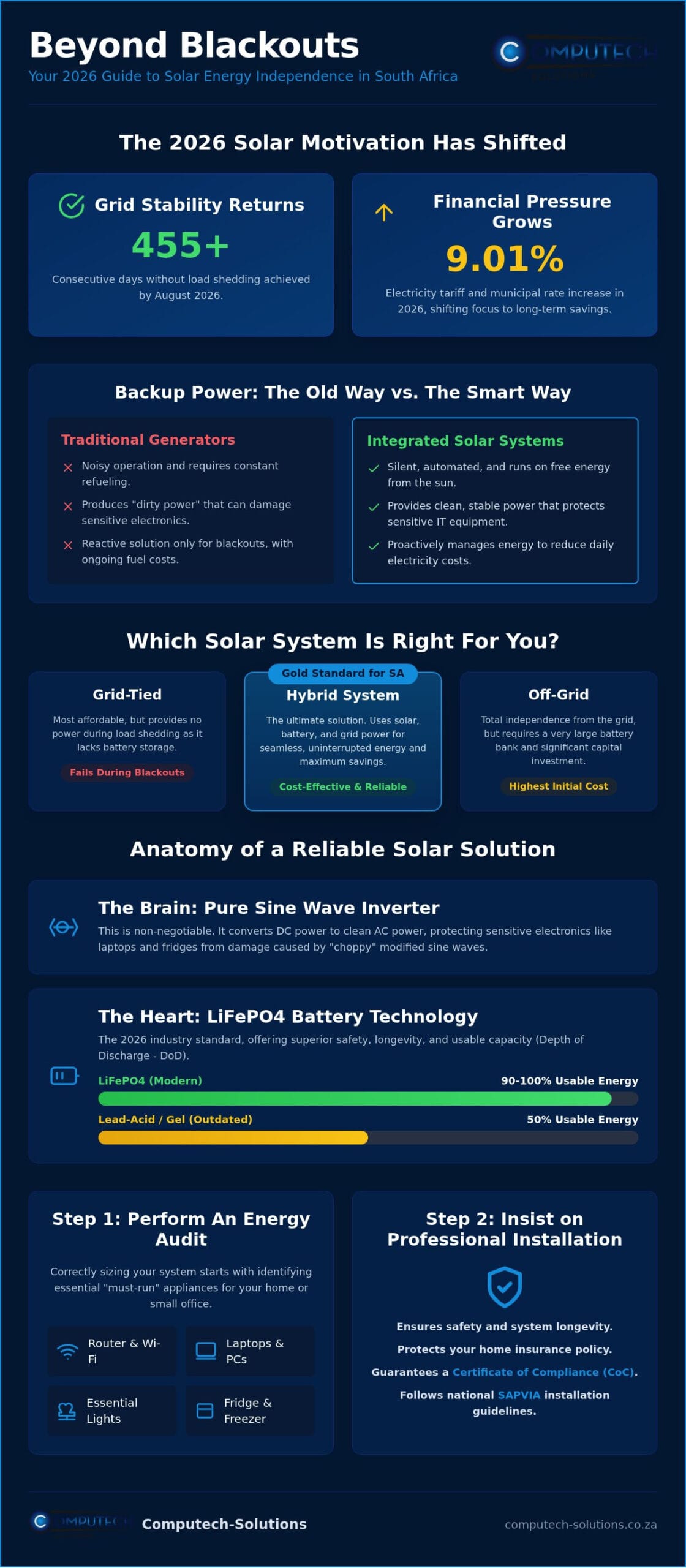
The South African energy crisis has fundamentally changed how we view power security. While the grid achieved over 455 days of stability by August 2026, the underlying infrastructure remains under pressure. This makes solar power solutions for load shedding south africa a strategic investment rather than a reactive purchase. Homeowners are no longer just looking for a way to keep the lights on; they’re looking for a way to hedge against Eskom’s 2026 tariff increases. With municipal rates rising by 9.01%, the long-term economic argument for self-generation is now stronger than the need for emergency backup.
Traditional backups like petrol generators are becoming obsolete for modern residential use. They’re noisy, require constant refueling, and provide “dirty” power that can harm delicate circuitry. An integrated solar solution is different. It consists of high-efficiency panels, a hybrid inverter, and lithium battery storage working in unison. This setup doesn’t just react to power cuts; it actively manages your energy consumption by prioritizing solar harvest during the day and battery discharge during peak tariff periods.
Grid-Tied vs. Off-Grid vs. Hybrid Systems
Choosing the right architecture determines your resilience. Grid-tied systems are the most affordable but fail during blackouts because they lack battery storage. Off-grid setups offer total independence but require massive capital for storage. Hybrid systems are the gold standard for South Africans. These systems allow you to remain connected to the grid for extra capacity while utilizing battery storage to maintain seamless operation during load shedding stages. It’s the most flexible approach for balancing cost and reliability.
The Role of Solar in Protecting Sensitive IT Equipment
Frequent power cycling is the primary cause of hardware failure in home offices. When the grid returns after a scheduled outage, voltage spikes often degrade laptop batteries and damage desktop power supplies. Implementing solar power solutions for load shedding south africa provides a consistent, regulated electrical flow. A professionally commissioned solar system serves as an advanced power filtration layer, isolating sensitive electronics from the volatile voltage fluctuations common on the national grid.
This stability is critical for preserving the lifespan of your workstations and servers. Modern lithium batteries, particularly those used in integrated solar setups, provide the steady discharge required for high-performance computing. By removing the stress of sudden shutdowns, you protect your digital assets and maintain productivity regardless of the grid’s status.
Core Components of a Reliable Solar Power Solution
Building a resilient energy system requires more than just mounting panels on a roof. High-quality hardware ensures that your solar power solutions for load shedding south africa remain operational for a decade or more. A reliable setup depends on four primary pillars:
- The Inverter: The central hub that converts DC power into usable AC electricity.
- Battery Storage: The reservoir that keeps your home running when the sun goes down or the grid fails.
- Charge Controllers: The regulators that manage the flow of energy into your battery bank.
Why Pure Sine Wave Inverters are Non-Negotiable
The inverter is the brain of your installation. It converts direct current (DC) from your batteries and panels into the alternating current (AC) your home uses. In 2026, pure sine wave inverters are the only viable choice for modern households. Modified sine wave inverters produce “choppy” power that creates heat and harmonic distortion. This distortion can permanently damage laptop chargers, cause flickering in laptop LCD replacement panels, and lead to premature failure in fridge motors. When sizing your unit, look at the actual Wattage rating instead of just the kVA figure. This ensures the system can handle the high startup surge of appliances without tripping.
Battery Technology: Depth of Discharge and Cycle Life
Lithium Iron Phosphate (LiFePO4) has officially replaced Gel and Lead-Acid as the industry standard for 2026. This shift is driven by Depth of Discharge (DoD) and Cycle Life. Older battery technologies could only be discharged by 50% before sustaining internal damage. In contrast, LiFePO4 batteries allow for up to 90% or 100% discharge, giving you more usable power from a smaller footprint. Following SAPVIA Solar PV Installation Guidelines ensures your battery bank is safely integrated with a Battery Management System (BMS). A BMS is essential; it regulates cell voltage and temperature, preventing the thermal issues that plagued earlier backup systems.
Solar panel choice also impacts your long-term harvest. Mono-crystalline panels are preferred in South Africa because of their superior efficiency in high-temperature environments. When paired with a Maximum Power Point Tracking (MPPT) charge controller, you can maximize energy production even on overcast days. This technical synergy is what keeps your desktop computers and servers running during extended outages. If you need help selecting the right hardware for an IT-heavy setup, you can chat with our technical support team for expert guidance on component compatibility.
Sizing Your System for South African Households
Accuracy in sizing is the difference between a system that provides peace of mind and one that trips the moment you turn on a light. To choose effective solar power solutions for load shedding south africa, you must begin with a rigorous energy audit. This process involves listing every “must-run” appliance and calculating their combined wattage. For most households, the goal is to survive a Stage 4 outage, which typically requires four hours of continuous battery support. If your essential load includes a fridge, Wi-Fi, and a home office setup, your baseline consumption might sit around 500W to 800W per hour.
To calculate your required battery capacity, multiply your hourly consumption by the duration of the outage. For a four-hour window at an 800W draw, you need at least 3.2kWh of usable battery storage. However, it’s wise to include a 20% safety margin to account for efficiency losses and unexpected spikes. This ensures your desktop computers and security systems remain active even during the longest scheduled blackouts. If you’re running multiple laptops or high-end workstations, the stability provided by a correctly sized system prevents the data loss associated with sudden power failures.
Appliance Power Consumption Reference
Managing your load is just as important as the hardware itself. High-draw appliances like kettles, geysers, and ovens can pull between 2,000W and 3,000W instantly, which can overwhelm a standard residential inverter. In contrast, modern IT hardware and LED lighting are remarkably efficient; a laptop typically draws only 60W to 90W. The maximum concurrent power draw of your essential appliances dictates the required kilowatt rating of your inverter to prevent overload during startup. By shifting heavy tasks to times when the sun is at its peak, you can preserve your battery for the evening hours.
Scaling Your System Over Time
You don’t need to install a massive array on day one. Many South Africans find success by starting with a modular hybrid inverter and a single lithium battery bank. This initial setup functions as a sophisticated UPS, protecting your equipment from grid instability. As your budget allows, you can add solar panels to move from simple backup to active generation. When expanding, ensure that new components are compatible with your existing hardware generations. Professional commissioning is vital during these upgrades to ensure the Battery Management System communicates correctly with the inverter, maintaining the longevity of your investment.
Professional Installation and National Safety Standards
A successful solar power solutions for load shedding south africa installation relies on strict compliance with national safety standards. In South Africa, the most critical document is the Certificate of Compliance (CoC). This isn’t just a suggestion; it’s a legal requirement under SANS 10142-1. A registered electrician must sign off on the installation to ensure it meets grid safety protocols and surge protection standards. Without a valid CoC, you face significant financial risk. Most home insurance providers will void your policy if a fire or electrical surge occurs on a system that hasn’t been professionally certified.
Registration with NERSA or your local municipality is another mandatory step for grid-connected systems. As of 2026, the process has become more streamlined to encourage adoption. Eskom has waived registration and connection fees for residential systems up to 50kVA until March 31, 2026. This initiative helps manage the national grid’s stability by ensuring all private generation is accounted for. Beyond paperwork, physical safety is paramount. Your array must include specialized grounding and lightning protection. South Africa’s high lightning frequency can easily destroy an unprotected inverter or battery bank, making these safety components essential for protecting your investment.
The Commissioning Process
Professional commissioning is where the hardware is fine-tuned to your specific needs. This involves configuring the inverter with the correct battery charge profiles to match the manufacturer’s specifications. For those working from home, the switch-over speed is a vital setting. A professionally commissioned system operates in a high-speed UPS mode; this ensures that your desktop computers and routers don’t restart when the grid drops away. Final testing includes simulating a power failure to verify that the system handles the essential load without interruption and provides a seamless transition for your electronics.
Maintenance for Long-Term Reliability
Maintenance ensures your system continues to perform at its peak for years to come. Dust and pollution can reduce solar panel efficiency by up to 25% in certain South African climates, so regular cleaning is necessary. You should also ensure your smart inverter receives periodic firmware updates. These updates often improve energy management algorithms and fix security vulnerabilities in monitoring apps. An annual inspection by a professional is recommended to check for loose electrical connections or cable degradation caused by UV exposure. If you aren’t sure if your current setup meets these 2026 standards, you can book a professional commissioning service to verify your system’s safety and performance.
Implementing Your Solar Solution with Computech-Solutions
Accessing the right hardware is simplified through our national online retail platform. We specialize in high-quality components designed specifically for residential and small office setups. Because we maintain a nationwide delivery network, clients across South Africa can receive inverters and battery backup systems directly at their doorstep. This logistical efficiency is paired with expert technical support, ensuring that your transition to solar is managed by professionals who understand both the electrical and IT requirements of a modern home office.
Our background in computer hardware provides a unique advantage when designing power systems. We don’t just see a battery; we see the lifeline for your desktop computers and laptops. Frequent power fluctuations can degrade hardware quickly. Because we sell specialized replacement parts like Apple, Lenovo, and HP replacement laptop batteries, we understand exactly how volatile grid power affects internal components. This perspective allows us to prioritize stable voltage and rapid switch-over speeds during the commissioning process.
We offer a total solution for operational continuity. If your current backup system has already taken a toll on your mobile devices, we provide the necessary laptop chargers and adapters to restore your mobility. Our expertise in laptop LCD replacement panels and internal hardware means we are uniquely positioned to protect your digital assets. We ensure that your solar installation isn’t just a backup, but a sophisticated shield for your entire technology stack.
Getting Started with Your Solar Journey
The path to energy independence begins with a precise understanding of your consumption patterns. Our technical team assists in sizing your hardware needs to ensure you don’t over-invest in unnecessary capacity or under-invest and face system trips. Once your requirements are defined, you can order your components with the confidence of reliable national shipping. Professional commissioning follows, ensuring your smart inverter is tuned for the specific battery chemistry you’ve selected.
Contact Computech-Solutions today for a professional solar assessment to begin building a resilient power environment. Our team is ready to help you navigate the technical complexities of solar power solutions for load shedding south africa, providing the stability you need to maintain productivity regardless of the grid’s status.
Securing Your Energy Future in 2026
Achieving energy independence in the current economic climate is about more than just avoiding blackouts; it’s about protecting your financial future and your technology. By choosing high-quality solar power solutions for load shedding south africa, you transition from a consumer at the mercy of rising tariffs to a self-sufficient producer. Success depends on selecting the right core components, like LiFePO4 batteries and pure sine wave inverters, and ensuring every installation meets national safety standards through a valid Certificate of Compliance.
Computech-Solutions provides the technical bridge between power infrastructure and sensitive IT hardware. We offer nationwide delivery across South Africa and expert technical support for power and IT integration to ensure your system performs optimally. Our professional commissioning services maximize your system’s lifespan and safeguard your operational continuity. Don’t let grid instability or rising costs dictate your productivity or your budget. The stability you need for your home and office is well within reach.
Explore our Solar Power Solutions and Professional Installation Services to start your journey toward reliable, cost-effective energy today. Our team is ready to help you build a resilient power environment that supports your growth for years to come.
Frequently Asked Questions
Is solar power cheaper than running a petrol generator in South Africa?
Solar is significantly cheaper over its operational lifespan because it eliminates ongoing fuel costs and frequent mechanical servicing. While a generator requires constant petrol or diesel purchases, solar power solutions for load shedding south africa utilize free energy from the sun. The initial capital outlay is higher, but the long term savings and lack of noise pollution make it the superior financial choice for modern households.
Can I run my whole house on solar during load shedding?
You can run your entire home on solar if the inverter and battery bank are sized correctly to handle your peak load. Most residential setups focus on essential circuits like lighting, Wi-Fi, and refrigeration to manage costs. Running high draw appliances like geysers or ovens requires a much larger system. A professional energy audit is necessary to determine the exact hardware required for full grid independence.
How long do lithium solar batteries last with daily load shedding?
Modern Lithium Iron Phosphate (LiFePO4) batteries typically last between 10 and 15 years, even when cycled daily. These units are generally rated for 4,000 to 6,000 cycles before their capacity reduces to 80% of the original rating. Unlike older lead acid technology, lithium batteries handle deep discharges efficiently. This longevity ensures your investment remains viable through years of grid instability while protecting sensitive electronics like desktop computers.
Do I need permission from the municipality to install solar panels?
All grid tied and hybrid solar installations must be registered with your local municipality or Eskom to ensure grid safety. This process confirms that your system won’t feed electricity back into the grid dangerously during maintenance. As of 2026, Eskom has simplified this process for residential systems under 50kVA. You must also obtain a Certificate of Compliance (CoC) from a registered electrician to satisfy legal and insurance requirements.
What happens to my solar system when the grid comes back on?
Your hybrid inverter automatically detects the return of grid power and manages the transition without any manual intervention. It will prioritize charging your battery bank if it was depleted while simultaneously powering your home’s load. The system also synchronizes with the grid to supplement solar production if your current demand exceeds what the panels are producing. This switching happens in milliseconds, preventing any disruption to your laptops or workstations.
Can I install solar panels myself to save on costs?
While mounting panels is possible for a DIY enthusiast, the electrical integration must be performed by a qualified professional. South African law requires a registered electrician to issue a Certificate of Compliance for the installation to be legally recognized. Attempting a DIY electrical setup can void your home insurance and manufacturer warranties on expensive components. Professional commissioning is essential to ensure the system operates safely and achieves maximum efficiency.
How many solar panels do I need to charge a 5kWh battery?
You typically need between four and six 550W solar panels to fully charge a 5kWh battery within five hours of peak sunlight. This calculation accounts for system efficiency losses and varying weather conditions. Sizing your array correctly ensures that your solar power solutions for load shedding south africa can replenish storage even on shorter winter days. This balance is critical for maintaining backup readiness for evening load shedding stages.
Will solar power work on cloudy days in South Africa?
Solar panels continue to generate electricity on cloudy days, although their output is reduced to approximately 10% or 25% of their rated capacity. Modern mono crystalline panels are designed to capture a broader spectrum of light, which improves performance in overcast conditions. During these periods, your system will rely more heavily on its stored battery power or the grid. A well designed system accounts for these fluctuations to keep your essential appliances operational.
