
While national load shedding has been suspended for over 392 consecutive days, localized load reduction in over 84 Gauteng areas proves that your home’s energy independence remains a critical operational priority. You’re likely asking, “what size inverter do I need for my home SA” to ensure your desktop computers and laptops stay powered during peak demand hours. Selecting the wrong capacity often leads to two expensive outcomes: overspending on a system that’s too large or experiencing total system failure when you need it most.
We understand the anxiety of choosing between complex hybrid and string inverter brands while trying to avoid unnecessary costs. This guide helps you master the exact calculation of your home’s power needs so you can select a reliable backup solution that protects your sensitive IT infrastructure. You’ll learn how to determine the perfect capacity for your specific equipment and how to align your system with the mandatory SSEG registration standards to avoid the R6,052 fine and potential grid disconnection. By the end of this article, you’ll have a clear, data-driven path to securing stable power for your home.
Key Takeaways
- Identify your essential peak power loads by applying the “Simultaneous Use” rule to prevent system trips without over-investing in unnecessary capacity.
- Discover why the 5kW hybrid model is the standard for most households and accurately answer “what size inverter do I need for my home SA” based on your specific appliance mix.
- Factor in inverter efficiency ratings and idle-consumption levels to ensure your backup system provides enough usable wattage for sensitive desktop computers and laptops.
- Ensure long-term reliability and warranty compliance by prioritizing professional commissioning and sourcing high-quality replacement parts for your power-dependent devices.
Understanding Inverter Capacity in the South African Context
The inverter serves as the central hub of your home’s energy resilience. While many people view it simply as a device that changes battery power into usable electricity, its role is far more sophisticated. A high-quality unit acts as a gateway, managing the transition between the national grid and your stored energy while filtering out voltage spikes that can destroy sensitive electronics. To understand the technology better, you can explore the technical foundations of What is a Power Inverter? and how it stabilizes current for residential use.
By 2026 standards, South African homeowners must prioritize Pure Sine Wave technology. Unlike cheaper modified sine wave alternatives, Pure Sine Wave inverters produce electricity that is identical to, or cleaner than, the power provided by the grid. This is non-negotiable if you intend to power desktop computers, high-end laptops, or specialized chargers. Using an inferior wave type can cause overheating in power supplies and permanent flickering in LCD panels. When asking “what size inverter do I need for my home SA,” you’re not just looking for a wattage number; you’re looking for the capacity to maintain this clean signal under pressure.
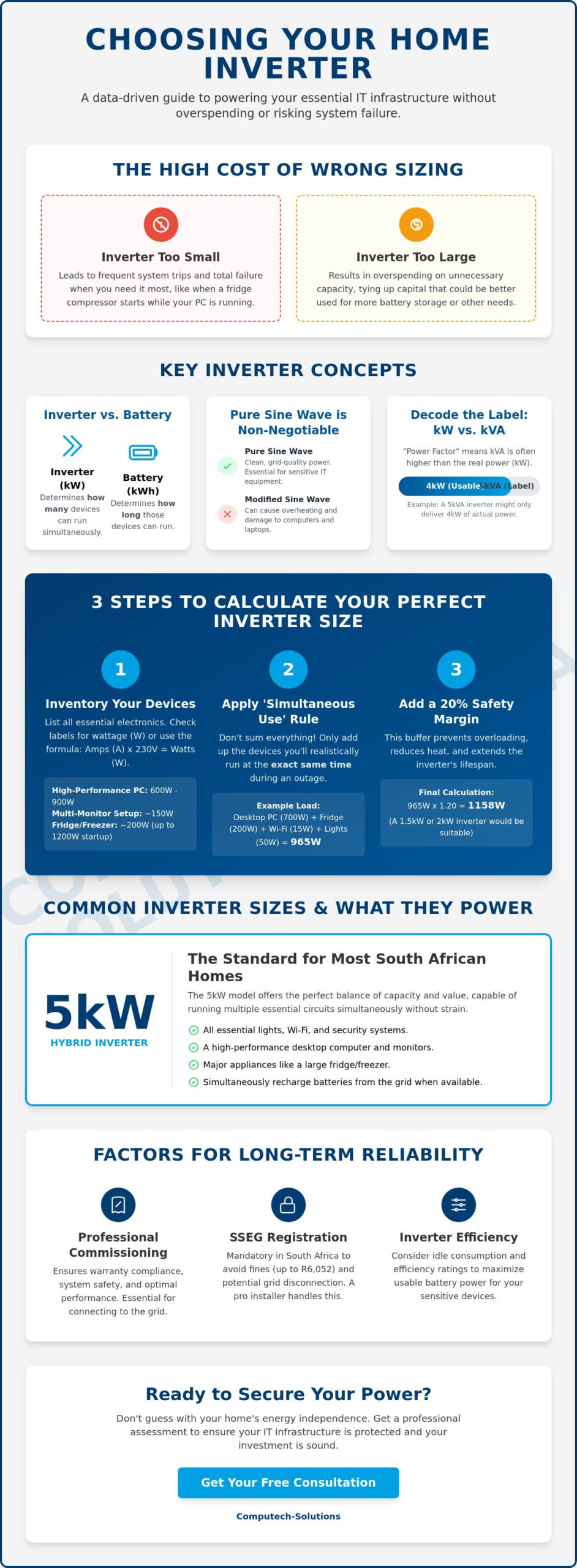
It’s also vital to distinguish between your inverter size (kW) and your battery storage (kWh). The inverter size determines how many appliances you can run at the exact same moment. The battery storage determines how many hours those appliances will stay on. If your inverter is too small, the system will trip the moment your fridge compressor kicks in while you’re working on your PC. If your battery is too small, even a massive inverter will leave you in the dark after an hour of use.
kW vs. kVA: Deciphering the Labels
You’ll often see inverters labeled in kVA (Kilo-Volt-Amperes). This can be misleading because of the “Power Factor,” which is the efficiency ratio of the device. In many older models, a 5kVA inverter only provides 4kW of actual power. Modern South African units are increasingly rated in true kW to simplify the planning process. Always check the data sheet for the real wattage output to ensure your desktop computers don’t exceed the system’s sustained limit.
Why Load Shedding Stages Influence Your Sizing Strategy
Even with national load shedding suspended, localized load reduction and potential Stage 6 scenarios require a strategic buffer. When outages occur multiple times a day, your inverter must be large enough to handle the “charging load” alongside your household needs. A smaller inverter might struggle to recharge your batteries fast enough before the next scheduled outage. Determining what size inverter do I need for my home SA involves calculating a minimum capacity that prevents your batteries from discharging too deeply, which preserves their lifespan and ensures you have a reserve for unexpected grid failures.
Step-by-Step: Calculating Your Total and Peak Power Loads
Determining what size inverter do I need for my home SA starts with a precise inventory of your electronics. You don’t need professional tools for this; simply check the silver or white stickers on the back of your devices. These labels list the maximum wattage or amperage. If only amps are listed, multiply that figure by 230, the standard South African voltage, to find the watts. For items without clear labels, this appliance power consumption chart provides reliable estimates for common household goods.
Modern home offices and gaming setups in 2026 demand more calculation precision than traditional appliance lists offer. A high-performance desktop computer equipped with a 2026-era GPU can pull between 600W and 900W under load. Multi-monitor configurations and high-refresh-rate displays add another 150W to that total. If your current hardware is aging and inefficient, upgrading to modern, energy-efficient desktop computers can significantly lower your total load and extend your battery runtime during outages.
The ‘Simultaneous Use’ rule is your best tool to avoid overspending. You don’t need to sum every appliance in your house. Instead, identify the maximum number of items you’ll realistically operate at the same time, such as your fridge, Wi-Fi router, and two laptops. Once you have this total, apply a 20% safety margin. This buffer prevents the inverter from running at its absolute limit, which generates excess heat and shortens the lifespan of the system’s internal capacitors.
Essential vs. Non-Essential Circuit Split
Effective sizing requires categorizing your home’s electricity needs. Essential loads typically include lights, security systems, and refrigeration. Non-essential items like geysers, underfloor heating, and electric ovens draw far too much current for standard residential backup systems and should stay on the grid-only side of your distribution board. The DB board split serves as the foundation of South African backup design. This physical separation ensures your inverter remains stable by only powering critical circuits when the grid fails.
Managing Surge Power: The ‘Start-up’ Trap
Wattage isn’t always a steady number. Inductive loads, which include anything with a motor like fridges, pumps, or gate motors, require a massive burst of energy to start up. This is often called the ‘3x rule’ because a 150W fridge compressor might need 450W for a fraction of a second to engage. When finalizing what size inverter do I need for my home SA, ensure the unit’s ‘peak’ or ‘surge’ rating can comfortably accommodate these brief but powerful bursts without triggering a system shutdown.
Common Inverter Sizes and What They Actually Power
Once you’ve calculated your peak loads, you must select an inverter tier that handles your maximum simultaneous demand. Inverters are generally categorized into four main sizes in the South African market. Selecting the correct one prevents the system from tripping when your household activity peaks. To accurately estimate your energy usage, you must categorize your appliances by their operational frequency and power draw.
- 3kW Entry-Level: This size is perfect for small apartments or dedicated “Work from Home” setups. It comfortably powers a router, two laptops, a few LED lights, and a TV. It isn’t designed for kitchen appliances or multiple fridges.
- 5kW Standard: This is the most popular choice for the average South African household. It provides enough capacity for essential electronics and refrigeration while allowing for some flexibility.
- 8kW Powerhouse: If you have a larger home with two or more fridges, a deep freezer, and an extensive outdoor security lighting system, an 8kW unit offers the necessary headroom.
- 12kW+ Industrial-Grade: These units are for large-scale residential properties or those aiming for complete off-grid independence. They can handle multiple high-draw zones simultaneously.
When asking “what size inverter do I need for my home SA,” most users find their answer within the 5kW to 8kW range. This provides a balance between cost-efficiency and operational reliability during localized load reduction events.
The 5kW Inverter: A Deep Dive into SA’s Most Popular Size
The 5kW hybrid inverter is the “sweet spot” because it manages a typical load profile of one TV, Wi-Fi, 20 LED lights, and two fridges with ease. However, you must respect the “one-at-a-time” rule. While a 5kW system can technically run a microwave (1500W) or a kettle (2000W), it cannot run both at the same time if your fridges are also active. Exceeding the 5000W limit will trigger an overload protection shutdown, leaving you in the dark until the system is manually reset.
Powering High-End IT and Gaming Hardware
High-end IT equipment requires a stable, high-capacity output that doesn’t fluctuate. Gaming PCs with modern power supplies and servers with redundant components pull significant wattage that stays constant, unlike the intermittent cycling of a fridge. If you’re running a multi-monitor setup or a home lab, your inverter must be sized to handle this continuous drain without overheating. At Computech-Solutions, we’ve seen how unstable power or under-sized inverters can damage sensitive components. Protecting your high-resolution displays is critical; if an unstable system causes a failure, sourcing quality Laptop LCD Replacement Panels becomes an avoidable expense. Always ensure your inverter’s Pure Sine Wave output is rated for at least 30% more than your IT rack’s maximum draw to account for heat and efficiency losses.
Critical Factors Beyond the Wattage Number
Selecting the right capacity is only the first step in securing your home’s energy future. When determining what size inverter do I need for my home SA, you must look past the face-value wattage and evaluate how efficiently that power is delivered. Most modern inverters operate at roughly 90% to 95% efficiency. This means a 5kW unit might only provide 4500W of usable continuous power after internal conversion losses. If you run your system at its absolute ceiling, you risk overheating the internal components and triggering safety shutdowns.
Idle consumption is another technical detail that impacts your daily performance. Every inverter requires a small amount of electricity just to remain powered on. In a large 12kW system, this “vampire drain” can be significant. If your primary goal is simply keeping a router and a few LED lights active during localized load reduction, an oversized inverter might waste more energy in self-consumption than it delivers to your devices. Always match the scale of the hardware to your actual operational requirements to maximize your battery runtime.
Physical installation environment and electrical phase also dictate your choice. Most South African residential properties use single-phase power, but larger estates often require three-phase inverters to balance the load across multiple circuits. Additionally, check the Ingress Protection (IP) rating of your unit. An IP20-rated inverter must stay in a clean, dust-free indoor environment, while an IP65 rating allows for installation in more exposed areas like a garage or a covered outdoor passage. Proper placement ensures the cooling fans remain unobstructed and functional over the long term.
Battery Compatibility and C-Ratings
In 2026, the industry has standardized on Lithium Iron Phosphate (LiFePO4) chemistry due to its superior lifespan and safety. However, your inverter and battery must “talk” to each other through a dedicated Battery Management System (BMS). Without this digital communication, the inverter cannot accurately monitor the state of charge, which leads to inefficient cycling. You must also consider the C-rating of your battery. A battery with a low 0.5C rating cannot provide the high current levels that a large inverter might demand during a surge, even if the total capacity seems sufficient.
Future-Proofing for Solar and Expansion
Investing in a hybrid inverter is the most cost-effective strategy for long-term growth. Unlike simple battery-only units, hybrid models include built-in MPPT charge controllers that allow you to add solar panels later without replacing your core hardware. Many high-quality brands also support “paralleling.” This feature enables you to link a second identical inverter to your system if your household power needs grow. While your home system handles the heavy lifting, ensure your mobile hardware is equally prepared by sourcing high-quality replacement laptop batteries to maintain productivity when you’re away from your backup hub.
Implementing Your Total Power Solution with Computech-Solutions
Calculating what size inverter do I need for my home SA is the foundation of a reliable backup system, but the physical implementation requires a focus on long-term reliability. Professional commissioning is vital for more than just performance; it’s a requirement for insurance validation and warranty protection. An expert installer ensures that your grounding is correct and that your inverter’s settings align with your battery’s specific discharge protocols. This level of precision protects your home’s infrastructure and the sensitive Desktop Computers that rely on it for steady current.
We view energy independence as a comprehensive service model. A robust inverter system is only as useful as the devices it powers. As your home transitions toward self-generation, maintaining your portable hardware becomes a priority. Computech-Solutions facilitates this by offering high-quality generic and brand-name replacement parts for all major manufacturers. Our nationwide delivery service ensures that you have access to HP Replacement Laptop Batteries or Lenovo Replacement Laptop Batteries within days, allowing you to maintain productivity even if localized load reduction affects your area.
Expert Technical Support and Reliability
Managing a household with multiple high-draw IT setups requires more than basic electrical knowledge. We offer the technical expertise needed to ensure your power electronics don’t just work, but thrive. Total solution modeling involves looking at everything from your central inverter capacity to the health of your Laptop Chargers. High-quality power electronics prevent the subtle voltage fluctuations that cause hardware fatigue over time. By sourcing reliable Samsung Replacement Laptop Batteries or Toshiba Replacement Laptop Batteries, you ensure that your hardware remains as resilient as your power supply.
Next Steps: From Calculation to Commissioning
Before moving forward, review your simultaneous load calculations one last time. Confirm that your inverter choice accounts for the 20% safety margin and the specific surge requirements of your inductive loads. Once your sizing is verified, consult with a professional installer to ensure your system meets the March 2026 SSEG registration deadline. Taking these steps now prevents fines and ensures your backup system remains a definitive, total solution for your home. You can Browse our range of power solutions at Computech-Solutions to find the essential hardware and replacement components that support your move toward energy stability.
Take Control of Your Home’s Energy Future
Finding the definitive answer to what size inverter do I need for my home SA requires balancing your peak appliance usage with the technical demands of your sensitive electronics. You’ve learned that sizing isn’t just about total wattage; it’s about managing simultaneous surges while ensuring your system remains compliant with 2026 SSEG registration standards. By prioritizing Pure Sine Wave technology and professional commissioning, you protect your investment and your hardware from the risks of localized load reduction and grid instability.
At Computech-Solutions, we provide the expert technical support needed to integrate your IT infrastructure with robust power solutions. Our nationwide delivery across South Africa ensures you receive the high-quality components and replacement parts required to maintain a seamless operation. Whether you’re upgrading your home office or securing a large-scale residential property, we deliver the stability and confidence your household deserves. Take the final step toward energy independence and operational efficiency today.
Secure your home’s power today with Computech-Solutions and experience the peace of mind that comes with a professionally tailored backup system.
Frequently Asked Questions
Can a 5kW inverter run a whole house in South Africa?
A 5kW system cannot typically power an entire South African household if you include high-wattage appliances like geysers or stoves. It’s designed to manage essential circuits, including lighting, refrigeration, and home office equipment. When determining what size inverter do I need for my home SA, remember that a 5kW unit is the standard for critical load backup but requires physical separation at the distribution board to prevent accidental overloads.
What is the difference between a hybrid inverter and an off-grid inverter?
Hybrid inverters manage power from the grid, solar panels, and batteries simultaneously, allowing you to export excess energy or supplement grid power. Off-grid inverters operate entirely independently of the national grid and cannot feed power back or use the grid as a secondary source. Hybrids are the preferred choice for South African homes because they provide seamless transitions during localized load reduction while maintaining grid connectivity for battery charging.
How many batteries do I need for a 5kW inverter during Stage 4 load shedding?
For a 5kW inverter during Stage 4 load shedding, you typically need at least 5kWh to 10kWh of lithium storage to cover 4-hour outages. This capacity ensures you don’t discharge your batteries too deeply, which preserves their operational lifespan. If you’re running high-performance desktop computers or multiple laptops, aim for the higher end of that range to maintain a sufficient safety buffer until the grid returns.
Can I run my geyser on an 8kW inverter?
You can technically run a geyser on an 8kW inverter, as most residential geyser elements draw between 2kW and 3kW. However, this is generally discouraged because it rapidly depletes your battery reserves. A single geyser cycle can consume a significant portion of your stored energy, leaving little for critical electronics. It’s more efficient to use a dedicated solar geyser or a timer to heat water while the grid is active.
What happens if I overload my inverter?
If you exceed the inverter’s rated capacity, the unit will trigger an internal safety shutdown to prevent circuit damage. You’ll lose power to all connected devices until you reduce the load and manually reset the system. Understanding what size inverter do I need for my home SA helps you avoid these trips by ensuring your peak simultaneous demand never exceeds the inverter’s continuous output limit during localized power outages.
Is it cheaper to run an inverter or a generator in 2026?
In 2026, running an inverter system is significantly more cost-effective than using a petrol or diesel generator. While the initial hardware investment is higher, inverters have much lower operational costs because they don’t require expensive fuel or frequent mechanical servicing. Additionally, inverters provide the clean Pure Sine Wave power necessary for sensitive laptops and LCD panels, which can be damaged by the unstable power often produced by budget generators.
Do I need a certificate of compliance (CoC) for my inverter installation?
Yes, a valid Certificate of Compliance (CoC) is a legal requirement for any fixed inverter installation in South Africa. This document confirms that the installation meets national safety standards and was performed by a qualified electrician. Without a CoC, you’ll likely face challenges with insurance claims in the event of a fire or electrical surge, and you won’t be able to legally register your system as required by the 2026 SSEG regulations.
Can I mix different battery brands with my inverter?
You shouldn’t mix different battery brands or even different models from the same manufacturer. Successful operation depends on the Battery Management System (BMS) communicating accurately with the inverter. Mixing batteries leads to unbalanced charging and discharging cycles, which can permanently damage the cells. To ensure system stability, always use identical battery units that are specifically certified to communicate with your chosen inverter brand.
