
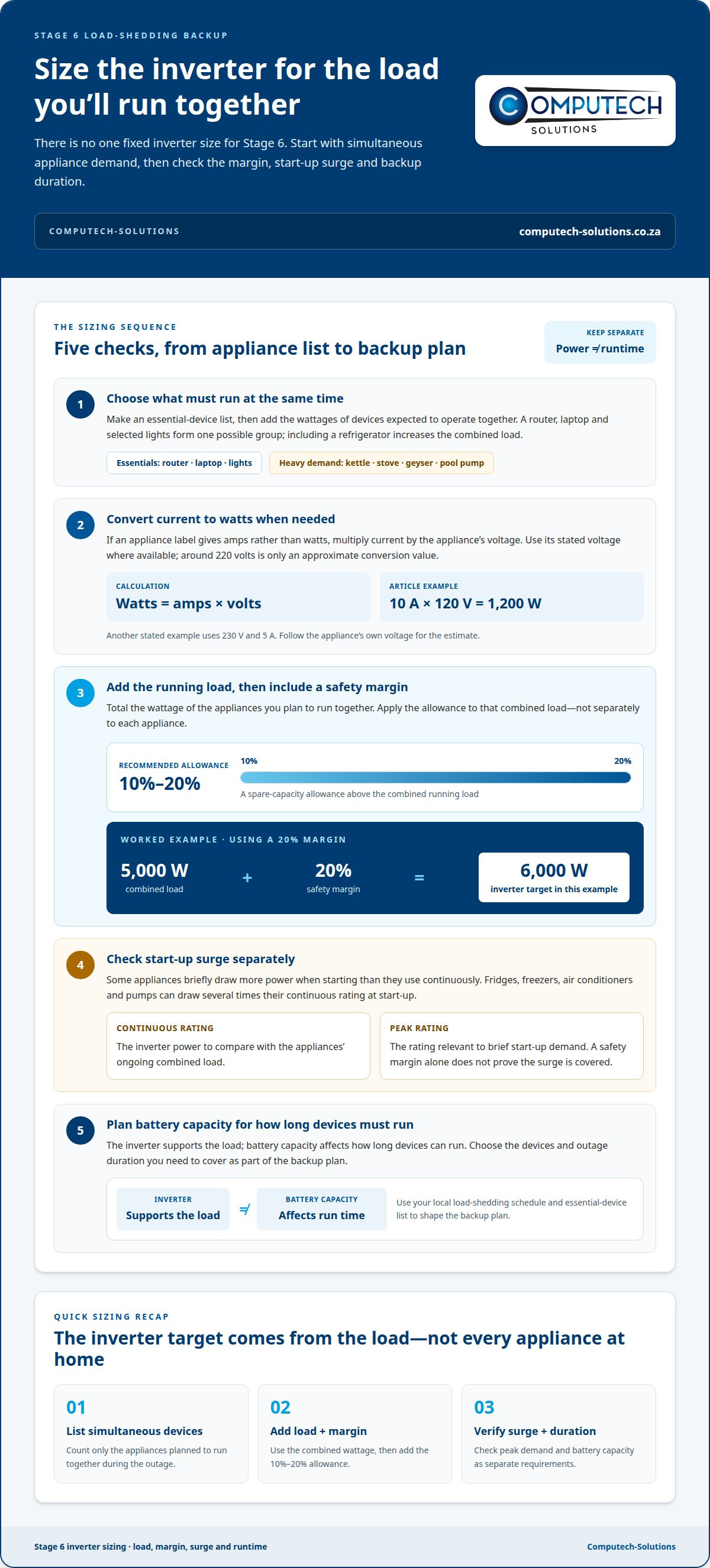
Stage 6 doesn’t call for one fixed inverter size. To work out what size inverter you need for Stage 6 load shedding, add the wattage of the appliances you want to run at the same time, then allow a 10% to 20% safety margin. For example, a combined load of 5,000 watts points to a 6,000-watt inverter when you use a 20% margin.
Choosing an inverter based only on total running wattage can leave too little capacity for appliances that draw extra power at start-up. The right setup also depends on which devices you need during an outage and how long they must run.
This guide shows how to calculate appliance loads, account for start-up surges and include a practical margin. You’ll also learn how continuous and peak ratings differ, and how battery capacity affects backup time, so you can choose a size based on your household’s needs rather than guess.
Key Takeaways
- Base inverter capacity on the appliances you plan to run together, using their wattage or converting current to watts where needed.
- Add a 10% to 20% safety margin to the combined load to leave room for variation in demand.
- Separate inverter power from battery capacity: the inverter supports the load, while battery capacity affects how long devices can run.
- Allow for start-up surges, as fridges, freezers, air conditioners and pumps can draw several times their continuous rating when they start.
- Use your local load-shedding schedule and essential-device list to shape a backup plan that suits your household’s needs.
Calculating inverter capacity from appliance power or current
To answer “what size inverter do I need for Stage 6 load shedding?”, start with the appliances you need during an outage. Add their power requirements, then separate essential devices from heavy-duty appliances before estimating capacity. The result represents the load your inverter must support, not necessarily every appliance in your home.
Appliance Power and Current Calculations
Appliance power is measured in watts, while electrical current is measured in amps. If a label lists amps instead of watts, multiply amps by volts to estimate power. This gives you a common unit for adding appliances together and comparing their combined demand with an inverter’s capacity.
An appliance’s continuous load can be estimated by multiplying its current by its voltage. Another example is 10 amps multiplied by 120 volts, which equals 1,200 watts. Use the appliance’s stated voltage for its calculation, since these examples use different voltages.
Estimating Appliance Wattage
Appliance wattage is the power rating shown on its label or specification plate. If the appliance lists amps instead, multiply current by voltage; around 220 volts is an approximate conversion value. This estimate helps create a consistent load total, while a stated wattage gives you a direct figure to use.
List devices that may operate together, such as a router, lights, laptop and refrigerator. Record each wattage, then add the figures. This helps determine what size inverter you need for Stage 6 load shedding based on simultaneous use, rather than counting every appliance in the home. A kettle adds its demand when it runs alongside other equipment.
Separate essential devices from heavy-duty items before calculating the total. A router, laptop and selected lights may be priorities, while a stove, geyser, pool pump or kettle can add substantial demand. This distinction helps define which appliances the inverter must support. The answer to what size inverter you need for Stage 6 load shedding depends on the devices you intend to run together.
For each group, add the wattage of appliances expected to run at the same time. Keep essential loads in one subtotal and heavier loads in another, then identify which devices need backup together. If a refrigerator and router must run alongside lights, include all three. Account for occasional kettle use separately.
Current-based calculations are estimates when the appliance voltage differs from the approximate 220-volt conversion value. Use the device’s own voltage where provided, as in the 230-volt, 5-amp example. This ties the calculation to the appliance’s stated conditions and gives you a clearer basis for selecting inverter capacity.
Adding a safety margin to inverter capacity
A safety margin adds spare capacity above the combined wattage of the appliances you plan to run. This allowance helps avoid selecting an inverter whose rating barely matches the calculated load. For household backup planning, the recommended margin is between 10 and 20 percent. Apply it after adding the devices’ wattages, not to each appliance as a separate, unrelated estimate.
For example, a device group requiring 5,000 watts needs a larger inverter rating once the margin is included. At a 20 percent margin, the safest inverter size in this example is 6,000 watts. The extra capacity is not an instruction to add more appliances automatically. It gives the selected system room beyond the group’s stated combined demand.
To use the margin, first establish which appliances will operate at the same time. Add their stated wattages into one combined load, then apply the chosen percentage to that total. A 10 percent margin is within the recommended range; 20 percent provides the larger allowance. The example of 5,000 watts shows why the selected margin changes the capacity target: 20 percent leads to 6,000 watts.
The right margin depends on how clearly the planned load is defined. A fixed group of essential devices gives a more stable calculation than a list that changes as household needs shift. If appliance use varies, choosing a margin within the recommended 10 to 20 percent range can account for some variation. Still, the margin does not replace counting the appliances that may run together.
Keep the inverter’s continuous rating in view when applying the allowance. The margin is additional capacity above the combined running load, while a separate peak rating addresses brief start-up demand. These figures serve different purposes. A 6,000-watt target based on the 5,000-watt example should not be treated as proof that every appliance’s start-up surge is covered.
A practical calculation has three parts: the appliances running together, their combined wattage and the margin you choose. Write down the total before selecting an inverter, then compare your target with its power rating. This makes your assumptions clear and helps prevent a close match from leaving no room for changes in use.
If you’re planning a system around your household’s calculated load, discuss your backup power requirements.
Calculating backup power requirements
Backup planning has two separate parts: the load the inverter must support and how long the batteries must supply it. Add the power requirements of the devices you want running during an outage. Their combined demand must stay below the inverter’s power rating. This shows whether the inverter can support those appliances at the same time.
Start by deciding which devices need power at the same time. A laptop, router and selected lights are one possible group; adding a refrigerator increases the total. Note each device’s power requirement and add the figures. Leave out appliances that won’t run during the outage, such as a stove or kettle, unless they’re part of your planned backup load.
Next, consider how long the group needs to run. The inverter’s power rating describes the load it can support, while battery capacity relates to how much energy is available over time. The inverter rating alone doesn’t tell you the backup duration. Consider the devices’ demand and battery capacity together.
A 7 amp-hour battery illustrates the relationship between current and time: the example sizing rule gives 7 amps for one hour. The same 7 amp-hour example can supply a 14-amp load for 30 minutes, or a 1.5-amp load for 2 hours. These examples show why a higher current demand uses the available capacity faster.
Use battery examples to understand the trade-off, not as a direct estimate for every household. Your backup plan depends on the connected devices and their combined demand. A group made up mostly of lower-power devices places a different demand on the battery than one that includes power-hungry equipment.
For an example appliance, the recommended inverter has approximately 1 500 watts of continuous power and 3 500 watts of peak or surge power. The continuous figure relates to sustained operation; the peak figure accounts for a brief higher demand. Battery sizing remains a separate consideration, because having enough inverter power doesn’t establish how long the appliance can run.
For a useful estimate, keep the load and runtime questions separate:
- Which appliances need to operate together during an outage?
- What is the combined power requirement of those appliances?
- How long should the battery supply that load?
Answering all three gives you a clearer backup requirement than choosing an inverter based on wattage alone. The combined appliance load must fit within the inverter’s power rating, while battery capacity must suit the required operating time.
Continuous and peak inverter ratings
An inverter’s continuous rating describes the power it can supply during normal operation. Its peak, or surge, rating describes a higher level available briefly when an appliance starts. Both matter: the continuous rating must support the running load, and the peak rating must accommodate temporary start-up demand.
Induction-motor appliances can draw a start-up peak 3 to 7 times their continuous rating. Fridges, freezers, air conditioners and pumps use these motors. Their initial demand can therefore exceed the power they need once running. A system sized only around steady operation may struggle when one of these appliances starts.
Consider an appliance with a 15-amp peak load at 230 volts. An appliance’s start-up demand can be higher than its normal running demand. That is the brief start-up requirement, not necessarily the appliance’s continuous consumption. The distinction helps prevent treating a surge figure as though the device draws that amount throughout its operation.
Compare both inverter ratings with the appliances’ demands. The continuous rating must cover the combined running load of devices operating together. The peak rating must accommodate the highest relevant start-up surge. If a fridge and pump may start while other devices are running, their brief demands can overlap with the existing load.
Keep each appliance’s running and starting requirements separate in your notes. A useful comparison includes:
- The combined continuous demand of appliances running at the same time.
- The peak demand of appliances with induction motors.
- The inverter’s continuous and peak ratings, considered separately.
This comparison shows why a large continuous rating alone doesn’t settle inverter sizing. A unit may support the steady household load but lack the peak capacity needed to start a motor-driven appliance. Conversely, a high peak rating doesn’t mean the inverter can supply that power continuously. Each rating answers a different question.
For Stage 6 backup planning, include motor-driven appliances only if they’re part of the intended load. A refrigerator may be essential, while an air conditioner or pool pump may be excluded to reduce demand. The choice changes both the continuous total and the surge requirement. A suitable comparison therefore reflects the appliances you actually expect to operate together.
Read the inverter’s continuous and peak figures alongside appliance requirements, not as interchangeable numbers. An appliance’s brief start-up demand is worth considering when assessing an inverter’s surge capacity. The continuous rating still needs to support the appliance after start-up, together with other running devices.
What does Stage 6 load shedding mean for outage duration and schedule in South Africa?
Stage 6 load shedding affects when electricity supply is interrupted, but it doesn’t by itself tell you how long a particular home’s outage will last. The applicable schedule depends on the area and its assigned switching times. For inverter planning, use the expected interruption pattern for your location alongside the appliances you need to keep running.
An inverter’s power rating tells you how much load it can support at once. Battery capacity affects how long it can supply that load. These are separate planning questions. A system may support a laptop and router together, but the backup time still depends on the outage duration and how much power those devices use.
In South Africa, use the load shedding schedule that applies to your area rather than assuming every household loses power at the same time. The relevant outage window helps define your backup needs. For example, a household prioritising a router and laptop during an interruption has a different plan from one that also needs a refrigerator.
Base your estimate on the longest scheduled interruption you need to cover, then identify the devices that must stay on throughout it. If an outage falls during work hours, laptop and router use may be priorities. If it falls during meal preparation, you may choose a different set of essential devices. Those choices affect both power demand and battery runtime.
The schedule can also help you plan when battery use begins and when appliances can return to normal supply. If household demand changes during an outage, the running load changes too. For instance, using a kettle while a refrigerator and other devices are operating increases demand compared with running essential equipment alone.
Separate the schedule information from the equipment calculation:
- Use your area’s Stage 6 switching times to identify the outage window.
- List the appliances needed during that window and whether they run together.
- Match the inverter rating to their combined demand, then plan battery capacity around the required operating time.
This approach avoids treating Stage 6 as a single inverter-size recommendation. The stage describes the load-shedding context, while appliance demand and backup duration determine the system requirements. A schedule is useful because it turns a general concern about outages into a specific time period and a practical list of devices.
For a backup plan shaped around your household’s outage schedule and essential loads, discuss your inverter requirements.
Computech-Solutions
Computech-Solutions helps customers across South Africa consider practical computing needs alongside backup planning. Once you’ve identified the devices that must stay usable during load shedding, consider your laptop battery’s condition too. A replacement battery can support portable laptop use when mains power is unavailable, while an inverter plan addresses the wider household load.
Computech-Solutions offers replacement laptop batteries for Acer, Apple, ASUS and Dell models. These products are relevant if a laptop is one of the devices you rely on during outages; they don’t replace inverter capacity for other appliances. For help with your computing needs, contact Computech-Solutions.
Make your backup plan work for your household
Planning for an inverter is also an opportunity to work out how you’ll keep essential work and communication going during outages. Look beyond the equipment rating: consider which devices matter most, how your routine changes during an interruption and whether portable computing needs its own backup. This turns a capacity calculation into a plan that fits daily life.
If a laptop is central to your outage plan, its battery condition can affect how long you can use it away from mains power. Computech-Solutions offers Acer, Apple and ASUS replacement laptop batteries. These support laptop use, while inverter capacity addresses the wider household load.
With your priorities in mind, you can move from asking what size inverter you need for Stage 6 load shedding to choosing a setup around your actual requirements. Contact Computech-Solutions for inverter advice and take the next step toward a backup plan that supports the devices you rely on.
Frequently Asked Questions
How many hours of backup power should an inverter provide during Stage 6 load shedding in South Africa?
Choose backup duration based on the scheduled outage window for your area and the devices you need to keep operating. Stage 6 alone doesn’t establish one fixed duration for every household. For example, someone working remotely may need a laptop and router for the full interruption, while another household may prioritise refrigeration. Match battery energy to that planned runtime and appliance demand.
How do I calculate inverter size in kW or kVA from the appliances I need to run?
Add the wattage of appliances expected to run together, then compare the total with the inverter’s continuous power rating. Kilowatts express power in thousands of watts; kVA is another rating shown on some inverters. The values aren’t automatically interchangeable because their relationship depends on the equipment’s power factor. Check the inverter rating and appliance requirements before deciding whether the system can support the combined load.
What are the typical starting and running watts of fridges, pumps, lights, TVs and routers?
There isn’t one dependable wattage for every fridge, pump, light, TV or router because models and operating conditions vary. Use each appliance’s label or specifications for its running demand, and look for a separate starting or surge figure for motor-driven equipment. Fridges and pumps can have start-up peaks several times their continuous rating. Count lights, TVs and routers using their own stated power requirements too.
What battery capacity in kWh do I need for an inverter during Stage 6 load shedding?
Estimate battery energy by multiplying the combined power demand by the time you want the appliances to run. Multiply the load in watts by planned operating hours to estimate energy in watt-hours, then convert the result to kilowatt-hours to compare it with battery capacity. Usable energy and system losses affect runtime, so the battery’s full rated capacity may not be available to appliances.
How do I estimate backup time and choose an inverter using my appliance list?
Group appliances by when they’ll run instead of adding every device in the home as if they operate together. Total the demand for each group, note the start-up requirements of motor-driven appliances, and compare the figures with the inverter’s continuous and peak ratings. Then estimate energy use across the outage and compare it with usable battery capacity. This keeps inverter power and the battery energy needed for runtime distinct.
What are the risks of oversizing or undersizing an inverter, and what safety features should I check?
An undersized inverter may not support the appliances running together or their start-up surges; fridges, freezers, air conditioners and pumps can draw 3 to 7 times their continuous rating when starting. The material gives no basis for assessing oversizing risks or safety features.
