
A larger solar system can look more impressive on a quote, but it won’t necessarily deliver a faster payback. When calculating the ROI of a solar system in South Africa 2026, the key question is how much of its electricity your home or small office can use, not just how much it can generate.
Comparing quotes can feel difficult because your actual savings depend on your electricity use, applicable tariff and system cost. Battery, maintenance and eventual replacement costs can also change the financial picture. Load-shedding resilience has practical value, even when it doesn’t appear as a direct reduction on your electricity bill.
This article shows you how to build a transparent payback estimate from your own usage, tariff and system quote, then compare cautious and optimistic scenarios without relying on a single forecast. You’ll also see which costs and assumptions to account for, and why a properly scoped solar installation and commissioning process matters when assessing a system’s fit with your existing electrical infrastructure.
Key Takeaways
- Separate simple payback from ROI to understand what each measure says about a solar investment, and what it leaves out.
- Use your electricity bills, applicable tariff and installed quote to build an estimate based on your own circumstances.
- When calculating the ROI of a solar system in South Africa 2026, compare cautious, central and optimistic scenarios using consistent assumptions.
- Check how daytime consumption, stored energy, shade, seasonal patterns and occupancy could affect your estimate.
- Use payback as one comparison point, then consider whether the proposed system scope and configuration suit your existing electrical infrastructure.
What does solar system ROI mean in South Africa, and what does it measure?
A solar quote’s headline payback is an estimate, not a promise. To assess what a system could mean for your household or small office, separate the direct financial return from the practical value of having power available during an outage. Those benefits matter, but they don’t all belong in the same calculation.
Solar generation is only one part of the picture. The value of each usable unit depends on your electricity use and the tariff it displaces. For background on the country’s wider solar context, see solar power adoption in South Africa. A system’s rated output alone can’t establish its return: actual results also depend on system design, how much energy you use on site, your tariff structure and what the quote includes.
ROI, savings and payback: how are they different?
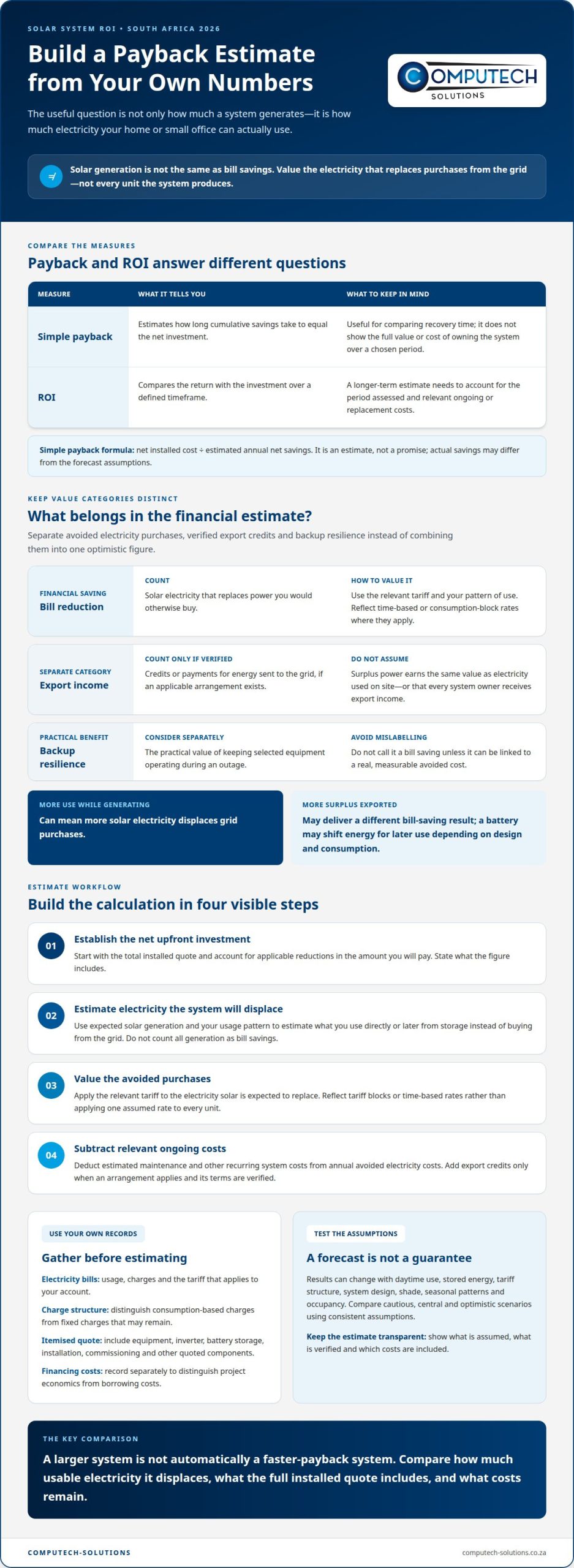
Payback estimates how long it takes for cumulative savings to equal the net investment. A simple estimate divides the net installed cost by estimated annual net savings. It’s useful for comparing recovery time, but it doesn’t show the full value or cost of owning the system over a chosen period.
ROI compares the return with the investment over a defined timeframe. A lifetime estimate, for example, must account for the period assessed and relevant ongoing or replacement costs, rather than treating a lower monthly bill as the return itself. Neither measure guarantees a specific outcome: actual savings can differ from the assumptions used in the forecast.
Which solar benefits belong in the calculation?
Keep the financial categories distinct. First estimate bill savings from electricity solar generation actually displaces. Record export credits separately, and include them only if an applicable arrangement and its terms have been verified. Don’t assume surplus power earns the same value as electricity used on site, or that every system owner receives income for exports.
- Bill reduction: Value the solar energy that replaces electricity you would otherwise buy, using the relevant tariff and your pattern of use.
- Export income: Include only verified credits or payments for energy sent to the grid. Keep this separate from avoided purchases.
- Backup resilience: Consider the practical benefit of keeping selected equipment operating during an outage, but don’t label it a bill saving unless you can link it to a real, measurable avoided cost.
For example, two systems could generate similar amounts of electricity but deliver different bill savings if one household uses more power while the system is generating and the other exports more surplus. A battery may shift energy for later use, but its value depends on the system design and consumption pattern. A clear estimate shows these assumptions instead of merging them into one optimistic figure.
That distinction gives you a sound starting point for calculating the ROI of a solar system in South Africa 2026. Treat payback as one comparison measure, and assess outage resilience separately so the financial case stays transparent.
How to calculate solar system payback using your own numbers
A useful payback estimate starts with your records, not a generic calculator result. The method below makes each assumption visible, so you can see which inputs drive the result and revise them if your quote or usage changes. Keep estimates labelled as estimates: actual generation, consumption and savings may differ from the figures used.
What inputs should you collect before calculating ROI?
Gather recent electricity bills that show how much power you use, what you pay and how charges are structured. Separate charges that vary with consumption from fixed charges, which may remain even if solar reduces grid purchases. Use the tariff that applies to your account rather than a national average, and note any time-based or consumption-block rates shown on your bill.
Then review an itemised system quote. Include the full installed scope in the investment figure, such as solar equipment, inverter, battery storage, installation and commissioning, along with any other quoted components. Record financing costs separately from the system cost so you can distinguish the project’s underlying economics from the cost of borrowing.
How do you calculate simple payback and longer-term ROI?
Work through these steps in order:
- Establish the net upfront investment. Start with the total installed quote and account for any applicable reductions in the amount you’ll pay. State clearly what the figure includes.
- Estimate electricity the system will displace. Use expected solar generation and your usage pattern to estimate how much energy you’ll use directly or later from storage instead of buying from the grid. Don’t count all generated electricity as bill savings.
- Value the avoided purchases. Apply the relevant tariff to the electricity solar is expected to replace. If your tariff varies by block or time, reflect that structure rather than assigning one assumed rate to every unit.
- Subtract relevant ongoing costs. Deduct estimated maintenance and other recurring system costs from annual avoided electricity costs. Add export credits only if an arrangement applies and its terms have been verified. For example, municipal embedded generation feed-in tariffs may apply to eligible customers under specific terms, so don’t treat them as a default assumption for every South African household.
Simple payback (years) = net upfront investment ÷ estimated annual net savings. Keep the units consistent: divide a Rand amount by annual savings in Rand. If savings change over time, a constant annual figure gives only a simplified estimate.
For longer-term ROI, choose a period and total the expected net savings over it, subtract the upfront investment, then divide the result by that investment and multiply by 100. Include relevant ongoing costs, financing costs if assessing your personal cash flow, and replacement costs only when supported by a stated assumption. Don’t present an uncertain future tariff increase as fact.
Keep the inputs beside the result. Computech-Solutions provides solar inverter and battery-backup installation and commissioning for residential and small-office use, including configuration to work with existing electrical infrastructure. You can discuss your solar requirements as part of assessing the system scope.
Why solar ROI estimates differ: test tariffs, self-consumption and system choices
Two payback estimates can differ even when they use the same headline system size. The result changes with the tariff applied, how much solar electricity is used on site, the system configuration and the costs included. A reliable comparison keeps the calculation method consistent and changes only the assumptions being tested.
Build three scenarios: a cautious case with lower usable generation or self-consumption and no assumed tariff escalation; a central case based on your best-supported usage and tariff inputs; and an optimistic case that includes stronger self-consumption or a stated tariff-increase assumption. For each, use the same net investment and annual net savings formula. Label every changed input instead of presenting the optimistic result as the expected outcome.
- Cautious: Use conservative estimates for solar energy used on site and exclude unconfirmed export credits or future tariff increases.
- Central: Reflect your typical consumption pattern, quoted system scope and current applicable tariff.
- Optimistic: Test a plausible higher-use or tariff-growth assumption, clearly identifying it as a scenario, not a forecast.
How do tariff changes and self-consumption affect savings?
Solar only avoids a grid purchase when its electricity is available at a time you can use it, directly or after storage. If generation exceeds on-site demand, the surplus may be exported, curtailed or handled under an applicable arrangement. Don’t value it like avoided grid electricity unless the export terms support that assumption.
Use the tariff on your own bill and test future increases separately, rather than treating a projected rise as certain. Tariff structures can vary by electricity provider and customer type. For grid-connected systems, Eskom’s small-scale embedded generation guidelines provide relevant context for considering connection and export assumptions. Use current utility information that applies to your property.
How should you compare batteries, maintenance and replacement costs?
Compare like with like. Set out the quoted components for each option, including whether battery storage is included, and keep installation and commissioning scope visible. A grid-tied configuration and a battery-backed configuration serve different usage and backup priorities, so neither is automatically the better financial choice. Compare their estimated savings and costs using the same tariff and scenario assumptions.
A battery can shift some solar energy for use later, potentially changing the share used on site, but the benefit depends on when you consume electricity and on the quoted system design. Include maintenance or component replacement costs only where you have a relevant, supported estimate. Leaving them out may make a long-term return look stronger than it is.
If usable savings are low, solar may not pay back quickly. That can happen when much of the generation doesn’t displace grid purchases, or when the system cost is high relative to the savings it delivers. When calculating the ROI of a solar system in South Africa 2026, show how changing consumption, generation, tariff or cost assumptions shifts both simple payback and longer-term ROI. If the cautious case no longer suits your goals, revisit the system scope instead of relying on a single favourable estimate.
A South Africa solar ROI checklist: validate assumptions before relying on a forecast
A forecast is only as useful as its inputs. Before treating a payback estimate as a decision tool, check that the electricity records, tariff, quoted scope and property conditions all describe your situation. A structured review also helps reveal whether a result depends on an assumption that hasn’t been supported.
Which documents and assumptions should you check?
Start with recent electricity bills and the current tariff schedule that applies to your account. Then compare the itemised quote with the system assumed in the estimate. For generation and on-site use, consider the property’s roof conditions and when electricity is typically consumed. If your usage varies through the year, use records that reflect that variation rather than a single unusually high or low month.
- Check the bills: Record electricity use, variable charges, fixed charges and the applicable tariff structure. Make sure the calculation period matches the bill records.
- Review the full quote: Identify equipment, whether battery storage is included, installation and commissioning, and any other components included in the total. Keep optional items distinct from the core system cost.
- Test generation assumptions: Consider shade, roof orientation and other site conditions that could affect actual production. Don’t rely on a generic output figure without checking how it relates to the property.
- Match use to generation: Compare expected daytime consumption and energy use after sunset with the system’s assumed self-consumption. Seasonal routines, work-from-home patterns and changes in occupancy can alter both.
- Check the tariff basis: Use the current schedule relevant to your electricity provider and account type. Keep any assumed future tariff increase as a separate scenario, not a guaranteed rate.
- Separate additional financial assumptions: Show financing costs, any claimed tax treatment and potential export income in distinct lines or scenarios. Include export credits only when the applicable arrangement and terms are verified.
How can you avoid an overly optimistic solar forecast?
Run a lower-savings case alongside your central estimate. Reduce the assumed share of generation used on site, exclude unverified export credits and avoid relying on future tariff increases to make the numbers work. Then identify which changed input affects payback most. This sensitivity check shows whether the decision still fits your priorities under less favourable assumptions.
For a business calculation, don’t include a tax benefit based on an old article or a calculator default. Check current SARS guidance for the relevant tax year and the business’s circumstances, then model any applicable treatment separately from operating savings. Financing also deserves its own view: a project’s estimated energy savings and the borrower’s total cash outlay are related, but they aren’t the same measure.
Use the completed checklist to shape a system scope that reflects your usage and existing electrical infrastructure. Computech-Solutions provides residential and small-office solar installation and commissioning, helping configure inverters and battery-backup systems for the existing electrical setup. You can talk through your solar system requirements with the team.
Turn your solar ROI estimate into a practical installation decision
A payback figure is useful for comparing options, but it shouldn’t decide the project on its own. Use the estimate to understand what each proposed system is expected to do, what the quoted scope includes and which assumptions drive its financial case. A system with a longer estimated payback may still suit your backup priorities better, while a shorter estimate may depend on assumptions that don’t match your daily usage.
What should a useful solar proposal make clear?
A proposal should make the system components, installation scope and calculation assumptions understandable side by side. Check what equipment is included, whether battery storage forms part of the configuration, what installation and commissioning cover, and which items are excluded or optional. This makes it easier to compare proposals on equivalent scope instead of headline price or payback alone.
Relate the proposed configuration to your electricity use and backup needs. For example, note which regular loads you expect to run during the day and which you want supported during an outage. The proposed system should connect those priorities to its design assumptions without guaranteeing a particular level of generation, savings or backup performance.
Computech-Solutions supplies solar power solutions and provides solar inverter and battery-backup installation and commissioning for residential and small-office use. The technical work includes configuring systems to work with existing electrical infrastructure. The financial estimate should describe the system being installed, while the project scope should account for how it fits the property’s electrical setup.
How can you move from an estimate to a project discussion?
Prepare a short brief before discussing the project. Include your typical electricity use, the tariff information you used, the estimate’s main assumptions, the system scope being considered and your backup priorities. Mention any changes that could affect future demand, such as occupancy or regular appliance use. This gives the discussion a practical starting point and connects the numbers to a workable project scope.
Use the same comparison framework for each option: the installed scope, expected on-site use, relevant ongoing costs, and the cautious and central financial cases. If one option appears more attractive only because it assumes higher self-consumption, a different tariff or fewer costs, make that distinction visible before deciding. The aim isn’t to force every benefit into a payback calculation; it’s to understand the financial estimate alongside the practical requirements.
Calculating the ROI of a solar system in South Africa 2026 is most useful when it leads to a clear, realistic specification rather than a single headline number. A properly scoped system discussion can bring together your electricity patterns, backup goals and existing infrastructure without promising a particular return.
To discuss your requirements and solar power solution, message Computech-Solutions on WhatsApp.
Make your next solar decision with confidence
A useful ROI estimate is a starting point for a better project conversation, not a verdict you need to follow blindly. Decide what matters most to your home or small office, whether that’s managing electricity costs, maintaining selected power during outages, or balancing both. Then use those priorities to guide the scope and assumptions you want reflected in a proposal.
Calculating the ROI of a solar system in South Africa 2026 becomes more practical when your financial expectations and operational needs are considered together. A clear discussion can help turn your usage patterns and priorities into a system plan that fits your existing setup. Computech-Solutions also provides technical support for power solutions as your plans take shape.
Discuss your solar system requirements with Computech-Solutions on WhatsApp and take the next step with a clearer view of what you need.
Frequently Asked Questions
How do you calculate the ROI of a solar system in South Africa?
Estimate annual net bill savings from electricity the system is expected to replace, then compare those savings with the net installed investment. For calculating the ROI of a solar system in South Africa 2026, use your own bills and applicable tariff, and include installation and equipment in the cost figure. Simple payback is an estimate, not a guarantee. Test more than one scenario because future tariffs and actual system performance can differ.
How long does it take for a solar system to pay for itself in South Africa?
There isn’t one payback period that applies to every South African property. The result depends on your quote, electricity use, tariff, system configuration and the share of generation used on site. Calculate it using your own bills, then compare a cautious case with a central estimate. A payback example for another household or business can illustrate a method, but it isn’t a prediction for your property.
Does a solar ROI calculation include load-shedding savings?
Usually, a standard bill-savings calculation measures avoided electricity purchases, not the full practical value of backup power. Keeping selected equipment running during an outage may matter to a household or business, but that benefit isn’t automatically a cash saving. If you can identify a defensible cost avoided during outages, assess it separately and state the basis. Otherwise, keep resilience as a practical benefit outside the financial return calculation.
Should I include a battery when calculating solar system ROI?
Compare the installed quote with and without a battery when both configurations suit your needs. Include the battery in the investment cost for the option that contains it. Its financial effect depends on how much stored energy you use, when you use it, the applicable tariff and system design. Don’t assume storage always shortens payback; model each configuration with consistent usage and cost assumptions.
How do Eskom or municipal tariff increases affect solar payback?
Higher grid tariffs can increase the value of electricity a solar system displaces, but future increases aren’t certain and tariff structures vary by provider and account. Use the current applicable tariff as your baseline, then model any possible escalation as a separate scenario. Before using specific rates or forecasts, consult current Eskom or municipal tariff information relevant to your property rather than relying on a general national assumption.
Can a South African business claim a tax benefit for a solar system in 2026?
Potential tax treatment depends on current legislation, eligibility, the business’s circumstances and investment timing. Don’t rely on an older article’s rebate or accelerated-depreciation claim as if it necessarily applies in 2026. Check current South African Revenue Service guidance and get professional tax advice before including a tax benefit in an ROI estimate. Keep the calculation without that benefit visible as a separate comparison.
Does excess solar electricity always earn money in South Africa?
No. Export compensation and connection arrangements depend on the electricity provider and the terms that apply to the customer. Build a baseline estimate using avoided grid purchases without export income. Then add a separate export scenario only after confirming that an applicable arrangement covers your system and understanding its terms. This avoids relying on a planned, announced or location-specific scheme as though it were available to every system owner.
