
With municipal electricity tariffs continuing to rise across the country as of July 2026, the financial argument for energy independence has never been stronger. You’ve likely felt the frustration of paying more for less reliable power while worrying about the high cost of replacement parts. Computech-Solutions understands that your primary goal isn’t just to escape load shedding, it’s to protect a significant capital investment from the harsh South African climate.
This guide outlines the complete solar panel installation process South Africa demands to ensure your system remains a high-yielding asset. You’ll learn how to implement a reliability audit to combat performance drops caused by winter dust and bird droppings. We’ll also provide a maintenance framework designed to extend battery lifespan and prevent electrical fire risks. From navigating NERSA registration to maximizing winter generation, this comprehensive checklist ensures your transition to renewable energy is safe, compliant, and operationally efficient. By following these technical protocols, you can secure maximum electricity generation and safeguard your operational continuity against escalating grid costs.
Key Takeaways
- Implement a preventative maintenance strategy that protects your inverter hardware from the technical stress caused by frequent grid switching.
- Master the solar panel installation process South Africa requires by identifying micro-cracks and adjusting cleaning schedules for local dry and rainy seasons.
- Perform electrical health audits to prevent thermal throttling and eliminate the risk of electrical fires through regular fan and terminal checks.
- Optimize your battery bank’s performance by verifying State of Charge calibration and inspecting terminals for signs of heat stress or corrosion.
- Distinguish between DIY-safe tasks and critical inspections that require a qualified electrician to maintain your mandatory Certificate of Compliance.
Understanding Solar System Maintenance in the South African Context
In 2026, solar maintenance has evolved from a secondary task into a core preventative strategy. The initial solar panel installation process South Africa homeowners undergo is only the first step in a multi-decade energy plan. High municipal tariff increases, such as the 14% hike in Buffalo City effective July 2026, mean every kilowatt-hour lost to poor maintenance carries a direct financial penalty. Efficiency equals profit. Proactive monitoring ensures your hardware survives the unique operational stresses of the local environment.
The “Load Shedding Factor” represents the single greatest threat to your hardware’s longevity. Frequent grid switching forces your inverter to cycle between grid-tied and island modes several times a day. This constant mechanical and electrical transition creates thermal stress on internal capacitors and switching components. A successful solar panel installation process South Africa residents invest in must account for these extreme cycling demands. Without a proactive maintenance framework, these parts face premature failure long before their rated lifespan ends.
Why Maintenance is Not Optional in South Africa
Documenting periodic inspections is essential for protecting your equipment warranties. Most manufacturers require proof of professional oversight to honor claims on high-value components. Regular audits also help identify “silent failures,” such as micro-cracks in photovoltaic (PV) systems, which might not cause an immediate blackout but significantly degrade output over time. In a market where lithium-ion batteries now face a 15% ad valorem import duty, protecting your existing hardware is a fiscal necessity. Proactive care is cheaper than replacement.
The ROI of a Well-Maintained System
Solar Panel and Mounting Checklist: Combatting Dust and Debris
The exterior array is the most exposed component of your energy system. While the initial solar panel installation process South Africa homeowners follow focuses on grid compliance and hardware placement, the long term success of the project relies on managing environmental wear. Our local climate presents unique challenges, from the abrasive red dust of the Highveld to the corrosive salt mist of the Atlantic and Indian Ocean coastlines. Ignoring these factors leads to “hot spots,” where localized heating on a panel surface can cause permanent cell damage and significant yield loss.
Visual inspections should be conducted at least once a quarter. Look for micro-cracks that appear as thin, web-like fractures on the glass. These often result from thermal expansion or physical impact from hail. You should also check for bird activity. Pigeons frequently nest under panel arrays, leading to acidic dropping accumulation and restricted airflow. This lack of ventilation increases operating temperatures, which reduces the efficiency of the entire string. If you find your property’s tech infrastructure is expanding, it’s a good time to audit your hardware reliability to ensure your office equipment matches the efficiency of your power supply.
The South African Cleaning Protocol
Cleaning schedules must align with local seasonal shifts. During the dry winter months in the interior, dust buildup can reduce output by over 15% in just a few weeks. Conversely, coastal systems require monthly rinsing to prevent salt crusting. Never use high-pressure washers or abrasive chemicals; these strip the anti-reflective coating off the glass. Always clean panels at dawn or dusk. Applying cold water to sun-drenched panels creates thermal shock, which can shatter the tempered glass instantly. Use deionized water or a soft squeegee to maintain a streak-free finish.
Structural Integrity and Wiring
South African wind loads are formidable, particularly during Highveld thunderstorms or Cape Town’s “South Easter” season. Inspect mounting rails and clamps annually for signs of oxidation or movement. A loose clamp doesn’t just create noise; it allows for vibration that causes internal cell micro-cracking. Verify that all DC cabling is tucked neatly into UV-protected conduits. Harsh South African sunlight degrades standard plastic cable ties within months, leaving wires to dangle and rub against sharp roof edges. Finally, trim any foliage overgrowth. Even partial shading from a single branch can trigger bypass diodes, cutting the power output of the entire panel string.
Inverter and Electrical Component Health Audit
Your inverter serves as the central intelligence of your energy system, managing the high-frequency transitions between the grid, your battery bank, and the solar array. While the physical solar panel installation process South Africa residents invest in is often the focus, the long-term reliability of the system depends on the health of these internal electronics. Inverters are sensitive to the voltage fluctuations common on the South African grid, especially when power returns after a period of load shedding. Regular audits of your electrical components prevent minor technical glitches from escalating into catastrophic hardware failures.
Electrical safety starts with verifying terminal tightness within your distribution board and inverter casing. The constant thermal expansion and contraction caused by high-current throughput can gradually loosen screw terminals. Loose connections are a primary cause of electrical arcing, which presents a significant fire risk. You should also monitor your system’s error logs for “Grid Out of Range” warnings. These logs indicate when the local grid frequency or voltage exceeds safe operating parameters, often a precursor to surge-related damage. Checking your surge protection devices (SPDs) after our intense seasonal lightning storms is a non-negotiable safety step to ensure your equipment remains shielded from atmospheric discharges.
Thermal Management and Airflow
Dust accumulation in cooling fans is the leading cause of inverter failure across the country. When fans clog, the unit cannot dissipate heat effectively, leading to thermal throttling where the inverter intentionally reduces power output to protect its internal circuitry. Ensure your installation area remains well-ventilated and free of household clutter. Listen for unusual fan grinding or high-pitched electrical hums during peak load periods; these sounds often signal that a component is operating outside its ideal thermal range and requires immediate technical attention.
Firmware Updates and Data Monitoring
Modern energy management relies heavily on manufacturer firmware to optimize the communication between your inverter and battery management system (BMS). Updates often include critical patches that improve charging efficiency and hardware protection protocols. Use your system’s monitoring app to track the performance of individual strings. If one string shows a sudden drop in voltage compared to others, it’s an early indicator of a blown fuse or a loose DC connector. Consistently resetting your communication modules ensures you receive real-time data, allowing you to make informed decisions about your energy consumption patterns.
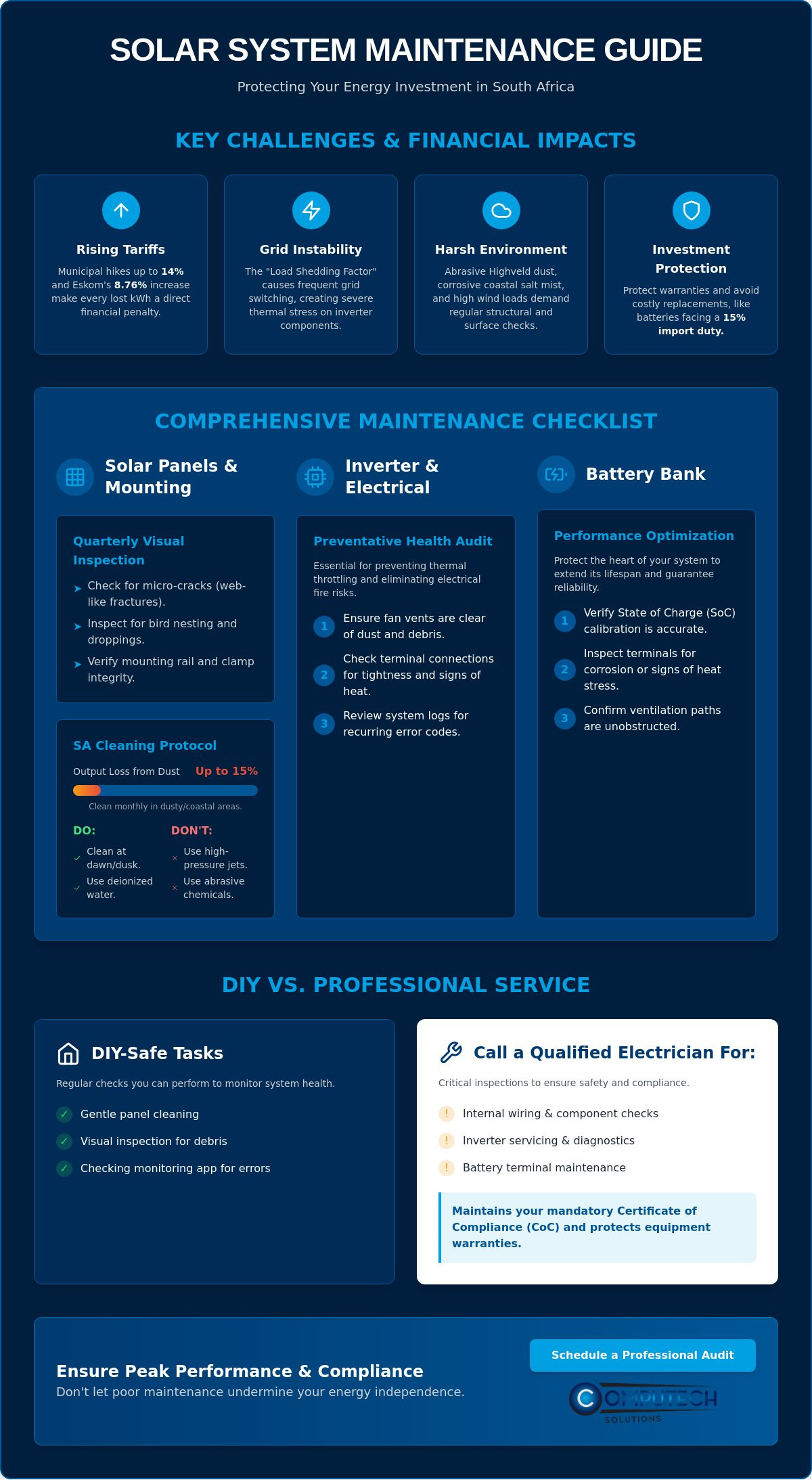
Battery Bank Optimization: Protecting the Heart of Your System
The battery bank is the most significant capital expense in the solar panel installation process South Africa residents choose to combat energy instability. Because these units endure the heavy lifting during load shedding, they require precise management to avoid premature capacity loss. In 2026, with the 15% ad valorem duty on lithium-ion batteries making replacements more expensive, protecting your existing cells is a priority for any operational budget. Heat is the enemy. Inspecting battery terminals for signs of heat stress, such as discolored plastic or melted insulation, can prevent a minor connection issue from destroying an entire module.
Physical swelling or “venting” in backup units is a critical warning sign. If a battery casing appears distorted, it indicates internal gas buildup, usually from overcharging or excessive heat. You should also verify the State of Charge (SOC) calibration through your system software regularly. Over time, the reported percentage can drift from the actual physical charge, leading to unexpected shutdowns during a power outage. While securing your home’s energy storage, ensure your mobile devices stay powered during outages with high-performance laptop batteries that match your operational needs.
Managing Cycles During Heavy Load Shedding
Adjusting your Depth of Discharge (DOD) settings is vital for seasonal efficiency. During South African winters, shorter daylight hours and lower solar intensity mean your system might struggle to reach a full 100% charge. Reducing your DOD from 80% to 50% during June and July prevents the battery from sitting in a low State of Charge for extended periods, which can lead to cell degradation. Float and Bulk voltages must be calibrated to the manufacturer’s specifications to ensure the charging profile matches the battery chemistry. Lithium-ion batteries are far more sensitive to voltage precision than older AGM or Gel technologies; they require active management through a digital interface rather than simple voltage-based cutoffs.
BMS and Communication Verification
The communication cable between your inverter and the Battery Management System (BMS) is the lifeline of your storage bank. If this connection fails, the inverter may default to “lead-acid” charging parameters, which can quickly damage lithium cells. Check your system management software for cell imbalance warnings, which indicate that individual cells within the pack are not charging at the same rate. This data allows you to address technical faults before they result in a total pack failure. State of Health (SOH) represents the percentage of a battery’s original capacity that remains available, serving as the definitive metric for its remaining operational lifespan.
Professional Maintenance vs. DIY: When to Call the Experts
Maintaining a high-performance energy system requires a clear distinction between basic housekeeping and technical intervention. While the solar panel installation process South Africa homeowners undergo is designed for durability, the complexity of modern hybrid systems necessitates professional oversight. Homeowners can safely manage surface tasks like rinsing dust or checking for visible cable damage. However, opening a distribution board or adjusting inverter voltage parameters carries significant safety risks. Safety must always take priority over cost-saving.
A comprehensive maintenance log is your strongest asset for insurance and warranty protection. In the event of a surge-related failure or a lightning strike, insurance providers often demand proof of regular professional servicing. This log should include dates of professional inspections, cleaning cycles, and any firmware updates performed. Keeping these records ensures that if a component fails, you have the necessary documentation to secure a replacement under manufacturer terms. If your operational setup includes remote work or business management, Ensure your system is load shedding ready with Computech-Solutions by maintaining your secondary power sources as diligently as your primary solar array.
The Annual Professional Inspection
Annual inspections go beyond visual checks to include technical stress tests. Qualified electricians use thermal imaging to detect hidden heat signatures in your panels or DB boards, identifying potential fire risks before they manifest. They also verify that your earthing and lightning protection systems remain effective against South Africa’s high-intensity atmospheric discharges. This visit is also the ideal time to ensure your system remains compliant with municipal Small-Scale Embedded Generation (SSEG) requirements. As regulations evolve in 2026, maintaining your Certificate of Compliance (CoC) is essential for legal grid-tied operation.
Computech-Solutions: Your Partner in Solar Reliability
We provide the technical support and high-quality hardware needed to maintain your total energy ecosystem. Whether you need to source replacement batteries for your mobile workstation or require expert guidance on inverter configuration, our team ensures your technology remains operational. We specialize in providing replacement laptop batteries for major brands including Acer, Apple, ASUS, Dell, HP, Lenovo, Samsung, Sony, and Toshiba. By pairing a well-maintained solar system with reliable hardware components and chargers, you can achieve true energy independence. Our focus remains on delivering streamlined solutions that protect your investment and maximize your electricity generation throughout the year.
Securing Your Energy Independence for the Long Term
Transitioning to renewable energy is a significant financial commitment that demands proactive oversight. The solar panel installation process South Africa requires doesn’t end when the hardware is mounted; it marks the beginning of a strategic energy management phase. By implementing regular thermal audits and seasonal cleaning protocols, you protect your system from the abrasive environmental factors and grid instability unique to our local market. These technical steps ensure your hardware survives the cycling stress of load shedding while maintaining peak generation efficiency. Reliability is the result of consistent care.
Since 2018, we’ve specialized in power backup solutions tailored specifically for South African conditions. Whether you’re optimizing an existing array or upgrading your storage bank, our team provides expert technical support and nationwide delivery on all critical components. Browse our range of Solar Inverters and Backup Batteries to secure your operational continuity against rising utility costs. With a robust maintenance framework and high-quality hardware, your path to energy independence remains clear, safe, and profitable. It’s time to take full control of your power future.
Frequently Asked Questions
How often should I clean my solar panels in South Africa?
You should clean your panels at least twice a year, though monthly cleaning is necessary during the dry Highveld winters. Dust accumulation in the interior provinces can reduce your system’s efficiency by 15% or more in a single season. Coastal residents should rinse panels monthly to prevent salt spray from crusting on the glass. Regular cleaning ensures you maximize your electricity generation during the peak sunlight hours of the day.
Can I maintain my solar system myself or do I need a professional?
Homeowners can safely perform visual inspections and low-pressure cleaning, but technical electrical work requires a qualified professional. You should never attempt to open your inverter or distribution board because of the high-voltage DC risks involved. An annual professional “Health Check” is essential for maintaining your Certificate of Compliance (CoC) and ensuring your equipment warranties remain valid. Professionals use specialized tools like thermal cameras to find hidden faults you can’t see.
What happens if I don’t maintain my solar inverter?
Neglecting your inverter leads to thermal throttling, where the unit reduces its power output to prevent internal components from melting. Dust buildup in the cooling fans is the primary cause of hardware failure in South African installations. If the fans fail, the internal capacitors face extreme heat stress, which significantly shortens the lifespan of the device. Regular fan cleaning and filter checks prevent these costly hardware replacements and ensure consistent energy conversion.
How does load shedding affect my solar system maintenance schedule?
Load shedding increases maintenance requirements because frequent grid switching puts additional thermal and mechanical stress on your inverter and batteries. This constant cycling is a critical factor in the solar panel installation process South Africa residents must manage to ensure long-term reliability. You’ll need to check electrical terminals and battery connections more frequently to ensure they haven’t loosened due to the repeated expansion and contraction caused by high-current surges.
Is it safe to wash solar panels with a garden hose?
It is safe to use a garden hose if you only wash the panels at dawn or dusk when the glass is cool. You should avoid using high-pressure nozzles because they can damage the seals or force water into the electrical junctions. Never use cold water on sun-drenched panels during the middle of the day. The resulting thermal shock can cause the tempered glass to shatter instantly, which isn’t covered by most standard equipment warranties.
What are the signs that my solar battery needs replacing?
The most common signs of battery failure include rapid discharging under light loads and physical swelling of the battery casing. You should monitor the State of Health (SOH) percentage through your system’s monitoring app. If the SOH drops below 70% or the battery fails to reach a full charge even after a clear sunny day, the cells are likely reaching the end of their functional life. Physical distortion or venting requires immediate professional intervention.
Why is my solar system producing less power than last year?
Decreased power production is usually caused by heavy dust buildup, new shading from growing trees, or aging electrical components. In some cases, micro-cracks in the panels from hail or thermal stress can reduce the output of an entire string. If your panels are clean and there is no new shade, the issue might be a faulty bypass diode or a loose DC connection. A professional diagnostic can identify if the drop is environmental or a technical hardware fault.
Does my solar system need maintenance during the winter months?
Winter is actually the most important time for solar maintenance in South Africa due to the lack of rainfall and shorter daylight hours. You must clean your panels more often during this period to remove the thick layers of dust that accumulate without rain. It’s also the time to adjust your Depth of Discharge (DOD) settings on your inverter. This protects your battery bank from being drained too deeply during the long winter nights when solar recharge time is limited.
