
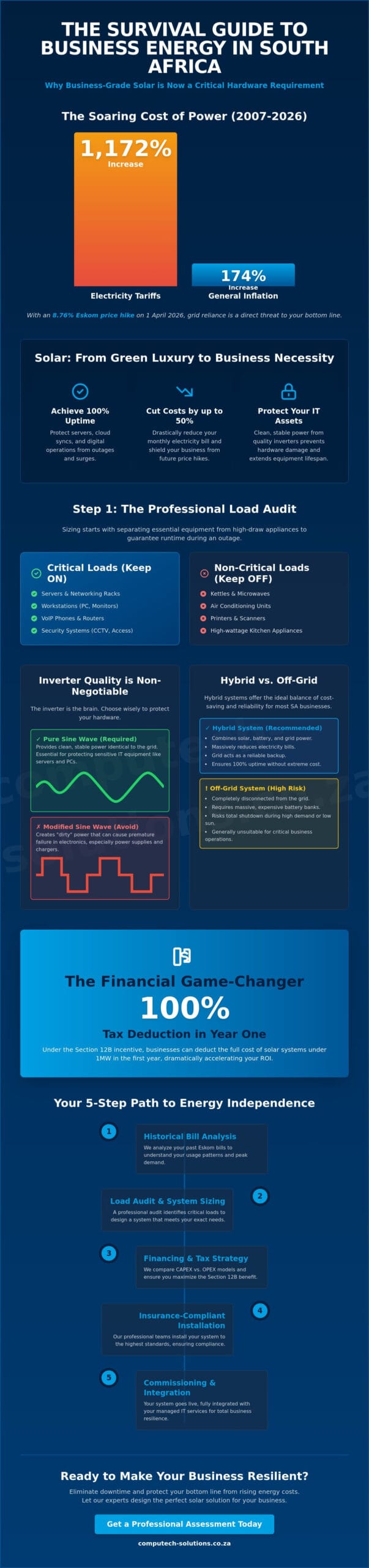
Between 2007 and 2026, South African electricity tariffs skyrocketed by 1,172 percent, while inflation rose by only 174 percent. This massive gap, combined with the 8.76 percent Eskom price hike on 1 April 2026, means your operational overheads are now a primary threat to your bottom line. You likely already feel the strain of balancing these rising costs with the constant need for uninterrupted digital connectivity. Implementing the right solar power solutions for small business SA is no longer a secondary sustainability goal. It’s a critical hardware requirement for any company that relies on servers, cloud infrastructure, and consistent uptime to remain competitive.
We understand that sizing an inverter correctly or navigating the complexities of Section 12B tax incentives can feel overwhelming. This guide simplifies your transition by showing you how to claim a 100 percent tax deduction in year one for systems under 1 megawatt. You’ll learn how to secure professional installations that satisfy insurance requirements and protect your expensive IT equipment from power surges. We also review the latest financing options, including the Energy Bounce Back Loan Guarantee Scheme, to ensure your business remains operational through every outage while cutting monthly electricity costs by up to 50 percent.
Key Takeaways
- Understand why business-grade solar functions as a managed energy ecosystem to provide the stability required for modern IT infrastructure.
- Learn how to conduct a professional load audit to determine if the 5kW sizing standard meets your specific operational requirements.
- Compare CAPEX and OPEX financing models to find the best solar power solutions for small business SA while maximizing Section 12B tax deductions.
- Follow a structured five-step implementation guide to move from historical bill analysis to a fully commissioned, insurance-compliant system.
- Discover how integrating power backup with your managed IT services creates a resilient environment that eliminates technical downtime.
Understanding Solar Power Solutions for Small Business in SA
Business-grade solar is far more than a collection of glass panels on a roof. It represents a sophisticated, managed energy ecosystem designed to ensure your operations never skip a beat. As we move through 2026, the development of Solar power in South Africa has shifted from a luxury green initiative to a mandatory survival strategy for SMMEs. With Eskom direct customer tariffs rising by 8.76 percent on 1 April 2026, grid independence is now a matter of protecting your margins. You can’t afford to let rising utility costs or grid instability dictate your productivity.
While a residential backup system might keep a few lights and a TV running, commercial continuity systems are built for endurance and precision. These solar power solutions for small business SA prioritize the stability of your IT infrastructure. They ensure that servers don’t reboot and cloud syncs aren’t interrupted during a switchover. The inverter acts as the brain of this setup, managing the complex flow between the grid, your battery storage, and your solar array with millisecond accuracy.
Hybrid vs. Off-Grid: Which fits your business model?
Most South African small businesses find the greatest success with hybrid configurations. These systems allow you to blend power from the grid and your panels simultaneously, providing a safety net during cloudy periods or high-demand spikes. Pure off-grid setups often carry too much risk for businesses with fluctuating power needs. An unexpected surge could trigger a system shutdown if your battery bank isn’t massive. Hybrid systems offer the best of both worlds: significantly reduced monthly bills and 100 percent uptime without the extreme cost of total grid disconnection.
The Role of Inverter Quality in Protecting IT Hardware
Your choice of inverter directly impacts the lifespan of your electronic assets. Pure Sine Wave inverters are non-negotiable for professional environments. Unlike cheaper modified sine wave alternatives, they provide clean, stable power that mimics the grid perfectly. This precision protects sensitive components in your servers and prevents the premature degradation of replacement laptop batteries. When you match your inverter capacity to peak office loads, such as the initial surge from printers and air conditioning units, you eliminate the risk of hardware-damaging brownouts. Investing in a high-quality “brain” for your power system is the most effective way to safeguard your hardware investment.
Sizing Your System: From Home Office to Small Commercial Units
Every successful energy transition begins with a rigorous load audit. You must distinguish between “Critical” loads—your servers, networking switches, and security systems—and “Non-Critical” loads like air conditioning or high-wattage kitchen appliances. For many micro-businesses in South Africa, a 5kW system has emerged as the ideal starting point. It provides enough capacity to keep a five-person office running through a four-hour load shedding block without exhausting battery reserves. By adhering to South African solar industry standards, you ensure your system is sized for reliability rather than just cost-cutting. While a small commercial setup for 20 to 50 employees might require a 20kW to 50kW system, the principles of load separation remain identical.
Calculating the “IT Load” for Office Continuity
A standard workstation consisting of a laptop, two monitors, and a desk lamp typically draws between 150W and 250W. If you have ten employees, that’s a constant 2.5kW draw before considering your networking rack. Server rooms require separate consideration because cooling systems often consume more power than the servers themselves. If your air conditioner isn’t on the solar circuit, your hardware risks thermal shutdown during an outage. Conversely, putting it on the battery circuit can drain your autonomy in minutes. We recommend prioritizing high-efficiency cooling or dedicated DC-powered fans to maintain environmental stability without compromising battery life. Avoid using high-draw appliances like kettles or microwaves during outages, as a single three-minute boil can strip away thirty minutes of runtime for your entire PC fleet.
Panel Efficiency vs. Roof Space Constraints
Urban offices often have limited roof space, making panel efficiency critical. Tier 1 mono-crystalline panels are the preferred choice for South African conditions due to their superior performance in high heat. Unlike older poly-crystalline panels, they offer higher energy yield per square meter. To maximize generation during the crucial 9 AM to 5 PM window, panels should ideally face north at a tilt of 25 to 35 degrees. This alignment ensures peak production coincides with your highest operational demand. If you’re unsure how many panels your roof can support, our technical team can provide a site assessment to optimize your layout for maximum ROI.
Choosing a modular system is the smartest way to future-proof your investment. As your business grows, your solar power solutions for small business SA should scale accordingly. Modular inverters and stackable Lithium Iron Phosphate (LiFePO4) batteries allow you to expand capacity without replacing your existing core components. This incremental approach protects your initial capital while ensuring your energy security keeps pace with your business expansion. Aim for at least four to six hours of battery autonomy to bridge the gap between peak sun hours and the end of the business day.
The Financials: ROI, Section 12B, and Financing Options
Investing in solar power solutions for small business SA is as much a financial strategy as it is an operational one. With municipal electricity tariffs increasing by 9.01 percent on 1 July 2026, the cost of grid reliance is eating into small business margins faster than ever. Most commercial solar installations now achieve a full return on investment within three to five years. This rapid payback is driven by the widening gap between rising utility costs and the falling price of high-efficiency lithium battery storage. You can choose between a capital expenditure (CAPEX) model, where you own the asset and claim all tax benefits, or an operating expenditure (OPEX) model, such as a subscription or Power Purchase Agreement (PPA), to preserve your cash flow.
Protecting this investment is vital for long-term ROI. Your insurance provider will likely require a Certificate of Compliance (CoC) and evidence that the installation meets the latest fire safety and surge protection standards. Professional installation doesn’t just ensure your servers stay online; it ensures your claim is valid if a lightning strike or grid surge affects your hardware. When you own the system, you also gain a tangible asset that increases the value of your commercial property while providing a predictable energy cost for the next 20 to 25 years.
Section 12B: The Small Business Solar Tax Hack
While the temporary 125 percent “enhanced” deduction under Section 12BA expired on 28 February 2025, the permanent Section 12B remains a massive advantage for South African businesses. For any solar PV installation under 1 megawatt, SARS allows you to deduct 100 percent of the cost in the very first year. This applies to the panels, inverters, batteries, and even the mounting structures. To qualify, you must ensure your system is installed by a qualified professional and that all documentation is meticulously filed. This immediate write-off can significantly reduce your taxable income, effectively subsidizing a large portion of your transition to energy independence.
Financing Your Solar Transition
If upfront capital is a barrier, several specialized financing routes exist in 2026. The Energy Bounce Back (EBB) Loan Guarantee Scheme remains a primary tool for SMMEs, offering government-backed loans with favorable terms. Major banks like Nedbank and Standard Bank have also launched dedicated green finance products with interest rates typically ranging from 13 to 16 percent, based on a prime rate of 11.25 percent. For businesses that prefer not to manage hardware, a PPA allows you to buy solar power at a fixed rate lower than the municipal tariff with zero upfront cost. However, remember that with a PPA, the provider claims the Section 12B tax benefits, not your business.
Implementation Guide: 5 Steps to a Seamless Solar Switch
Transitioning to solar power solutions for small business SA requires a systematic approach to avoid costly technical missteps. It’s not just about mounting panels; it’s about integrating a new power source into your existing IT workflow. Following a structured implementation guide ensures your business remains protected throughout the process and realizes the average 30 to 50 percent savings on electricity costs as quickly as possible.
- Step 1: Historical bill analysis. Review your utility statements from the last 12 months to identify your baseline consumption and peak demand periods. This data prevents over-investment in unnecessary hardware.
- Step 2: Structural and electrical site assessment. A qualified technician must verify that your roof can support the weight of Tier 1 panels and that your existing DB board is compatible with modern hybrid inverters.
- Step 3: Procurement of Tier 1 hardware. Select inverters and batteries with proven track records in the South African climate. Prioritize brands that offer local technical support and comprehensive warranties.
- Step 4: Professional installation and CoC. Ensure the installation team provides a Certificate of Compliance (CoC). This document is essential for insurance validity and for claiming your Section 12B tax benefits.
- Step 5: System commissioning and training. Once the system is live, train your staff on energy-smart habits. Small shifts, like scheduling heavy printing jobs during peak sun hours, maximize your ROI.
Choosing the Right Hardware Partner
Selecting a partner with deep IT expertise is a significant advantage. General contractors often lack the specialized knowledge required to ensure that solar switchovers don’t cause data corruption in your servers or networking equipment. Buying from an IT-specialist retailer ensures better hardware compatibility across your entire digital stack. You should also strictly avoid “Grey Market” imports. These units often lack the firmware updates necessary for South African grid conditions and can leave your business stranded without a valid warranty if a component fails. If you need assistance with the technical specifications of your setup, contact our engineering team for a detailed consultation.
Monitoring and Maintenance for SMMEs
Modern solar systems include mobile applications that allow you to track generation and consumption in real-time. This visibility helps you identify “vampire loads” that drain your batteries overnight. Maintenance is equally critical. In South Africa, accumulated dust and bird droppings can reduce your panel yield by 10 to 15 percent if left uncleaned. Establish a quarterly cleaning schedule to maintain peak performance. Finally, schedule an annual electrical inspection. These check-ups ensure that all connections remain tight and that your surge protection is still active, keeping both your hardware and your insurance coverage secure.
Computech-Solutions: Your Partner in Business Resilience
Computech-Solutions bridges the gap between electrical infrastructure and digital performance. Most solar installers understand wiring, but they don’t always grasp the delicate power requirements of a high-density server rack or a distributed workforce. We treat solar power solutions for small business SA as an essential component of your managed IT environment. By integrating power backup with your broader technology strategy, we eliminate the risk of hardware failure and data loss that often accompanies unstable grid transitions.
Our one-stop-shop philosophy simplifies your procurement process. You can source everything from replacement laptop batteries to full solar commissioning through a single, reliable partner. This unified approach ensures that every component, from the 5kW inverter to the individual laptop chargers, is compatible and optimized for longevity. We provide nationwide delivery and professional installation services across South Africa, bringing our Pretoria-based expertise to businesses from Cape Town to Polokwane.
Integrated IT and Power Solutions
Ensuring your solar system supports your office hardware requires more than just basic electrical knowledge. We analyze how your specific networking gear and cloud infrastructure interact with your power source. Sourcing batteries and inverters from a trusted IT retailer like Computech-Solutions means you get hardware that’s specifically tested for professional uptime. We offer expert advice on matching peripherals to your new power grid, ensuring that surge protection is layered correctly to protect your most valuable digital assets.
Get Started with a Business Energy Audit
Every business footprint is unique. Our Pretoria-based experts provide customized quotes tailored to your specific office or retail requirements. We don’t believe in generic packages. Instead, we build resilient systems based on your actual historical data and future growth projections. Contact us today to begin your audit and secure your operational continuity through 2026 and beyond. View our solar hardware and backup solutions today!
Secure Your Operational Future with High-ROI Solar
The 8.76 percent Eskom tariff increase effective from 1 April 2026 confirms that grid reliance is no longer a sustainable strategy for South African SMMEs. By leveraging the 100 percent first-year tax deduction through Section 12B and achieving a full return on investment in just three to five years, your business can transform a utility crisis into a competitive advantage. You don’t have to navigate these technical complexities alone.
Choosing the right solar power solutions for small business SA is about more than just panels. It’s about ensuring your servers, networking gear, and cloud infrastructure remain stable through every outage. As specialists in IT-compatible power systems, we provide expert technical support and nationwide delivery across South Africa. We help you eliminate downtime while reducing your monthly electricity overheads by up to 50 percent. It’s time to move beyond temporary backups and invest in a professional, managed energy ecosystem that secures your operational future.
Secure Your Business Continuity with Our Solar Solutions and take control of your energy costs today. We are ready to help you build a more resilient and profitable business.
Frequently Asked Questions
Is solar power really worth it for a small business in South Africa in 2026?
Solar power is a highly profitable investment for South African businesses in 2026. With Eskom tariffs rising by 8.76 percent on 1 April 2026 and municipal rates increasing by 9.01 percent in July, the cost of grid power is unsustainable. Most SMMEs see a 30 to 50 percent reduction in monthly utility bills, allowing the system to pay for itself within three to five years while ensuring total operational continuity.
Can I run my office air conditioning on a small business solar system?
You can run air conditioning on a solar system, but it requires careful planning of your inverter capacity and battery reserves. Air conditioners are high-draw appliances that can quickly deplete batteries during an outage. We recommend prioritizing energy-efficient inverter-type AC units and scheduling their use during peak sun hours between 10 AM and 3 PM to maximize direct solar generation and preserve battery life for IT equipment.
What is the difference between a solar inverter and a standard UPS?
A solar inverter acts as a sophisticated power management hub, while a standard UPS is designed only for short-term emergency backup. Unlike a UPS that simply bridges a 15-minute gap, solar power solutions for small business SA provide sustained energy for eight hours or more. Modern hybrid inverters also offer cleaner power delivery, which is essential for protecting sensitive IT hardware from grid fluctuations and potential damage.
How does the Section 12B tax incentive work for solar installations?
Section 12B allows businesses to deduct 100 percent of the cost of a solar PV system under 1 megawatt in the first tax year. This deduction includes all hardware, such as panels, inverters, and batteries, as well as the professional installation costs. By writing off the entire investment immediately, you significantly reduce your taxable income, effectively lowering the net cost of your transition to renewable energy.
Do I need permission from the landlord to install solar panels on a leased office?
You must obtain written consent from your landlord before installing any solar infrastructure on a leased property. Most commercial leases require a structural engineer to certify that the roof can support the additional weight of the panels. Alternatively, many businesses negotiate a Power Purchase Agreement (PPA) where the landlord or a third party owns the system and sells the cheaper power back to the tenant at a fixed rate.
What happens to my business power during a week of cloudy weather in SA?
Your solar panels will still generate electricity during cloudy weather, though output typically drops to 10 or 25 percent of their rated capacity. Hybrid systems manage this by automatically pulling the necessary shortfall from the national grid. If the grid is also down, your system will rely on battery reserves, making it crucial to have at least four to six hours of autonomy to bridge the gap during extended periods of low light.
How long do lithium-ion solar batteries typically last in a business environment?
Modern Lithium Iron Phosphate (LiFePO4) batteries generally last 10 years or approximately 6,000 cycles at an 80 percent depth of discharge. In a typical South African business setting with daily load shedding, you can expect reliable performance for at least a decade. This longevity is significantly better than older lead-acid or gel batteries, which often fail after only two years of frequent cycling and high-demand business use.
What is a Certificate of Compliance (CoC) and why does my business need one?
A Certificate of Compliance is a legal document confirming that your solar installation meets SANS 10142-1 electrical safety standards. Your business needs a CoC to ensure your commercial insurance remains valid in the event of a fire or power surge. When implementing solar power solutions for small business SA, this document is also required to claim the Section 12B tax incentive or legally connect your system to the municipal grid.
