
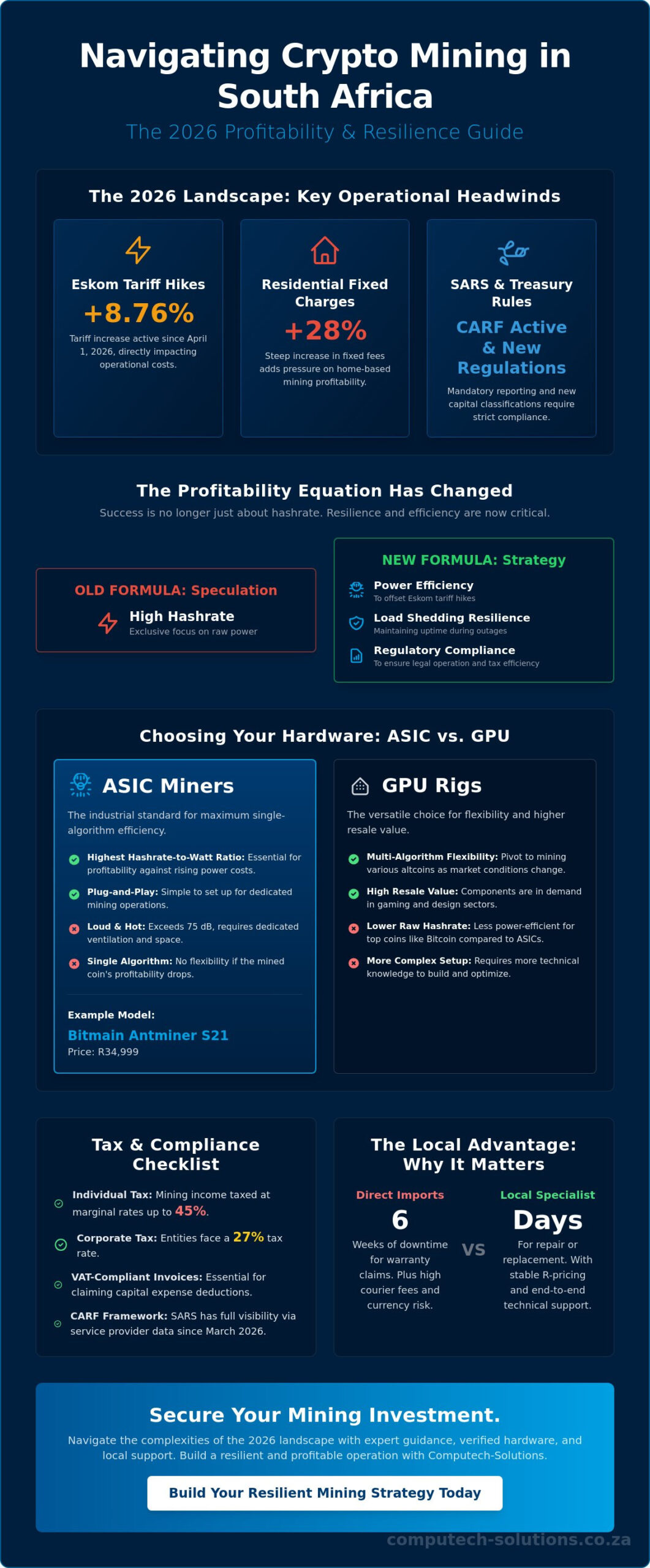
The fastest ASIC on the market won’t generate a cent of profit if it sits idle during a Stage 6 power outage. While many investors focus exclusively on finding high-performance crypto mining hardware for sale South Africa, the 2026 landscape requires a shift toward power resilience and cooling efficiency. With Eskom’s 8.76% tariff increase active since April 1, 2026, and fixed residential charges climbing by 28%, hardware choice is now only half of the profitability equation. You need a setup that survives local grid instability while maintaining the hashrates required to offset rising operational costs.
We understand the frustration of managing sensitive electronics when local technical support is scarce and SARS reporting under the new Crypto-Asset Reporting Framework adds administrative weight. This guide simplifies your path to a stable mining operation by providing expert technical and logistical insights. You’ll gain a clear understanding of current hardware prices, such as the Bitmain Antminer S21 at R34,999, and learn how to navigate the draft Capital Flow Management Regulations. We’ll show you how to build a resilient mining strategy that secures local warranties and maximizes your return on investment despite the expiration of previous solar tax incentives.
Key Takeaways
- Learn how to select the most profitable crypto mining hardware for sale South Africa by balancing raw ASIC power against the versatile longevity of GPU rigs.
- Master the logistics of load shedding resilience with specialized power solutions designed to maintain 99% uptime during frequent grid interruptions.
- Discover why high-efficiency PSUs and advanced thermal management are essential for protecting your hardware investment in South African ambient temperatures.
- Evaluate the impact of the 2026 Eskom tariff hikes and new SARS reporting requirements on your net mining profitability.
- Minimize operational risks by sourcing through local South African specialists who provide end-to-end technical support and verified hardware warranties.
Navigating the South African Crypto Mining Landscape in 2026
The South African blockchain environment has transitioned from a speculative frontier into a sophisticated asset class. As of May 2026, the National Treasury’s draft Capital Flow Management Regulations have officially proposed classifying digital assets as capital, signaling a new era of institutional and professional involvement. For those seeking crypto mining hardware for sale South Africa, this shift means that success now depends on technical precision and regulatory alignment rather than luck. Investors require a foundational understanding of cryptocurrency to distinguish between the raw power of ASIC (Application-Specific Integrated Circuit) miners and the versatile, multi-algorithm capabilities of GPU-based rigs. This maturing market demands a move away from unverified imports toward hardware solutions that offer local support and predictable performance.
The Evolution of Mining Profitability
The transition from hobbyist setups to professionalized “home-farms” is a direct response to rising hashrate difficulty and the increasing cost of uptime. With Eskom implementing an 8.76% tariff increase on April 1, 2026, efficiency is the only path to a positive return. Standard hobbyist gear often lacks the power-to-hashrate ratio required to remain profitable under these new rates. Procurement is also complicated by the South African Rand’s volatility against the US Dollar, which can fluctuate by 5% or more in a single week. Buying local hardware stabilizes these costs, as established providers often hedge their inventory against currency swings. This allows you to plan your capital expenditure without the fear of sudden price hikes during the shipping process.
Regulatory and Compliance Basics
Compliance is no longer a grey area for South African miners. Since the implementation of the Crypto-Asset Reporting Framework (CARF) on March 1, 2026, SARS has direct visibility into mining activities through service provider data. Individual mining income is taxed as revenue at marginal rates reaching 45%, while corporate entities face a 27% tax rate. Sourcing your crypto mining hardware for sale South Africa from VAT-compliant retailers ensures you have the necessary documentation to claim capital expense deductions against your tax liability. Local warranties are also a critical component of business continuity. If a hashboard fails, a local warranty allows for a replacement or repair within days. This is a vital advantage over direct imports, where shipping a unit back to a manufacturer in Asia can result in six weeks of lost revenue and high courier fees.
Choosing Between ASIC Miners and GPU Rigs for Local Profitability
Selecting the right crypto mining hardware for sale South Africa involves a strategic trade-off between raw hashing power and operational flexibility. ASIC miners, such as the Bitmain Antminer S21 (188TH) currently priced at R34,999, are engineered for a single purpose: maximum efficiency on specific algorithms. These units offer the highest hashrate-to-wattage ratio, which is vital for staying ahead of Eskom’s 8.76% tariff increases. Conversely, GPU rigs provide a multi-purpose alternative. These systems use high-end graphics cards to mine various altcoins, allowing you to pivot as market conditions shift. While a GPU rig might deliver lower hashrates for Bitcoin, its components retain significantly higher resale value in South Africa’s active gaming and digital design sectors. If you’re unsure which path fits your current infrastructure, our team at Computech-Solutions can provide a tailored hardware assessment.
ASIC Miners: The Industrial Standard
ASIC machines currently dominate the local market due to their plug-and-play nature. Models like the WhatsMiner M60 (156TH), available for R48,200, or the budget-friendly S19K Pro (120TH) at R23,900, are designed for 24/7 industrial use. However, these machines are loud and generate substantial heat, often exceeding 75 decibels. This makes them unsuitable for residential areas without dedicated soundproofing and ventilation. Technically, they require specialized high-amperage power environments and 16A plugs, as standard domestic circuits often fail under the sustained 3000W+ draw. Maintaining these units requires a stable environment, as research into Solar Integration and Load Shedding Resilience highlights that consistent power is the primary factor in hardware longevity.
GPU Mining: The Flexible Alternative
GPU rigs remain the preferred choice for those who value hardware versatility. A typical rig consists of a specialized motherboard, PCIe risers, and multiple NVIDIA or AMD cards. While the initial setup is more complex than an ASIC, the ability to mine different algorithms offers a hedge against the volatility of any single coin. To maintain stability, these rigs require high-wattage, Gold or Platinum-rated power supplies to handle the fluctuating power draw of multiple cards. South African investors often favor this route because, unlike ASICs which become obsolete once their hashrate is no longer competitive, GPUs can be liquidated easily to local PC enthusiasts. When looking for crypto mining hardware for sale South Africa, consider your long-term exit strategy; a GPU rig is an asset with a much broader secondary market than a specialized ASIC.
Solving the Power Puzzle: Solar Integration and Load Shedding Resilience
Maintaining 99% uptime during Stage 6 load shedding is the most significant operational hurdle for local miners. Most off the shelf UPS units are designed for office workstations with a 200W draw. A high performance ASIC pulls between 1200W and 3500W continuously. A standard UPS will deplete its lead acid battery in minutes, causing a hard shutdown that risks corrupting firmware or damaging delicate hashboards. When you invest in crypto mining hardware for sale South Africa, your power strategy must be as robust as your hashing gear. Hard shutdowns aren’t just an inconvenience; they’re a direct threat to the lifespan of your equipment.
The “Solar Alpha” refers to the competitive edge gained by utilizing zero marginal cost energy. Although the 25% residential solar tax rebate expired on February 29, 2024, the business case for solar remains strong due to the rising fixed charges implemented by Eskom this year. By integrating a solar array, you effectively lock in your energy costs for the next two decades. This move insulates your operation from future NERSA approved increases and significantly reduces your break even time by eliminating the highest tier of municipal electricity billing during daylight hours.
Inverter and Battery Requirements
Successful integration requires pure sine wave inverters rated for continuous industrial loads. Modified sine wave units generate “dirty” power that can cause PSU failure in weeks. High discharge Lithium Iron Phosphate (LiFePO4) batteries are essential for this application. Unlike older gel batteries, LiFePO4 cells support a high depth of discharge and thousands of cycles without significant degradation. Professional miners use automated management software to throttle or shut down rigs when the battery state of charge drops below a specific threshold. This ensures the system never crashes unexpectedly during extended night time outages.
The Computech-Solutions Advantage
Computech-Solutions bridges the gap between IT infrastructure and energy management. We don’t just supply hardware; we commission entire power ecosystems. Our backup solutions include advanced surge protection, drawing on the engineering expertise of Energy Control Systems, to shield sensitive hashboards from the voltage spikes that frequently follow load shedding restoration. Choosing a partner with a one stop shop philosophy means your crypto mining hardware for sale South Africa is backed by technicians who understand both the blockchain and the electrical grid. We provide the end to end support necessary to keep your rigs hashing when the rest of the country goes dark.
Critical Hardware Components: Beyond the Miner
While the miner itself performs the work, the supporting infrastructure determines if that work is sustainable. High-quality power supply units (PSUs) are the first line of defense against local grid fluctuations. For professional operations, Gold or Platinum-rated PSUs are non-negotiable because they ensure 90% to 94% efficiency. Lower-tier units waste energy as heat, which compounds your cooling costs. When evaluating crypto mining hardware for sale South Africa, you must also prioritize high-gauge 16AWG cabling and verified PCIe risers. Substandard components can melt under the continuous 24/7 draw of a high-hashrate miner, creating a fire hazard that standard insurance may not cover.
Monitoring tools provide the necessary oversight for remote operations. Smart plugs with high-amperage ratings allow you to power-cycle a frozen rig from your phone, while temperature sensors alert you to fan failures before they cause permanent damage. These small additions turn a high-maintenance hobby into a professionalised asset.
Cooling and Airflow Strategy
A “Hot and Cold Aisle” system is the most effective way to manage heat in South African conditions. This involves physically separating the intake side of your rigs from the exhaust side to prevent hot air recirculation. Dust and humidity also pose significant risks to hashboard longevity, requiring regular cleaning with compressed air. Thermal throttling is a protective mechanism where hardware reduces its clock speed to prevent heat damage, resulting in a significant drop in hashrate and profitability.
Networking and Stability
Low-latency internet connections are more critical than raw download speed. High latency causes “stale shares,” where your miner submits a solution for a block that’s already been found by someone else. Hardwired Ethernet is always superior to Wi-Fi for this reason, as it eliminates the packet loss common in wireless environments. If you’re building a multi-rig farm, professional network switches ensure consistent data flow across all units. For a comprehensive list of high-durability components, contact Computech-Solutions for professional hardware procurement and technical guidance.
Secure Your Mining Investment with Computech-Solutions
Buying crypto mining hardware for sale South Africa shouldn’t be a gamble with unverified international sellers or fly-by-night importers. Computech Solutions provides a stable, authoritative bridge between high-performance hardware and the practical realities of the South African business environment. We eliminate the stress of customs delays and the inherent risk of receiving dead-on-arrival equipment without a clear return path. By sourcing locally, you secure a partner committed to your long-term uptime. Our team understands the technical nuances of the 2026 regulatory environment, including the April 1 Eskom tariff hikes and the March 1 CARF reporting requirements. We ensure that your hardware investment is not only technically sound but also strategically aligned with local compliance standards.
Our Pretoria-based technical hub serves as the core of our national support network, providing a level of service excellence that international retailers cannot match. We provide more than just a box. We offer the expertise needed to maintain rig controllers and replace specialized components, such as high-discharge capacitors and industrial-grade fans, that standard IT shops simply do not stock. This one-stop-shop philosophy is essential for investors who need their IT infrastructure, solar backup, and mining hardware to function as a single, cohesive unit. Whether you require a replacement fan for an Antminer S21 or a firmware optimization for a multi-GPU rig, our technicians ensure your hardware remains within its optimal operating parameters.
Technical Support and Maintenance
- Direct access to replacement parts including laptop-grade rig controllers and high-CFM cooling fans.
- Expertise in Pretoria translated into nationwide service excellence through remote diagnostics and on-site support.
- A unified support structure covering IT networking, solar integration, and specialized mining hardware.
Getting Started Today
Building a future-proof operation starts with a bespoke consultation. We analyze your available power capacity against your hashrate goals to provide a realistic projection of operational viability. Our procurement process is streamlined for efficiency, offering nationwide shipping and professional installation services to ensure your equipment is configured correctly from the first boot. We take the guesswork out of thermal management and power distribution, allowing you to focus on managing your digital asset portfolio. Don’t let technical complexity or energy uncertainty stall your investment. Reach out to our specialists to discuss a tailored hardware and power configuration that meets your specific requirements.
View our full range of computer hardware and power solutions to begin your journey with a partner you can trust. Our commitment to end-to-end support ensures that your mining operation remains resilient, profitable, and professionally managed.
Secure Your Competitive Edge in the Local Mining Market
Successful mining in 2026 requires a shift from pure performance to total operational resilience. You’ve seen that high-end units only deliver value if you can maintain 99% uptime through local load shedding cycles. With the April 1, 2026, Eskom tariff hikes and the March 1, 2026, implementation of the Crypto-Asset Reporting Framework, the margin for technical error has disappeared. Finding the right crypto mining hardware for sale South Africa is now about securing local warranties and expert technical support to protect your capital investment against grid instability and regulatory shifts.
Computech Solutions has been a trusted South African IT retailer since 2018, providing the stability you need in a volatile market. We offer nationwide delivery across all nine provinces and specialized expertise in integrating power and hardware solutions. Whether you’re scaling an existing farm or starting your first professional setup, our team is ready to help you navigate these technical requirements with confidence. We ensure your hardware is backed by the support necessary for long-term profitability.
Browse Our Professional Crypto and Power Hardware Range to secure your infrastructure today. Your path to a profitable, future-proof mining operation is within reach when you have the right partner by your side.
Frequently Asked Questions
Is crypto mining still profitable in South Africa in 2026?
Profitability remains viable for operators who prioritize energy efficiency and utilize solar integration to offset the 8.76% Eskom hike implemented on April 1, 2026. Success requires using high-hashrate crypto mining hardware for sale South Africa that delivers a low watt-per-terahash ratio. Those relying solely on residential grid power face tighter margins due to the 28% increase in fixed monthly charges that took effect earlier this year.
How much electricity does a typical ASIC miner consume per month?
A high-performance unit like the Bitmain Antminer S21 consumes approximately 2,520 kWh per month when running continuously. This calculation is based on its 3,500W power draw over a 24-hour, 30-day cycle. You must factor in the July 1, 2026, municipal tariff increase of 9.01% when calculating your monthly overheads to ensure your mining revenue consistently exceeds these localized utility costs.
Can I run a mining rig entirely on solar power in South Africa?
Running a rig 100% on solar is technically possible but requires a substantial investment in Lithium Iron Phosphate (LiFePO4) battery storage for night-time operation. A single 3,500W ASIC requires roughly 84kWh of storage to survive a full 24-hour cycle without grid assistance. Most local investors opt for a hybrid approach; they use solar during peak sunlight hours to reduce the impact of high daytime electricity tiers.
What is the difference between a GPU rig and an ASIC miner?
ASIC miners are specialized machines built for one specific algorithm, while GPU rigs use graphics cards to mine various digital assets. ASICs offer significantly higher hashrates and efficiency for coins like Bitcoin or Kaspa. GPU rigs provide better flexibility and hardware longevity, as the components can be resold to the local gaming or design markets if you decide to exit the mining sector.
How do I protect my mining hardware from power surges during load shedding?
You must use industrial-grade surge protection and pure sine wave inverters to shield your hashboards from voltage spikes. The most dangerous moment for your equipment is when the grid returns after a load shedding cycle. Smart management tools and high-quality PSUs are essential components when looking for crypto mining hardware for sale South Africa to prevent permanent electrical damage to the chips.
Do I need a special permit to mine cryptocurrency in South Africa?
No specific mining permit is required as of May 2026, but compliance with the Crypto-Asset Reporting Framework (CARF) is mandatory. You must report your transactions to SARS, as mining income is taxed as revenue at rates up to 45%. The draft Capital Flow Management Regulations released in April 2026 may also require residents to declare holdings above a specific threshold yet to be finalized.
What happens if my mining hardware fails and it is out of warranty?
Out-of-warranty failures require specialized repair at a technical hub that stocks ASIC-specific components like hashboards and control boards. Most generic PC repair shops cannot service these units due to the specialized soldering and firmware required. Sourcing your hardware from a local partner ensures you have access to a supply chain of replacement parts and technicians who understand the specific thermal requirements of mining gear.
How much does it cost to set up a basic home mining rig?
A basic professional setup starts with the hardware cost, such as the Bitmain Antminer S19K Pro at R23,900, plus the cost of electrical infrastructure. You should budget for a 20A circuit breaker, high-gauge 16AWG cabling, and adequate ventilation. If you include a basic power backup system to survive Stage 4 load shedding, your initial capital expenditure will increase based on the specific battery capacity required for your uptime goals.
