
Is paying a significant premium for a branded logo the only way to keep your hardware functional? Many South Africans wonder are generic laptop chargers safe when faced with original equipment manufacturer costs that far exceed third-party alternatives. While the national grid has remained stable with no load shedding since mid-May 2025, the risk of unexpected power surges still makes your choice of power adapter a critical hardware decision.
We understand the frustration of trying to decode complex technical specifications while worrying about potential motherboard failure or electrical fires. This guide provides the technical clarity you need to distinguish between a dangerous counterfeit and a high-quality, regulated replacement. You’ll learn how to verify the mandatory NRCS Letter of Authority, match voltage and amperage with precision, and identify reliable South African suppliers for brands like Dell, HP, and Lenovo. We’ll show you how to secure a cost-effective power solution that maintains your laptop’s operational efficiency without compromising its safety.
Key Takeaways
- Distinguish between high-quality generic adapters and dangerous counterfeits by identifying illegal branding and inferior internal circuitry.
- Master the technical requirements for your hardware, ensuring an exact voltage match while understanding why higher amperage is safe for your laptop.
- Learn how premium capacitors and transformers within vetted chargers act as a critical defense against unpredictable grid surges.
- Understand the regulatory landscape to determine are generic laptop chargers safe by verifying the mandatory NRCS Letter of Authority for South African electronics.
- Identify the operational benefits of sourcing replacement chargers from a specialist that tests components for long-term hardware stability.
Understanding the Safety of Generic Laptop Chargers
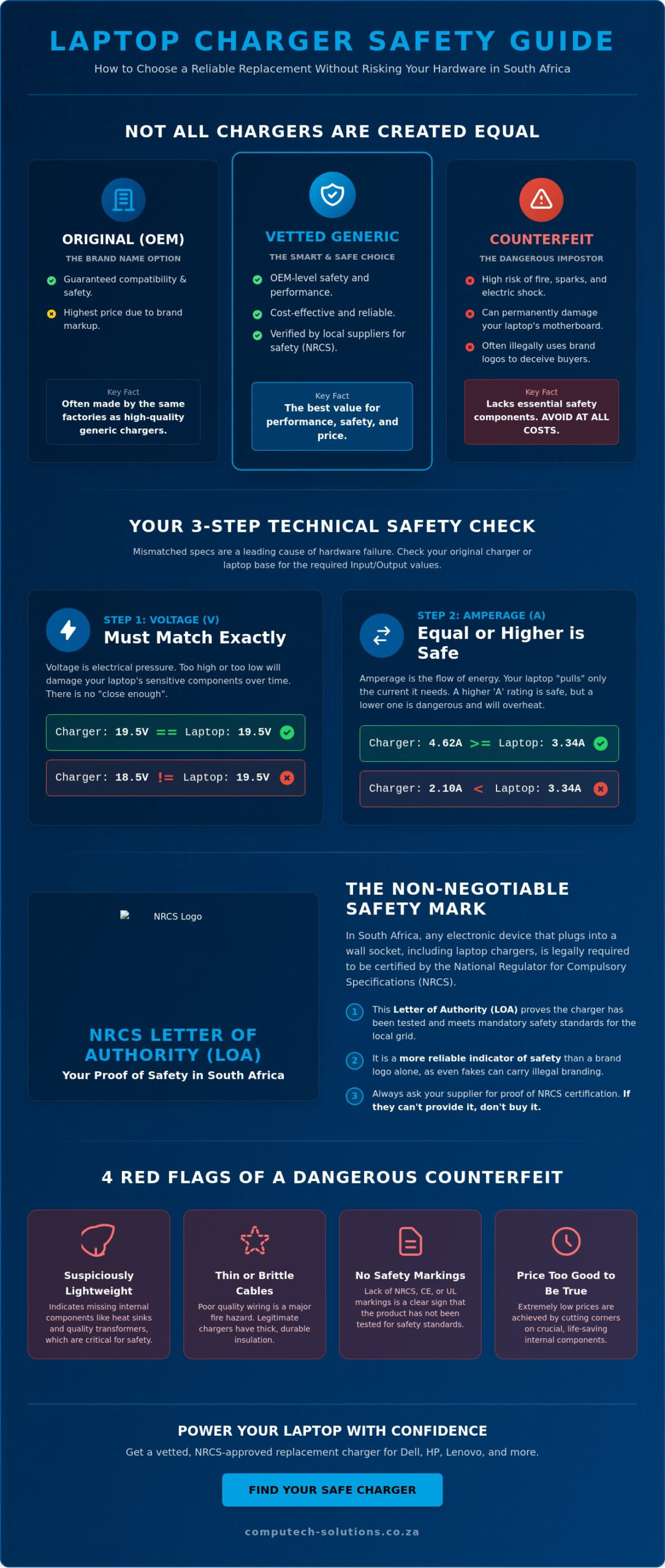
The question of whether are generic laptop chargers safe often stems from a lack of clear definitions within the consumer electronics market. To make an informed decision, you must distinguish between three distinct categories: Original Equipment Manufacturer (OEM) units, high-quality third-party replacements, and dangerous counterfeits. While the term “generic” is often used as a catch-all for anything without a brand-name logo, the reality is more nuanced. High-quality generic chargers are engineered to meet the same electrical standards as original parts, providing a reliable power solution at a more accessible price point.
The Myth of the “Magic” OEM Charger
Many users believe that laptop brands like Dell or HP manufacture their own power supplies in-house. In reality, these companies typically outsource production to specialized electronics firms. These third-party manufacturers produce the internal circuitry based on the brand’s specifications. When you buy an OEM charger, you’re frequently paying a significant premium for the logo rather than a proprietary technology that doesn’t exist elsewhere. Understanding what an AC adapter is helps clarify this; it’s a standard piece of power conversion hardware designed to transform high-voltage AC from your wall socket into the low-voltage DC your laptop requires. If a generic replacement uses the same high-grade internal components, it’s technically equivalent to the original.
When “Generic” Becomes a Risk
The danger arises when consumers confuse reputable third-party replacements with unverified, ultra-cheap counterfeits. A counterfeit charger often illegally uses a brand’s logo to hide inferior internal components that lack essential safety features. These “grey market” units are the primary reason why people ask are generic laptop chargers safe. To protect your hardware, watch for these red flags:
- Lightweight housing that suggests missing heat sinks or smaller transformers.
- Cables that feel thin or brittle to the touch.
- A complete lack of mandatory safety markings or the NRCS Letter of Authority certification.
A reputable replacement charger isn’t “unbranded” in a way that hides its origin. Instead, it’s a transparent alternative sourced from a supplier that assumes responsibility for the unit’s performance and safety. In South Africa, every charger sold must have a Letter of Authority (LOA) from the National Regulator for Compulsory Specifications (NRCS). This certification is a more reliable indicator of safety than a brand logo alone. When sourced from a specialized partner, a vetted generic charger provides the stability your hardware needs without the inflated brand-name cost.
The Technical Checklist: Voltage, Amperage, and Polarity
To determine are generic laptop chargers safe for your specific device, you must look beyond the plastic casing and examine the electrical output specifications. Technical compatibility is not a suggestion; it’s a strict requirement for hardware safety. While the South African power grid has stabilized significantly since 2025, using a charger with mismatched specifications remains one of the leading causes of avoidable motherboard failure. Matching the technical profile of your original adapter ensures that your laptop receives stable power without overstressing internal components.
Matching Specs to Your Laptop Base
Your first step is identifying the exact power requirements of your machine. You’ll find these details on a sticker located on the bottom of the laptop or printed directly onto the original power brick. Look for the “Output” section on the charger or “Input” on the laptop. Voltage represents the electrical pressure, while Amperage represents the flow of energy. You must find an exact match for the Voltage (V) to ensure the device operates within its designed parameters. If you’re struggling to identify these numbers, sourcing Laptop Chargers from a specialized technical supplier can help you avoid the guesswork of manual matching.
The “Close Enough” Trap
Many users fall into the trap of thinking a small difference in Voltage won’t matter. This is a mistake. A difference of even 1V can potentially damage sensitive motherboard capacitors or cause the battery to degrade prematurely. While Voltage must be an exact match, Amperage (A) works differently. It’s perfectly safe to use a charger with a higher Amperage than your laptop requires because the device will only “pull” the current it needs. However, using a charger with lower Amperage is dangerous. An underpowered charger will run at maximum capacity constantly, leading to extreme overheating and potential fire risks. A higher wattage charger actually runs cooler and lasts longer because it isn’t constantly pushed to its thermal limits.
Beyond the numbers, the physical connection and electrical orientation are vital. The connector tip must provide a snug, secure fit. Loose connections cause electrical arcing, which generates intense heat and can melt the DC jack inside your laptop. You also need to verify the polarity, which is the positive and negative orientation of the plug. Most modern laptops use a “center-positive” configuration, but a mismatch here will result in an immediate short circuit. High-quality replacements often adhere to the UL Information and Communication Technology (ICT) Power Cable Certification Program, which tests for these specific thermal and electrical hazards. When these technical boxes are checked, are generic laptop chargers safe? The answer is a definitive yes, provided the build quality matches the specification accuracy.
Generic vs. Counterfeit: Why Quality Standards Matter
Understanding the physical construction of a power adapter is just as important as matching the electrical specifications discussed previously. When users ask are generic laptop chargers safe, they’re often actually concerned about counterfeits. A counterfeit product is an illegal imitation that uses a recognizable brand logo to mask substandard internal components. In contrast, a high-quality generic is a transparent third-party replacement built to rigorous electrical standards. The distinction lies in the integrity of the internal circuitry, which determines how the unit handles heat and electrical noise.
The weight of a charger is a primary indicator of its safety and build quality. Quality units contain heavy copper transformers and large capacitors designed to smooth out the electrical signal. Extremely light chargers often skip essential electromagnetic shielding and heat sinks to reduce manufacturing costs. These missing components lead to a “ripple effect” where the DC output isn’t a smooth line but a jagged, unstable wave. This “dirty” power doesn’t just cause immediate glitches; it slowly degrades the chemical health of your laptop battery, leading to premature capacity loss and expensive hardware replacements.
Essential Safety Protections to Look For
A reliable replacement charger acts as a firewall between the wall socket and your expensive hardware. High-quality generics include Overvoltage Protection (OVP), which prevents sudden grid spikes from reaching your motherboard. They also feature Short Circuit Protection (SCP) to shut down power instantly if a fault is detected. Finally, Over-temperature Protection (OTP) ensures the plastic housing doesn’t become a fire hazard if the unit is used in a poorly ventilated area. These features are standard in vetted replacements but are frequently omitted in unbranded, ultra-cheap alternatives.
The Cost of Cutting Corners
Choosing an unverified charger leads to operational disruptions that extend beyond simple charging issues. Substandard internal components often result in electromagnetic interference (EMI), which can disrupt your Wi-Fi signal or cause static in audio devices. You might also notice screen flickering or erratic touchpad behavior while the laptop is plugged in. These are clear signs of unstable power delivery that puts your motherboard at risk. Sourcing your hardware from a reputable local retailer is your best defense against these risks. When you choose a supplier that tests their stock for safety compliance, the answer to are generic laptop chargers safe becomes a reassuring yes. This professional vetting process ensures that your replacement hardware supports your business continuity rather than threatening it.
Protecting Your Laptop from Power Surges and Load Shedding
As of May 2026, South Africa has experienced a full year without load shedding. This dramatic improvement in grid stability is a significant milestone, yet it doesn’t eliminate the need for robust power protection. Localized faults, lightning strikes, and maintenance-related switching can still cause electrical surges. When users ask are generic laptop chargers safe, they must consider how a charger handles these unpredictable events. A high-quality power adapter serves as the first line of defense, sacrificial if necessary, to save your laptop’s more expensive internal components.
The standard 230V supply in South Africa can fluctuate. While we no longer face the 335 days of load shedding seen in 2023, the national infrastructure still experiences “restoration surges” during localized repairs. Poorly manufactured chargers often lack the sophisticated surge suppression required to filter these spikes. In contrast, vetted generic replacements use high-grade metal oxide varistors (MOVs) to clamp excessive voltage before it reaches your motherboard. This protection is vital for maintaining the operational life of your hardware in a region where grid instability was historically a major economic burden.
Surge Suppression and Voltage Regulation
A premium adapter acts as a sophisticated buffer. It converts raw AC power into a regulated DC stream, absorbing minor fluctuations within its internal transformer. The “brick” is designed to manage these variances so your laptop doesn’t have to. For maximum safety, you should always pair your charger with a SANS 164-2 compliant plug, the current South African standard for new installations. This ensures a secure physical connection that minimizes the risk of arcing during power spikes. If you need a reliable power solution, you can browse our range of Laptop Chargers to find a tested replacement for your specific model.
Managing Heat During Power Cycling
Heat is the primary enemy of electronics. Even without frequent load shedding, your charger works harder when your laptop battery is deeply discharged. High-quality generic chargers are designed with superior heat dissipation, often featuring larger internal heat sinks and ventilated housings. This prevents the unit from reaching dangerous temperatures during long charging cycles. To ensure safety, don’t cover your charger with papers or fabric while it’s in use. Placing the adapter on a hard, flat surface allows for natural airflow, which is essential for the longevity of both the charger and your laptop’s battery. When these thermal and electrical protections are present, the answer to are generic laptop chargers safe is a confident yes, even within the unique context of the South African power environment.
Why Vetted Replacement Chargers are the Smart Choice
Determining are generic laptop chargers safe comes down to a single factor: professional accountability. In a market flooded with unverified imports, the risk of purchasing a unit with poor voltage regulation is high. Computech-Solutions eliminates this uncertainty by acting as a technical filter. We source only from manufacturers who comply with the National Regulator for Compulsory Specifications (NRCS) standards. This proactive approach ensures that every charger we sell provides the precise electrical pressure your motherboard requires without the risk of thermal runaway.
The Computech-Solutions Quality Guarantee
Our technical team understands that a charger for a high-end Dell or HP workstation has different thermal requirements than a standard Acer notebook. We don’t just look for a plug that fits; we verify that the internal capacitors and transformers can handle the 230V standard and occasional grid fluctuations. By focusing on NRCS safety certifications rather than the lowest possible manufacturing cost, we provide a product that protects your investment. Our vetting process is rigorous and brand-specific, covering replacements for ASUS, Lenovo, and Samsung laptops to ensure the exact output profile matches the original factory specifications.
We prioritize the inclusion of high-grade internal shielding and robust power cords that meet the SANS 164-2 standard. This level of detail prevents the common pitfalls of dirty power, such as erratic touchpad behavior or screen flickering, which are often seen in unvetted generic alternatives. By selecting components based on performance benchmarks rather than price alone, we ensure your hardware remains operational for years to come. When you choose a vetted unit, you’re opting for a component that has been tested for long-term stability and electrical safety.
Easy Nationwide Access to Reliable Power
Buying online often leaves users feeling isolated if a technical mismatch occurs. We solve this by providing direct local support to help you verify voltage and amperage before you buy. Our nationwide delivery service ensures you receive a high-quality replacement quickly, backed by a South African warranty that a foreign marketplace seller simply can’t offer. Supporting a local business means you get expert advice and a definitive solution for your IT needs, whether you’re looking for Apple, Sony, or Toshiba power adapters.
Securing a reliable power supply is essential for business continuity in 2026. Find the perfect safe replacement charger for your laptop today and enjoy the peace of mind that comes with professionally vetted hardware. We offer a comprehensive range of power solutions that balance cost-efficiency with uncompromising safety, ensuring you aren’t just buying a power brick, but investing in the stability of your digital workspace.
Secure Your Hardware with Professional Power Solutions
Choosing the right power adapter is a critical decision that directly impacts the lifespan of your laptop. We’ve established that the answer to are generic laptop chargers safe depends entirely on technical accuracy and manufacturing integrity. By matching voltage precisely and ensuring your charger has the necessary surge protections, you can maintain your device’s operational efficiency without the excessive cost of OEM branding. While South Africa’s grid has stabilized, the internal quality of your power brick remains your primary defense against electrical faults and hardware degradation.
Computech-Solutions provides a definitive solution for users who need reliability without compromise. Every replacement unit in our inventory undergoes strict quality control to meet the high standards your business demands. We offer expert technical support based right here in South Africa and provide a comprehensive warranty on all chargers and batteries for your peace of mind. Don’t leave your hardware safety to chance with unverified imports. Browse our range of high-quality, vetted laptop chargers with nationwide delivery today. You can confidently power your professional growth with hardware that’s built to last.
Frequently Asked Questions
Is it okay to use a charger with a different Wattage than my original?
It’s safe to use a charger with a higher wattage than your original, but you should never use one with a lower rating. A higher-wattage unit provides more headroom, allowing the adapter to run cooler while the laptop only draws the specific power it needs. Using a lower-wattage unit forces the charger to work at maximum capacity constantly, which leads to overheating and potential component failure.
Can a generic charger damage my laptop battery health?
High-quality generic chargers that match your machine’s voltage won’t damage your battery health. However, poorly made units often produce “dirty” power with excessive electrical noise or ripple. This unstable current causes chemical stress within the battery cells, leading to a faster decline in capacity. When asking are generic laptop chargers safe for your battery, the answer depends entirely on the quality of the internal capacitors.
How can I tell if a generic charger is high quality or a dangerous fake?
Look for the mandatory NRCS Letter of Authority certification on the label, which is a legal requirement for all chargers sold in South Africa. High-quality units generally feel heavier because they contain substantial copper transformers and internal heat sinks. Avoid adapters that illegally use a manufacturer’s logo while being sold at suspiciously low prices, as these are often dangerous counterfeits rather than reputable replacements.
Do generic chargers void my laptop manufacturer warranty?
Using a third-party charger doesn’t automatically void your entire hardware warranty. However, if a substandard charger causes physical damage to the motherboard or charging port, the manufacturer will likely refuse to cover those specific repairs. It’s best to use a vetted replacement from a reputable supplier to ensure the electrical output stays within the laptop’s safe operating parameters at all times.
Why does my generic laptop charger get so hot when I use it?
Chargers naturally generate heat during power conversion, but excessive heat often indicates an underpowered unit or poor internal heat dissipation. If the charger is too hot to touch comfortably, it might be struggling to meet the laptop’s amperage demands. High-quality generics use larger internal heat sinks to manage this thermal energy more effectively than ultra-budget alternatives that skip these essential safety components.
What should I do if the charger connector feels loose in the laptop port?
Stop using the charger immediately if the connection feels loose or unstable. A poor fit causes electrical arcing, which generates intense heat capable of melting the plastic housing or damaging the internal DC jack on your motherboard. This physical mismatch is a common issue with low-quality universal tips. Always ensure you use a replacement with a connector tip specifically engineered for your laptop model.
Are universal laptop chargers with multiple tips safe to use?
Universal chargers are generally less reliable than model-specific replacements. The adjustable voltage sliders can be accidentally moved, potentially sending excessive power to your device. Additionally, the interchangeable tips often provide a less secure connection than a fixed tip, increasing the risk of overheating. For maximum safety, choose a dedicated replacement designed for your specific brand, such as Dell, HP, or Lenovo.
Does it matter if the Amperage on the replacement is higher than the original?
It doesn’t matter if the replacement charger has a higher amperage than the original unit. Your laptop’s internal charging circuit only draws the specific amount of current it needs to operate and charge the battery. A higher amperage rating simply means the charger has a greater capacity to provide power. This makes it a safe choice that typically runs more efficiently and cooler than a unit matched exactly to the minimum requirement.
