
If you’re still relying on the national grid, you’re paying 8.76% more for electricity this year while risking the lifespan of your sensitive IT equipment with every power surge. Investing in a solar backup system for home South Africa is no longer just about avoiding the dark; it’s a precision-engineered strategy to protect your lifestyle and your hardware. You’ve likely felt the stress of unpredictable load shedding schedules and the rising costs of Eskom and municipal tariffs, which are set to climb by another 9.01% in July 2026. It’s frustrating to watch escalating bills coincide with a grid that threatens your productivity.
DIY solar kits might look appealing on a spreadsheet, but they carry significant technical risks that can compromise your home’s safety. Incorrectly installed systems lead to fire hazards, inefficient energy yields, and voided hardware warranties. A solar backup system for home South Africa is a high-voltage electrical installation that requires precise engineering to function safely over its lifespan. Treating these components as simple “plug-and-play” devices often results in premature battery failure or inverter damage. These systems are precision-engineered technical ecosystems, not retail commodities, and they require professional oversight and industrial-grade fastening materials to protect your property; learn more about the specialized assembly supplies from Würth South Africa.
We understand that your home office, laptops, and desktop computers require absolute stability to function effectively. This guide provides the technical roadmap you need to select, size, and implement a professionally commissioned, SANS-compliant system that secures your energy independence. We’ll walk you through the latest 2026 regulations, including the September 30 SSEG registration deadline and the specific battery configurations required to keep your essential electronics running without interruption.
Key Takeaways
- Understand why 2026 marks a critical transition from temporary emergency backups to primary residential energy generation models.
- Identify the four core pillars of a residential power kit and why the hybrid inverter is the essential brain for managing energy flow.
- Compare hybrid and off-grid configurations to determine which solar backup system for home South Africa provides the best balance of reliability and grid interaction.
- Learn the precise formula to calculate your daily kWh requirements by auditing essential loads like home offices and high-performance desktop computers.
- Discover how professional commissioning ensures your installation remains SANS-compliant while protecting your hardware warranties and home safety.
Navigating the South African Energy Landscape with Home Solar Kits
A solar backup system for home South Africa is a modular, integrated energy solution designed for long term residential stability. It’s no longer a temporary fix for occasional outages. In 2026, the landscape has shifted significantly. We’re seeing a definitive transition from “emergency backup” models to “primary generation” strategies. This change is driven by the 8.76% Eskom tariff hike and the 9.01% municipal increase effective July 1, 2026. By generating your own power, you offset these escalating costs while securing your home’s operational efficiency. A true “Total Solution” combines high grade hardware with expert technical commissioning to ensure your system meets all safety standards.
Understanding the technical synergy between various photovoltaic system components is the first step toward energy independence. These systems move beyond simple battery storage by creating a sophisticated ecosystem that manages energy flow between the sun, the grid, and your home. This approach provides a streamlined path to reducing monthly utility bills while maintaining a consistent power supply for your most critical devices.
The Reality of Load Shedding in 2026
The national grid remains unpredictable, making energy sovereignty a necessity rather than a luxury. While a basic UPS might keep a router alive for an hour, a full scale residential solar panel kit manages your entire household load. This level of protection is vital for sensitive home office equipment. Power surges and brownouts can easily destroy the internal components of high end laptops or desktop computers. Investing in a robust system prevents the hardware failure and data loss that often accompany grid instability, ensuring your professional tools remain operational during any stage of load shedding.
Why Pre-Configured Kits are the Smart Choice
Choosing a pre-configured kit eliminates the technical risks associated with mismatched components. These kits ensure tested compatibility between inverters and lithium batteries, which maximizes the overall lifespan of your storage units. Modern systems are also highly scalable. You can start with a baseline configuration and add more capacity as your energy demands grow. With nationwide delivery available across South Africa, you can access consistent hardware quality regardless of your location. This approach allows you to move quickly from identifying an energy challenge to implementing a definitive, all encompassing solution.
Anatomy of a Solar Power Kit: Essential Components for Residential Use
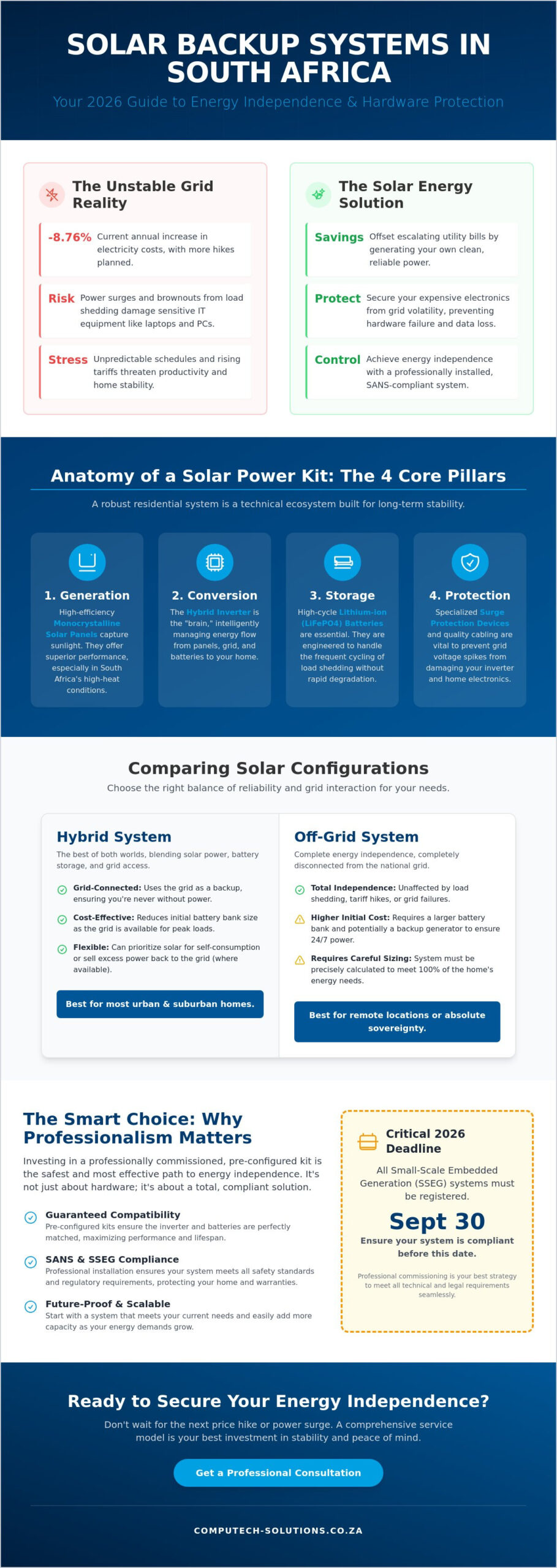
A robust solar backup system for home South Africa isn’t just a single appliance; it’s a technical ecosystem built on four core pillars: Generation, Conversion, Storage, and Protection. While portable power stations offer temporary relief for small gadgets, a fixed residential kit provides the stability required for long term energy independence. The hybrid inverter acts as the “brain” of this operation, intelligently managing the flow of electricity between the solar panels, the Eskom grid, and your battery bank. This modularity allows homeowners to scale their systems as their energy needs evolve, ensuring the solution remains effective for years to come.
Modern South African installations have transitioned almost exclusively to high-cycle Lithium-ion (LiFePO4) batteries. These units are specifically engineered to handle the frequent cycling caused by load shedding without the rapid degradation seen in older lead-acid technology. A well-designed solar backup system for home South Africa relies on this synergy between storage and protection. Given the volatility of South Africa’s renewable energy landscape, specialized surge protection devices and high-quality, heat-resistant cabling are essential. These components prevent grid-induced voltage spikes from damaging your expensive inverter or sensitive household electronics.
Solar Panels: Efficiency and Reliability
Monocrystalline panels are the preferred choice for South African homes due to their higher efficiency and superior performance in high-heat conditions compared to polycrystalline alternatives. When reviewing panels, focus on the wattage rating to dictate your daily energy generation potential. We recommend sourcing Tier 1 manufactured panels. This classification ensures the hardware is produced by financially stable companies using automated processes, which translates to long-term hardware reliability and valid 25-year performance warranties even in harsh coastal or highveld environments.
Inverter and Battery Synergy
Your inverter’s peak load must be sized to match the startup requirements of your essential appliances. For professionals, using a Pure Sine Wave inverter is non-negotiable. These units produce clean power identical to the grid, which is vital for protecting the delicate circuitry in desktop computers and laptops. Additionally, pay close attention to the Battery Depth of Discharge (DoD). A higher DoD allows you to use more of the stored energy overnight without damaging the battery, ensuring your home remains powered until the sun rises the next morning.
Comparing Solar Configurations: Hybrid vs. Off-Grid Systems
Hybrid systems represent the most balanced and popular choice for South African homeowners in 2026. Unlike basic grid-tie configurations, which legally must shut down during load shedding to prevent back-feeding the grid, a hybrid solar backup system for home South Africa remains operational. It uses an integrated battery bank to bridge the gap the moment the national grid fails. This setup provides a reliable safety net for urban residents who want to reduce their reliance on Eskom while maintaining a connection for emergency backup or supplemental power during high-demand periods.
Choosing the right configuration starts with a clear understanding of your energy goals. Learning how to size your solar system is essential for determining if you can achieve total independence or if a blended approach is more cost-effective. While off-grid models offer total sovereignty, they require a significantly higher initial investment in hardware. For the majority of residential users, the hybrid model offers the best return on investment by combining cost-efficiency with absolute energy security.
Hybrid Solar: The Most Versatile SA Solution
Hybrid kits prioritize solar power for immediate household consumption and battery charging. They only draw from the grid when your solar generation and battery reserves are insufficient. This versatility is particularly useful in municipalities that allow for feed-in tariffs, enabling you to earn credits for excess energy sent back to the local network. The most critical benefit for professionals is the seamless transition. The switch to battery power happens in under 20 milliseconds. This speed is fast enough to prevent IT equipment like servers and desktop computers from rebooting, protecting your workflow from sudden outages.
Off-Grid: Total Energy Sovereignty
Off-grid systems are designed for total independence from the national grid, making them a definitive solution for remote areas or homeowners with substantial budgets. These systems require massive hardware arrays, including significantly larger battery banks to sustain the home through consecutive cloudy days. Without the grid as a fallback, your system must be perfectly engineered for worst-case scenarios. Before choosing this path, verify your home’s suitability with this technical checklist:
- Does your roof have the structural integrity and space for 15 or more high-efficiency panels?
- Is your budget prepared for a lithium battery bank with triple the capacity of a standard hybrid system?
- Can your household manage high-draw appliances manually during periods of low solar generation?
While off-grid living eliminates Eskom bills entirely, it demands disciplined energy management and a commitment to maintaining a complex, self-contained technical ecosystem.
Sizing Your Solar Solution: Calculating Load for Energy Stability
Sizing a solar backup system for home South Africa requires a data-driven approach rather than guesswork. You must conduct a thorough home energy audit to distinguish between “Essential” and “Non-Essential” loads. Essential loads are the devices that must remain operational during an outage, such as Wi-Fi routers, LED lighting, and refrigeration. Non-essential loads include high-drain appliances like geysers and electric ovens. These high-drain items can quickly deplete a battery bank if they aren’t managed correctly or isolated during load shedding.
To calculate your specific requirements, use the standard formula: (Watts of Appliance x Hours of Use) / 1000 = Daily kWh requirement. For example, a home office running a high-performance desktop computer (300W) and a monitor (50W) for 8 hours consumes 2.8 kWh daily. However, you can’t just look at running watts. You must also account for the “Startup Load” of inductive motors. A fridge or pool pump might only draw 150W to 500W while running, but these devices require three to five times that power to kick-start their compressors. If your inverter isn’t sized to handle these momentary peaks, the system will trip even if your total running load is low.
Always size your solar array for “worst-case” winter generation. In South Africa, June and July provide the fewest sunlight hours. Designing your system based on summer yields will lead to energy deficits during the colder months. Ensuring your system is robust enough for winter guarantees year-round stability and prevents deep-cycle stress on your lithium batteries.
Essential Load vs. Full Home Power
Smart load management is the most effective way to reduce your initial investment. By isolating your distribution board so that only essential circuits are backed up, you can install a smaller, more affordable kit. This strategy ensures your home office remains productive without paying for the massive battery capacity required to run a tumble dryer during a blackout. Prioritizing efficient hardware is key to this balance. If you’re building a system to protect your professional workflow, ensure you have the right desktop computers and laptops that are energy-efficient and compatible with pure sine wave power.
Future-Proofing Your Investment
Modern lithium battery racks are modular, allowing you to expand your storage capacity as your budget permits. Choose an inverter that supports parallel expansion and has a higher PV input than your current panel count. This allows you to add more panels or batteries later without replacing the core hardware. Maintain an “Inverter Overhead” by ensuring your average load doesn’t exceed 60% of the inverter’s rated capacity to maximize the lifespan of the internal components.
Why a Comprehensive Service Model is Your Best Investment
DIY solar kits might look appealing on a spreadsheet, but they carry significant technical risks that can compromise your home’s safety. Incorrectly installed systems lead to fire hazards, inefficient energy yields, and voided hardware warranties. A solar backup system for home South Africa is a high-voltage electrical installation that requires precise engineering to function safely over its lifespan. Treating these components as simple “plug-and-play” devices often results in premature battery failure or inverter damage. These systems are precision-engineered technical ecosystems, not retail commodities, and they require professional oversight to protect your property and your family.
We’ve seen many homeowners attempt to bypass professional services only to face massive repair costs later. By choosing a comprehensive service model, you ensure that every component is optimized for the specific environmental conditions of your province. This approach places your needs at the center of the narrative, moving quickly from identifying an energy challenge to presenting a streamlined, functional solution that works the first time you flip the switch.
Professional Commissioning and Compliance
Commissioning is the specialized technical process of configuring communication between your inverter and lithium battery bank. A properly commissioned system ensures that the battery’s internal Management System (BMS) talks directly to the inverter’s firmware. Without this synchronization, the “brain” of your system won’t understand the charging parameters of the storage unit, leading to inefficient performance and a shorter battery life. Professional oversight also ensures your installation is SANS-compliant. A valid Certificate of Compliance (CoC) is a legal and insurance requirement in South Africa. If a non-compliant system causes damage, insurance providers will likely reject your claim, leaving you with total financial liability.
Expert support also prevents technical issues like earthing loops. These electrical anomalies can create “noise” that interferes with sensitive IT equipment. This interference is particularly dangerous for high-end desktop computers and laptops, as it can degrade internal circuitry or cause unexpected hardware reboots. Ensuring your system is professionally grounded protects your professional tools and ensures that your remote work environment remains stable regardless of the grid’s status.
Nationwide Reliability and Support
Purchasing from a national retailer with established logistics provides a layer of security that local, unverified installers can’t match. You gain access to brand-name hardware with local technical backing and a reliable supply chain for replacement parts. This long-term stability is essential for maintaining a solar backup system for home South Africa over its 10 to 15-year lifespan. You don’t want to be left without support if a component fails three years from now. Computech-Solutions acts as your partner in this journey, bridging the gap between high-quality hardware and a fully commissioned residential power ecosystem.
Secure your home’s energy future with a professional solar solution from Computech-Solutions.
Secure Your Energy Sovereignty Today
Transitioning from a reactive backup mindset to a primary generation model is the only definitive way to navigate South Africa’s evolving energy costs and grid instability. By implementing a high-performance solar backup system for home South Africa, you protect your professional workflow and your household from the rising 2026 electricity tariffs. We’ve explored the necessity of accurate load sizing and the critical role of hybrid inverters in maintaining seamless power for your desktop computers and laptops.
The technical complexity of modern energy ecosystems demands more than just hardware; it requires expert commissioning to ensure SANS compliance and long-term reliability. We bridge this gap by providing nationwide delivery and specialized support for IT-solar integration, ensuring your system is safe and efficient from day one. Don’t leave your home’s energy future to chance or unverified DIY configurations that might void your warranties.
Explore our range of professionally supported solar power solutions to secure your energy independence. You’re now equipped with the technical roadmap to eliminate load shedding disruptions and secure your home energy future for good.
Frequently Asked Questions
Can a home solar kit run my entire house during load shedding?
Yes, provided the inverter and battery bank are sized to meet your peak demand and total energy consumption. Most residential setups prioritize essential circuits like LED lighting, Wi-Fi, and refrigeration to manage costs. Running high-draw appliances like geysers or electric ovens requires a significantly larger configuration to prevent system trips during an outage.
How many solar panels do I need for a 5kW inverter system?
A 5kW inverter typically handles between 6 and 10 high-efficiency 550W panels depending on its specific PV input rating. This setup generates roughly 20kWh to 30kWh per day under standard South African sunlight conditions. It’s vital to verify the inverter’s maximum voltage range to ensure the panel string is optimized for peak generation levels.
Is it better to buy a pre-configured solar kit or individual components?
Pre-configured kits are the superior choice because the inverter and lithium batteries are pre-tested for communication compatibility. This eliminates the technical risk of mismatched firmware or charging protocols that often plague custom builds. Choosing a pre-vetted solar backup system for home South Africa ensures all safety components like surge protectors are correctly rated for the hardware.
What is the difference between a lead-acid and a lithium-ion battery in a solar kit?
Lithium-ion (LiFePO4) batteries offer a 90% depth of discharge and up to 6,000 cycles, while lead-acid units only offer 50% discharge and roughly 500 cycles. In the context of daily load shedding, lithium is the only viable long-term investment. It charges faster and maintains a stable voltage, which is safer for high-performance laptops and desktop computers.
Do I need municipal permission to install a solar panel kit in South Africa?
Yes, all grid-tied or hybrid systems must be registered with your local municipality or Eskom by the September 30, 2026 deadline. Failure to register can result in significant fines ranging from R27,000 to R50,000 and potential disconnection. You’ll need a professional Certificate of Compliance (CoC) and a signed engineer’s letter to complete the legal Small-Scale Embedded Generation (SSEG) registration process.
How long does a typical home solar kit installation take to commission?
A standard residential installation usually takes two to three days to complete, with commissioning taking an additional few hours. Commissioning involves technical firmware updates and testing the automatic switch-over times. This ensures your home office stays online without reboots when the grid fails, providing a seamless transition for your essential IT equipment and chargers.
Can I use my solar kit to power my home office equipment safely?
Yes, a hybrid solar backup system for home South Africa with a pure sine wave inverter is specifically designed to protect sensitive electronics. It provides clean, stable power that is often higher quality than the national grid. This prevents voltage fluctuations from damaging the internal power supplies of your desktop computers, laptops, or replacement chargers.
What maintenance is required for a residential solar panel system?
Maintenance is minimal but essential, primarily involving cleaning the panels every few months to remove dust or debris. You should also schedule an annual technical inspection by a professional to check for loose connections or required firmware updates. Keeping panels clean ensures you maintain the high energy yields needed to keep your backup batteries fully charged throughout the year.
