
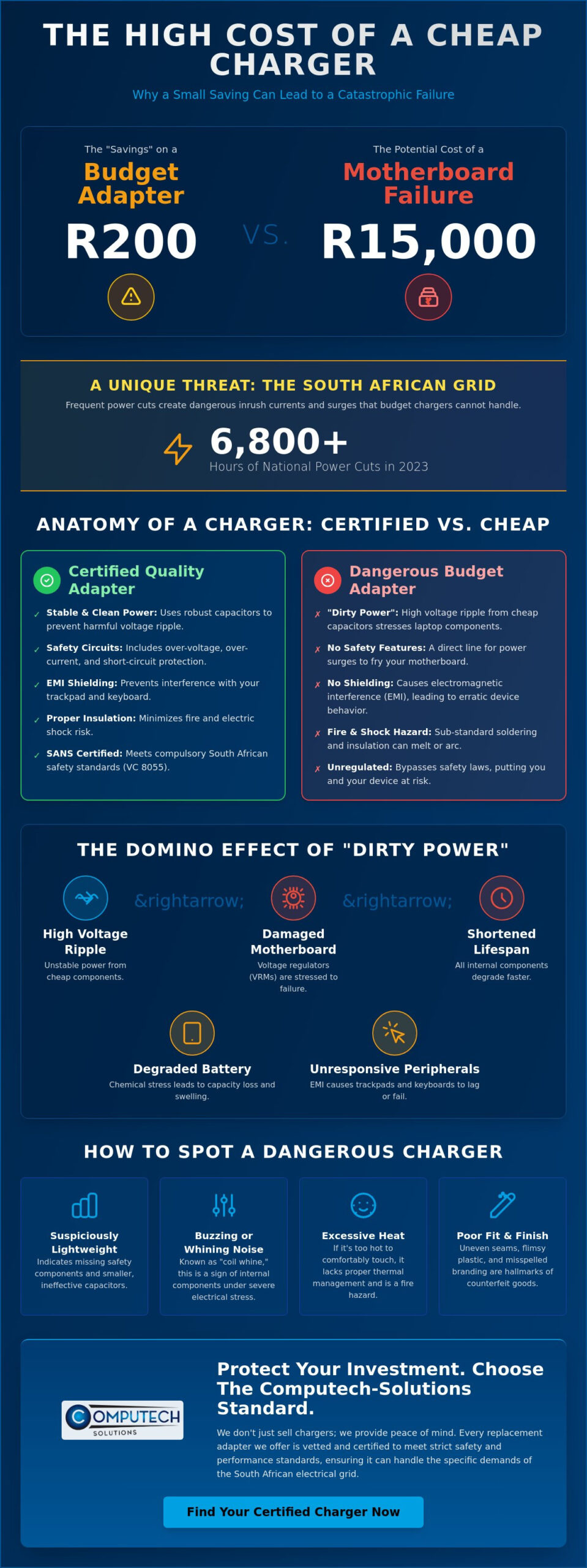
Is saving a few hundred Rand on a power adapter worth the potential R15,000 cost of a motherboard replacement? In South Africa, a budget-store adapter often acts as a weak link that fails to shield your device from the frequent power surges associated with load shedding. The risks of using a cheap laptop charger are amplified by our local grid conditions, where over 6,800 hours of national power cuts in 2023 have made electrical protection a non-negotiable requirement for any professional.
It’s understandable to feel anxious about choosing between an expensive OEM part and a generic alternative that might be a fire hazard. We’ll show you exactly how to distinguish between a dangerously cheap unit and a high-quality, certified adapter that meets SANS 60335 safety standards. This guide details the technical hazards of sub-standard hardware and provides a clear path to finding a reliable, cost-effective power solution that ensures your laptop survives the next surge.
Key Takeaways
- Understand how the absence of compulsory safety certifications on budget adapters increases the likelihood of catastrophic hardware failure.
- Examine the technical risks of using a cheap laptop charger, specifically how excessive voltage ripple and low-grade capacitors compromise device stability.
- Discover why “inrush current” during load shedding restoration creates a unique threat that standard budget chargers aren’t equipped to handle.
- Identify physical red flags, such as insufficient weight and poor casing texture, to spot dangerous hardware before it damages your laptop.
- Learn how Computech-Solutions maintains safety standards by vetting certified replacement laptop chargers for the specific demands of the South African market.
The Hidden Dangers of Low-Cost Laptop Adapters
A R200 price tag is an attractive solution when your original power brick fails. However, this initial saving is often a precursor to catastrophic hardware failure. The risks of using a cheap laptop charger extend far beyond simple reliability issues; they involve fundamental compromises in safety and engineering. To understand why these components matter, we must look at What is an AC Adapter? and its role in converting high-voltage AC into stable DC power. It isn’t just a cable; it’s a sophisticated power converter that stands between your laptop’s delicate internal circuits and the unpredictable South African grid.
Most budget adapters found in local flea markets or unvetted online marketplaces lack the compulsory VC 8055 specification. In South Africa, the National Regulator for Compulsory Specifications (NRCS) requires all electrical apparatus to meet specific SANS standards. Cheap units bypass these regulations by using inferior components that cannot handle the thermal load of continuous use. It is vital to distinguish between a high-quality generic charger and a counterfeit brand-name adapter. Counterfeits use stolen logos to deceive you into thinking you’re buying an OEM product, while actually housing the same dangerous internals as the cheapest unbranded units.
Early warnings of failure often manifest as physical symptoms. If your charger is too hot to touch or emits a high-pitched buzzing sound, it’s failing. These sounds, known as coil whine, indicate that internal components are vibrating under electrical stress. This is a common trait in sub-standard hardware where manufacturers skip the filtering stages that keep power delivery smooth and silent.
Fire Hazards and Electric Shock Risks
Sub-standard internal soldering is a primary cause of short circuits. In many cheap chargers, the distance between high-voltage and low-voltage components is insufficient. This creates a risk of arcing, where electricity jumps across gaps, potentially leading to a fire or an electric shock through the DC cable. Without proper insulation, the plastic casing can melt during a standard charging cycle, exposing live wires to the user or flammable surfaces.
Impact on Laptop Longevity
Your laptop’s motherboard is designed to receive a very specific, clean voltage. Cheap chargers often deliver “dirty” power with significant fluctuations that stress the voltage regulator modules (VRMs) on your motherboard. This constant electrical noise shortens the lifespan of every internal component. While you might save R300 on the purchase price, the resulting damage often leads to a R5000 repair bill or the total loss of your device. Choosing a certified replacement is a direct investment in the operational lifespan of your computer.
Technical Risks: What Happens Inside a Cheap Charger
Inside a power adapter, complex electronics manage the transition from high-voltage AC to the low-voltage DC your laptop requires. One of the primary risks of using a cheap laptop charger is high voltage ripple. This is the residual periodic variation of the DC voltage within an AC-to-DC power supply. High-quality units use robust capacitors to smooth this variation into a flat line. Cheap manufacturers often use undersized or low-grade capacitors that fail to maintain this stability. Understanding the risks of using a cheap laptop charger is the first step in protecting your professional hardware from avoidable electrical damage.
When these capacitors underperform, the “dirty power” they produce creates electromagnetic interference (EMI). You might notice your trackpad becoming unresponsive or your keyboard input lagging while the charger is plugged in. This isn’t a software bug; it’s electrical noise leaking into your laptop’s sensitive components because the charger lacks proper EMI shielding. Professional designs prioritize this shielding to ensure your peripherals function without disruption.
Voltage Ripple and Battery Degradation
Unstable voltage doesn’t just affect performance; it physically damages your battery cells. Consistent voltage fluctuations cause chemical stress inside lithium-ion batteries, leading to premature capacity loss and swelling. This is why following Official guidance on charger safety is critical for preventing thermal runaway. If you’ve already noticed reduced runtime, you may need high-quality Acer Replacement Laptop Batteries to restore your device’s mobility. You’ll often feel the laptop chassis getting unusually hot during charging with a low-end adapter, which indicates the battery is struggling with irregular current.
The Absence of Over-Current Protection
Safety circuits act as a digital fuse for your hardware. A professional-grade adapter will shut down if it detects a power spike or an internal short. Budget units frequently omit these protection layers to save on manufacturing costs. Without an over-current protection mechanism, a simple power spike passes directly through the charger and into your CPU or GPU. Using the wrong wattage or amperage for your specific model further compounds this danger. If your laptop requires 90W but you use a cheap 65W unit, the charger will run at 100% capacity constantly, increasing the likelihood of a catastrophic meltdown. To avoid these technical failures, it is essential to source a certified laptop charger that matches your device’s exact specifications.
Cheap Chargers vs. Load Shedding and Power Surges
South African users operate in an electrical environment that is significantly more volatile than that of Europe or North America. Our local grid is subject to extreme stress, evidenced by the fact that in 2023, the country experienced over 6,800 hours of national load shedding. This environment creates specific risks of using a cheap laptop charger, as budget units are rarely engineered to survive such frequent and aggressive power cycling. While a charger in London might only deal with stable current, a charger in Johannesburg must act as a frontline defense against a highly unpredictable power supply.
The primary threat occurs the moment the lights come back on. This is known as the “Inrush Current” problem. When the grid is restored after a load shedding block, there is often an initial surge of electricity that far exceeds standard operating voltages. High-quality adapters are designed with robust input stages that can dampen this surge. In contrast, cheap chargers often lack the sophisticated circuitry required to handle this sudden influx of energy. This is why budget adapters frequently fail, or even physically explode, exactly at the moment power returns.
Load Shedding and Component Stress
Frequent power cycling places immense thermal and electrical stress on internal components. During Stage 4 and Stage 6 load shedding cycles, a charger might be powered up and down multiple times a day. Low-quality capacitors inside budget units aren’t rated for this level of activity. They quickly degrade, lose their ability to filter power, and eventually fail. A quality adapter acts as a sacrificial buffer; if a massive surge occurs, it’s designed to fail safely, protecting the expensive laptop connected to it. A cheap unit often fails “open,” allowing the full force of a grid surge to pass directly into your laptop’s delicate motherboard.
The Need for Robust Surge Protection
There is a vast technical difference between a R150 “no-name” unit and a professional, surge-protected adapter. Quality chargers include Metal Oxide Varistors (MOVs) and transient voltage suppression diodes. These components are specifically designed to detect over-voltage events and divert excess energy away from your device. Budget manufacturers omit these parts to keep costs low, leaving your hardware completely exposed to the grid’s fluctuations. South African users cannot afford to compromise on charger quality in 2026 because the power grid’s instability makes a high-quality adapter the primary defense against catastrophic motherboard failure. By choosing a vetted power solution, you’re ensuring that your professional tools remain operational despite the challenges of our local infrastructure.
How to Identify a Dangerous Charger Before You Plug It In
Identifying the risks of using a cheap laptop charger requires a keen eye for physical and technical discrepancies. Before connecting a new power supply to your professional hardware, perform a basic tactile assessment. Quality chargers are built with substantial internal heatsinks and dense copper windings. If a replacement unit feels significantly lighter than your original OEM brick, it’s almost certainly missing the protective components necessary for safe operation. Weight is often the most reliable indicator of internal quality in power electronics.
The casing texture also reveals much about the manufacturer’s standards. Low-quality adapters use thin, brittle plastics that feel hollow when tapped. These materials lack the fire-retardant properties required by South African safety regulations. If the printing on the label is blurry, contains typos, or uses a font that looks inconsistent with official brand assets, you’re likely holding a counterfeit. These visual red flags suggest that the internal engineering is just as compromised as the external packaging.
Physical Inspection Checklist
- Compare the weight of the replacement to your original unit. A light charger indicates the omission of heavy filtering capacitors and shielding.
- Inspect the fit of the DC jack for any “wobble” or loose pins. Poor contact points create resistance, which leads to heat buildup and potential arcing.
- Check for the presence of a ferrite bead. This is the plastic cylinder located near the end of the cable. It’s essential for suppressing high-frequency noise and is often omitted on sub-standard units to save costs.
Understanding Safety Certifications
In South Africa, the National Regulator for Compulsory Specifications (NRCS) enforces the VC 8055 specification. This ensures that electrical apparatus meet the SANS 60335 series of safety standards. Look for the “Double Insulated” symbol, which appears as a square within a square. This indicates the device doesn’t require a safety connection to electrical earth because its internal insulation is robust. Be cautious of CE and RoHS markings on unvetted budget units; these are frequently printed on the labels of non-compliant hardware as a deceptive tactic. To ensure your hardware remains safe, source a certified laptop charger that has been properly vetted for the South African market.
Universal chargers present a unique set of hazards. These units often use a slider or interchangeable tips to adjust voltage. If the slider is accidentally moved or the internal voltage regulator fails, the charger can send 24V into a 19V system, instantly frying your motherboard. A dedicated, single-voltage adapter is always the safer choice for professional equipment. Perform a heat test during the first 30 minutes of use. A quality adapter will get warm, but it should never be too hot to hold. If the casing smells like burning plastic or reaches temperatures that could singe skin, disconnect it immediately.
Choosing Quality Replacements: The Computech-Solutions Standard
Many users believe they must choose between a prohibitively expensive original manufacturer part and a dangerous flea-market find. This is a false dichotomy. There is a significant technical difference between a “cheap generic” and a “certified replacement” adapter. While the former represents the primary risks of using a cheap laptop charger, the latter provides a stable, regulated power supply that meets the same engineering standards as your original equipment. Computech-Solutions bridges this gap by sourcing hardware specifically designed to handle the rigours of the South African electrical environment.
Our vetting process is rigorous. We ensure every unit complies with the compulsory specification VC 8055 and relevant SANS 60335 safety standards. This means the internal components aren’t just present; they’re high-grade and capable of managing heat and voltage spikes. Choosing a vetted solution eliminates the anxiety of operational disruptions and protects your long-term investment in your portable workstation. It’s about providing a reliable partner for your hardware, not just a temporary fix.
Reliable Power for Every Major Brand
Precision is vital when replacing power components. We supply adapters for all major manufacturers, ensuring that the voltage and amperage ratings match your device’s requirements exactly. If you are also sourcing high-quality Dell Replacement Laptop Batteries, using a matching, high-grade charger is essential to maintain the health of those new cells. Our replacement adapters are built with the robust filtering needed to withstand the electrical noise seen when power returns after load shedding. This level of resilience is something budget-bin alternatives simply cannot offer, as they lack the specialized surge suppression circuitry required for our local grid.
The Computech-Solutions Guarantee
Our commitment extends beyond the point of sale. We provide hardware that meets rigorous safety standards, backed by expert technical support to help you identify the precise adapter for your specific model. This removes the confusion between “high-quality generic” and “dangerously cheap” adapters. We support our customers nationally with reliable IT equipment, ensuring that professionals across South Africa have access to safe power solutions. Investing in a quality charger is a small price to pay to save your laptop from the risks of using a cheap laptop charger. Don’t let a sub-standard power brick become a single point of failure for your business operations. Secure your device’s future by choosing a power solution that prioritizes safety and operational stability.
Protect Your Professional Hardware Today
Choosing a power adapter is a decision that impacts the entire lifespan of your computer. You’ve seen how sub-standard components fail to filter voltage ripple and how the lack of surge protection leaves your motherboard vulnerable during load shedding restoration. Understanding the risks of using a cheap laptop charger is the final step in moving from reactive repairs to proactive hardware management. By prioritizing certified safety standards, you ensure your device remains a reliable tool for your business growth.
At Computech-Solutions, we specialize in surge-resistant power solutions engineered for the unique demands of the South African grid. Our expert technical support team is based locally to help you find the exact match for your hardware, backed by nationwide delivery on all replacement components. Don’t leave your productivity to chance with unvetted equipment. Browse High-Quality, Safety-Tested Laptop Chargers at Computech-Solutions to secure your device with confidence. We’re here to help you maintain a stable and efficient operational environment.
Frequently Asked Questions
Can a cheap charger really damage my laptop battery permanently?
Yes, a sub-standard adapter can permanently degrade your battery cells through excessive heat and voltage ripple. Unlike certified units, low-end chargers often lack the sophisticated circuitry required to maintain a steady current. This constant electrical stress causes the chemical components within the battery to break down faster than intended, leading to reduced capacity or swelling. It’s one of the primary risks of using a cheap laptop charger for daily professional work.
Is it safe to use a charger with a higher wattage than my original one?
It is generally safe to use a charger with a higher wattage than your original unit, provided the voltage output matches perfectly. Your laptop’s internal power management system only draws the amperage it requires to operate and charge. For example, using a 90W charger on a 65W laptop won’t cause damage. However, using a lower wattage charger is dangerous as it will overheat while trying to meet the device’s demands.
What are the signs that my laptop charger is about to fail or catch fire?
Warning signs include a strong smell of ozone or burning plastic, audible buzzing or hissing, and a casing that’s too hot to touch. If you notice any sparking when plugging the unit into a wall socket or see discoloration on the plastic housing, the internal components have likely failed. These physical indicators suggest a high risk of fire or short-circuiting, making immediate replacement essential for your safety and device protection.
Why does my laptop trackpad act weird when the charger is plugged in?
An erratic trackpad usually indicates high levels of electromagnetic interference (EMI) leaking from the power supply. Cheap chargers often omit the copper shielding and ferrite beads found in quality hardware to reduce manufacturing costs. This “dirty power” interferes with the sensitive capacitive sensors in your trackpad, causing the cursor to jump or lag. Replacing the faulty unit with a certified adapter typically resolves these input issues immediately.
Are universal laptop chargers safe for long-term use?
Universal chargers are often unsuitable for long-term use because they rely on manual voltage selectors or interchangeable tips that can fail. If the voltage switch is accidentally moved or the internal regulator malfunctions, the charger might deliver excessive power that fries your motherboard. Dedicated, single-voltage replacements are far more reliable for South African professionals who need to mitigate the risks of using a cheap laptop charger during frequent power cycles.
How do I know if a replacement charger is SABS approved?
You can verify compliance by looking for the SABS mark or the NRCS LOA (Letter of Authority) number on the label. In South Africa, all chargers must meet the VC 8055 compulsory specification to be legally sold. While some manufacturers fake these logos, a genuine certification is usually accompanied by clear, high-quality printing and a weight that suggests substantial internal components. When in doubt, source your hardware from a reputable local supplier.
What should I do if my charger gets extremely hot while charging?
You should disconnect the charger from both the wall socket and your laptop immediately. While all power bricks generate some warmth, they should never reach temperatures that make them uncomfortable to handle. Excessive heat suggests the charger is struggling to provide the necessary current or that internal capacitors are failing. Continuing to use a hot charger increases the likelihood of a thermal event or permanent damage to your laptop’s charging port.
Does using a non-original charger void my laptop warranty?
Using a non-original charger can void your manufacturer warranty if the technician determines that the power supply caused the specific hardware failure. Most warranty agreements require the use of OEM or certified compatible parts. If a cheap, uncertified unit surges and destroys your motherboard, the manufacturer will likely deny your claim. Investing in a high-quality, safety-tested replacement is the best way to maintain your device’s protection and operational integrity.
