
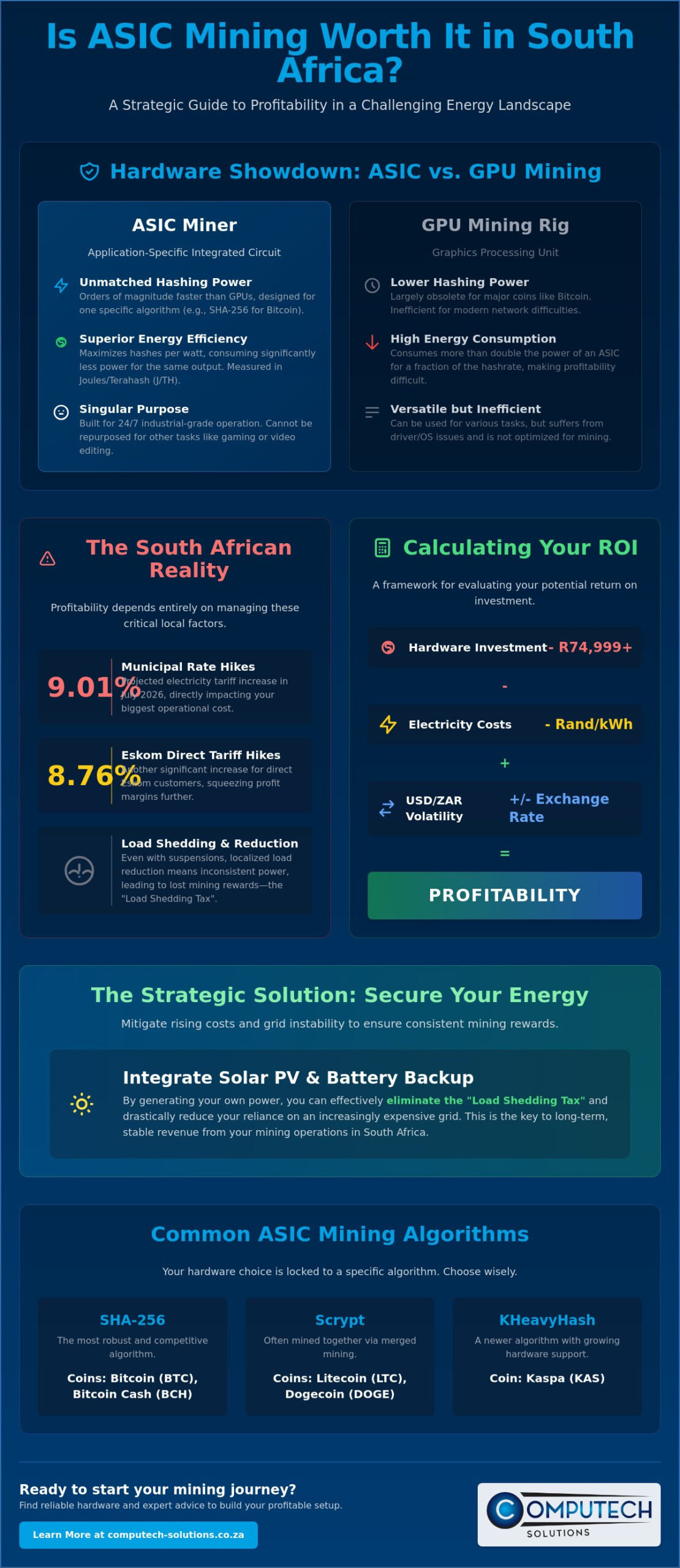
If South Africa has officially suspended national load shedding for over 399 consecutive days, why does the path to crypto profitability feel more complex than ever? You’ve likely realized that owning the hardware is only half the battle. With Eskom direct tariffs climbing by 8.76% and municipal rates jumping 9.01% in July 2026, the question of what is an ASIC miner and is it worth it in SA now depends entirely on your energy strategy. It’s a high-stakes environment where specialized Application-Specific Integrated Circuit machines offer massive hashing power, but only if you can manage the operational overhead.
We understand the pressure of balancing a R74,999 hardware investment against the latest winter tariffs and new capital flow regulations. This guide provides a clear framework to calculate your ROI, factoring in current Eskom rates and the necessity of solar backup to mitigate localized load reduction. You’ll learn which hardware models survive the South African climate and how to transform a noisy, heat-generating machine into a stable, revenue-producing asset for your business or home office.
Key Takeaways
- Understand why specialized ASIC hardware outperforms traditional GPUs through superior hashing power and purpose-built efficiency ratios.
- Evaluate the financial viability of your investment by understanding what is an ASIC miner and is it worth it in SA under the 2026 Eskom tariff hikes.
- Master a precise ROI calculation framework that accounts for the volatile USD/ZAR exchange rate and increasing municipal electricity costs.
- Discover how integrated solar PV systems and battery backups can eliminate the “load shedding tax” to secure consistent mining rewards.
- Identify the hardware specifications required to maintain operational stability within the unique heat and noise constraints of the South African climate.
Understanding ASIC Miners: Specialized Hardware for Crypto Success
An Application-Specific Integrated Circuit (ASIC) is a microchip designed for a singular, dedicated purpose. Unlike the processors found in high-end laptops or desktop computers, which are built to handle a wide variety of tasks like video editing or web browsing, an ASIC is hard-wired at the silicon level to execute one specific mathematical algorithm. This hyper-specialization is the foundation of modern cryptocurrency mining. When you ask what is an ASIC miner and is it worth it in SA, you must first understand that these machines are industrial-grade tools, not consumer electronics.
General-purpose hardware like CPUs and GPUs were once viable for mining, but they lack the efficiency needed for the current network difficulty. An ASIC miner achieves hash rates millions of times faster than a standard PC. By focusing all its resources on a single calculation, it maximizes output while minimizing wasted energy. These units are the primary guardians of decentralized networks like Bitcoin; they provide the massive computational power required to secure the blockchain against potential attacks. For serious South African miners, this hardware is the only way to remain competitive on a global scale.
The Anatomy of an ASIC Miner
A typical mining rig consists of three primary components: the hash boards, the controller board, and the power supply unit (PSU). The hash boards are the most critical, as they house the actual ASIC chips. The controller board acts as the brain, managing data flow to the mining pool and monitoring hardware health. Because electricity is your biggest overhead in South Africa, the most vital metric is energy efficiency, measured in Joules per Terahash (J/TH). Modern firmware plays a massive role here, as it allows you to tune the hardware for optimal performance based on your specific ambient temperature and power costs.
Common Algorithms and Supported Coins
ASIC miners are not interchangeable between different types of cryptocurrency. You must choose a machine that supports the specific algorithm of the coin you intend to mine. Some of the most common include:
- SHA-256: Used for Bitcoin (BTC) and Bitcoin Cash (BCH). This is the most robust and competitive mining sector.
- Scrypt: The algorithm for Litecoin (LTC) and Dogecoin (DOGE), often mined together through merged mining.
- KHeavyHash: A newer algorithm used for Kaspa (KAS), which has seen a surge in specialized hardware development.
Understanding these technical realities is the first step in deciding what is an ASIC miner and is it worth it in SA for your specific financial goals. Investing in the wrong algorithm or an inefficient model can lead to operational losses, especially when navigating the local energy landscape.
ASIC vs. GPU Mining: Why Specialized Circuits Dominate in 2026
The debate between using Graphics Processing Units (GPUs) and Application-Specific Integrated Circuits has shifted dramatically over the last few years. While GPUs were once the darling of the mining world due to their versatility, Ethereum’s transition to Proof of Stake effectively ended the era of profitable multi-purpose mining for most. Today, determining what is an ASIC miner and is it worth it in SA requires a deep look at hardware efficiency. ASICs are “unbrickable” in a functional sense; they are designed for 24/7 operation with a singular focus that standard computer hardware simply can’t match. They don’t suffer from the driver conflicts or OS bloat that often plague GPU rigs.
The sheer scale of modern networks means that even the most powerful gaming GPUs are now obsolete for mining major coins. Because crypto operations involve significant electricity consumption, the gap in efficiency ratios is the deciding factor for profitability. An entry-level ASIC can deliver a hashrate that is orders of magnitude higher than a rack of ten high-end GPUs while consuming less than half the total power. If you’re currently using reliable desktop computers for business tasks, it’s vital to keep those separate from the high-heat, high-draw environment of a dedicated mining setup.
Efficiency and Hashrate Explained
Hashrate is the speed at which a miner completes a cryptographic operation to solve a block. In 2026, the industry has moved toward 3nm and 5nm chip technology, which allows for billions of transistors to be packed into a tiny space. This architecture enables massive parallel processing of algorithms, ensuring that every watt of electricity pulled from the wall is converted into as much computational work as possible. For South Africans facing high municipal tariffs, this efficiency isn’t just a technical spec; it’s the difference between a profitable month and a loss.
Longevity and Resale Value
An ASIC’s lifecycle is typically three to five years before newer, more efficient models make the older hardware’s power cost too high. However, the secondary market in South Africa remains active for those with access to cheap or surplus solar power. Physical maintenance is the biggest hurdle in the local climate. Our dusty environment can quickly clog intake fans and degrade thermal paste, leading to overheating. Regular cleaning and strategic placement in a filtered, cool environment are mandatory to ensure your hardware reaches its full potential without premature failure. Unlike a laptop that stays on a desk, these machines require industrial-level care to survive the South African summer.
Is Mining Worth It in South Africa? Navigating Eskom and Load Shedding
Determining what is an ASIC miner and is it worth it in SA requires a cold look at the local energy landscape. As of April 1, 2026, Eskom direct customers face an average tariff increase of 8.76%, while municipal users saw a 9.01% jump on July 1, 2026. These rising costs, coupled with higher winter tariffs between June and August, create a narrow window for profit. While national load shedding has been suspended for over 399 consecutive days, localized “load reduction” remains a reality in high-risk areas. These outages often occur because of stressed local grids, making your physical location as important as your hardware choice.
Beyond the cost per kilowatt-hour, the South African climate presents unique operational hurdles. High-density mining generates immense heat; in our summer months, standard residential cooling is often insufficient. Without a dedicated strategy for airflow and heat extraction, your ASIC will automatically throttle its performance to prevent permanent damage. This thermal management is a critical part of the “is it worth it” equation, as it adds to your initial setup costs and ongoing maintenance requirements.
The Impact of Load Shedding on Profitability
Even with the current grid stability, the threat of power interruptions carries a hidden “load shedding tax.” When power drops, your miner loses its connection to the mining pool. Once power returns, the unit must reboot and re-sync to the blockchain, a process that can take several minutes of unproductive energy draw. To protect your investment, we recommend using smart plugs and automated restart sequences. These tools ensure your hardware stays offline during the volatile first minutes of power restoration, protecting delicate controller boards from the surges that frequently occur when the grid stabilizes.
South African Regulatory and Tax Environment
The financial side of mining is also subject to increasing scrutiny. In 2026, South Africa introduced new Capital Flow Management Regulations to bring crypto-assets under exchange control. From a tax perspective, you can deduct depreciation on your mining hardware as a business expense, which helps offset the 27% corporate tax rate or individual marginal rates. Mining income is generally treated as revenue for tax purposes in SA. Understanding these obligations is vital to ensure that your gross rewards aren’t wiped out by unforeseen compliance penalties or SARS assessments at year-end.
Calculating Your ROI: The Rand-Per-Kilowatt Reality
Determining the financial viability of a mining operation requires a rigorous framework that goes beyond simple daily earnings. The core ROI equation is: (Block Rewards × Crypto Price × USD/ZAR Exchange Rate) – (Electricity + Maintenance + Pool Fees). In the local context, the USD/ZAR exchange rate acts as a double-edged sword. While a weakening Rand can inflate the value of your rewards when converted to local currency, it simultaneously drives up the cost of importing replacement parts or upgrading to newer hardware. When evaluating what is an ASIC miner and is it worth it in SA, you must also factor in hardware depreciation. Most professionals recommend a 24 month depreciation cycle, as increasing global mining difficulty eventually renders even the most efficient machines obsolete.
Mining difficulty is an automated protocol adjustment that ensures blocks are found at a consistent rate. As more powerful 3nm and 5nm machines join the global network, your individual share of the rewards will naturally decrease over time. This makes the “time to ROI” a moving target. To maintain a competitive edge, you need a setup that survives both technical difficulty spikes and the volatile South African economic climate. To ensure your mining environment remains stable, consider investing in reliable desktop computers and power management tools to monitor your operations effectively.
Electricity: The Silent Profit Killer
Electricity is your primary recurring expense. With Eskom direct tariffs increasing by 8.76% and municipal rates like City Power rising by 9.01% in 2026, the margin for error is razor-thin. You should use an online profitability calculator to find your specific break-even electricity price. Direct Eskom supply is often more affordable than municipal billing, but both are subject to winter surcharges between June and August. Avoid the psychological trap of “mining at a loss” during market downturns; if your power cost exceeds the value of the coins produced, it’s often more efficient to buy the asset directly on an exchange until the price recovers.
Pool Fees and Network Latency
Your choice of a mining pool significantly impacts your consistent payout. Most pools charge a fee between 1% and 3%, using either a Pay Per Share (PPS) or Pay Per Last N Shares (PPLNS) model. PPLNS generally offers higher rewards for loyal miners with high uptime. However, South Africa’s geographic distance from major global servers can lead to “stale shares.” These are blocks solved by your hardware that reach the network too late to be counted. Choosing a pool with low-latency servers or local relays is essential to minimize this waste and ensure every watt of power contributes to your bottom line.
Optimizing Your Setup with Solar and Reliable Hardware
In a market where electricity prices rise by nearly 9% annually, relying solely on the grid is a risky gamble. The question of what is an ASIC miner and is it worth it in SA is increasingly answered by your access to renewable energy. Solar PV systems have become the ultimate “cheat code” for local miners. By shifting the bulk of your hashing power to peak daylight hours, you can utilize excess generation that would otherwise go to waste. This strategy drastically reduces your break-even point, making even older, less efficient hardware potentially profitable again.
Uptime is the lifeblood of mining rewards. While South Africa has enjoyed a long period of grid stability, localized load reduction and the potential for future outages mean you need a contingency plan. Sizing a battery backup system to carry your miners through Stage 2 load shedding ensures you don’t lose your spot in the mining pool’s payout queue. It’s a balance between protecting your battery cycle life and maintaining that 100% uptime during critical reward windows.
Integrating Solar Inverters and Battery Backups
Modern hybrid inverters allow you to prioritize solar energy for your mining rigs while keeping batteries reserved for critical backup. Using professional solar system installation ensures your distribution board can handle the sustained high amperage that ASIC miners demand. While batteries represent a significant upfront cost, they act as a buffer against the voltage fluctuations that can fry sensitive controller boards. You’ll need to weigh the cost of deep-cycle lithium batteries against the rewards earned during a two-hour power cut to find your optimal storage capacity.
Essential Accessories for Every SA Miner
Managing a remote mining site or a home-based rig requires more than just the miner itself. You need a dedicated laptop or desktop to run management software, monitor temperature logs, and adjust fan speeds in real-time. Mining environments are notoriously harsh; heat and dust can take a toll on your monitoring hardware just as much as the miners. Keeping high-quality laptop chargers and adapters on hand prevents unnecessary downtime when you’re troubleshooting onsite. For rigs using integrated diagnostic displays, sourcing replacement LCD panels ensures you always have a clear view of your hashrate without needing to haul a full monitor into a hot mining room. Successful mining in South Africa isn’t just about the biggest machine; it’s about the reliability of the entire ecosystem supporting it.
Securing Your Mining Future in the South African Market
The landscape of cryptocurrency mining has shifted from a simple hardware race to a sophisticated energy management challenge. Success in 2026 depends on your ability to leverage specialized hardware while insulating your operation from rising municipal tariffs and localized load reduction. Deciding what is an ASIC miner and is it worth it in SA ultimately rests on your setup’s total efficiency. Integrated solar solutions and high-performance monitoring hardware are no longer optional extras; they’re the foundation of a sustainable ROI in a competitive market.
By combining efficient 3nm or 5nm chip technology with a robust power backup strategy, you can maintain the uptime necessary to secure consistent rewards despite local grid pressures. We provide the technical infrastructure needed to keep your rigs running at peak performance. Explore our range of solar solutions and IT hardware to power your mining journey. With expert technical support for all hardware and nationwide delivery across South Africa, we specialize in the power backup and solar integration required for industrial-grade mining. Your path to profitable hashing starts with the right partner and a stable energy foundation.
Frequently Asked Questions
Is crypto mining legal in South Africa?
Yes, cryptocurrency mining is entirely legal in South Africa. However, it’s subject to the 2026 Capital Flow Management Regulations, which bring crypto-assets under the national exchange control framework. You must also report all mining earnings to SARS, as this income is generally taxed as ordinary revenue at your marginal tax rate, which can reach up to 45% for individuals.
How much electricity does a typical ASIC miner use per month?
A modern high-efficiency unit like the Bitmain Antminer S21 draws approximately 3,500 Watts of continuous power. If run 24/7, this equates to roughly 2,520 kWh per month. When calculating what is an ASIC miner and is it worth it in SA, this consumption is the most significant factor, especially with Eskom’s 8.76% tariff increase in 2026.
Can I run an ASIC miner on a standard home plug point?
We don’t recommend using a standard 16A South African wall socket for continuous mining. A 3,500W miner pulls about 15.2 Amps at 230V, which is too close to the safety limit of a residential circuit for 24/7 operation. You should have a qualified electrician install a dedicated 20A or 30A circuit with industrial-grade cabling to prevent overheating or fire risks.
What is the best ASIC miner for beginners in SA in 2026?
The Bitmain Antminer S21 series is currently the most viable option for newcomers due to its superior efficiency ratio. While the upfront cost is approximately R74,999, its lower Joules per Terahash (J/TH) rating helps protect your margins against rising municipal electricity rates. Choosing a less efficient, cheaper model often results in higher monthly losses that wipe out the initial savings.
How do I protect my miner from power surges during load shedding?
Protecting your hardware requires a multi-layered approach. You should install an industrial-grade surge protector at your distribution board and use smart plugs with a programmable “delay on make” function. This ensures your miner only reboots several minutes after power returns, skipping the initial voltage spikes that occur when the grid stabilizes after localized load reduction.
Do I need to pay customs duty when importing an ASIC miner to SA?
Yes, all imported ASIC miners are subject to 15% Value Added Tax (VAT) upon arrival in South Africa. While many computer components fall under a 0% customs duty classification, the specific tariff heading for ASICs can vary. It’s essential to factor in these clearing costs and potential shipping delays when ordering hardware from international manufacturers.
How loud are ASIC miners and can I keep one in my house?
ASIC miners are extremely loud, typically producing between 75 and 80 decibels of noise. This is equivalent to a vacuum cleaner running constantly in the room. Because of the noise and the massive amount of heat generated, these machines aren’t suitable for living areas. Most South African miners use dedicated garages, outbuildings, or sound-insulated enclosures with high-volume extraction fans.
Can I mine Bitcoin with a solar power system?
Mining with solar is the most effective way to maintain profitability in South Africa. By using a hybrid inverter system, you can power your miners directly from solar panels during peak sun hours, effectively reducing your cost per kilowatt-hour to zero for part of the day. This setup is the primary way to ensure your mining operation remains “worth it” despite the 9.01% municipal tariff hikes seen in July 2026.
