
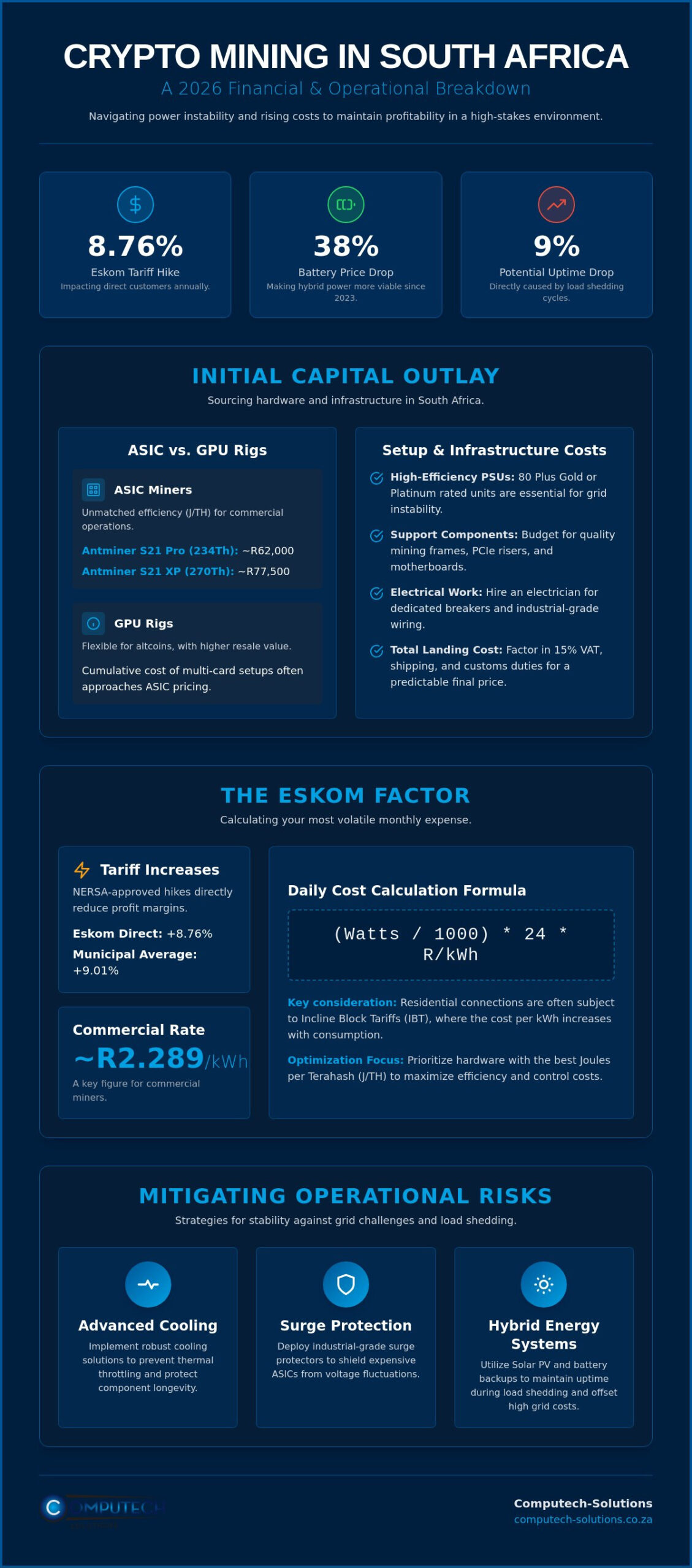
Did you know that in 2026, the success of your mining operation depends more on your power management strategy than the raw hashrate of your hardware? Calculating the cost of running a crypto mining rig in SA has become a complex exercise in balancing Eskom’s 8.76% tariff hikes against the 38% drop in battery prices we’ve seen since 2023. You’ve likely felt the frustration of watching your uptime drop by as much as 9% during load shedding cycles, or worried about power surges damaging your expensive ASIC components. It’s a high-stakes environment where technical disruptions directly erode your bottom line.
We understand that operational stability is your primary concern. This guide provides a definitive breakdown of the current financial landscape for South African miners. We’ll analyze current electricity rates, explore strategies to mitigate load shedding risks, and identify the most efficient hardware and power solutions available locally to ensure your operation remains profitable. From navigating SARS reporting requirements to sourcing reliable power components, we’ll provide the comprehensive insights needed to build a resilient, all-encompassing solution for your mining business.
Key Takeaways
- Quantify your total capital requirements by accounting for 2026 import duties and specialized component costs for various rig architectures.
- Determine the precise monthly cost of running a crypto mining rig in SA by aligning hardware efficiency with current municipal and Eskom power rates.
- Mitigate operational risks by deploying advanced cooling and surge protection strategies designed to handle the instability of the national power grid.
- Analyze the long-term profitability of hybrid energy systems, using battery backups and solar PV to maintain uptime during scheduled power interruptions.
- Establish a reliable supply chain for desktop computers and specialized power infrastructure to support hardware longevity and sustained performance.
The Initial Capital Outlay: Sourcing Hardware in South Africa
Starting a mining operation in 2026 requires a clear-eyed look at the initial investment. The total cost of running a crypto mining rig in SA begins long before you flip the power switch. You’re balancing high-performance hardware against the logistical hurdles of the South African market. It’s not just about the machine; it’s about the infrastructure that keeps it operational and profitable over the long term.
ASIC vs. GPU: Which fits your budget?
For most commercial-scale operators, Application-Specific Integrated Circuits (ASICs) are the standard. As of July 2026, a Bitmain Antminer S21 Pro (234Th) retails for approximately R62,000, while the higher-tier S21 XP (270Th) reaches about R77,500. These units offer unmatched efficiency in Joules per Terahash (J/TH) but limited flexibility. Conversely, GPU mining remains a viable entry point for those seeking to mine altcoins or retain resale value for gaming and creative industries. While individual GPUs are cheaper, the cumulative cost of building a multi-card rig with frames and risers often approaches ASIC pricing. Sourcing from local South African retailers is the most reliable way to mitigate shipping delays and ensure your equipment arrives with a valid local warranty.
If you are interested in high-performance GPU applications beyond mining, such as artificial intelligence or complex data processing, you can visit eCircles LLC to learn more about their specialized infrastructure.
The Hidden Costs of Setup
Hardware alone doesn’t make a rig. You must invest in high-efficiency Power Supply Units (PSUs) rated 80 Plus Gold or Platinum. These units are essential for handling the voltage fluctuations common on the national grid. Budgeting for specialized mining frames, quality PCIe risers, and industrial-grade motherboards is essential to prevent thermal throttling and electrical shorts. A stable hashrate also depends on robust network infrastructure. You shouldn’t rely on standard home Wi-Fi for reporting shares; use shielded Ethernet cables to maintain a direct connection to your router.
Electrical preparation is another non-negotiable expense. Most residential circuits aren’t designed for the continuous high-draw load of a mining rig. You’ll need to hire a qualified electrician to install dedicated breakers and industrial-grade cabling to prevent fire risks and ensure your home’s wiring doesn’t overheat. The total landing cost for your equipment is defined as the final price paid after factoring in international shipping, 15% VAT, and relevant customs duties for specialized electronic components. This comprehensive approach ensures that the cost of running a crypto mining rig in SA remains predictable and your investment is protected from the start.
The Eskom Factor: Calculating Monthly Electricity Consumption
Electricity is the lifeblood of your operation, and in 2026, it’s also your most volatile expense. NERSA-approved hikes have significantly shifted the landscape. Eskom direct customers faced an 8.76% increase in April, while municipal users saw a 9.01% average jump in July. In the City of Johannesburg, the 8.63% hike further complicates the cost of running a crypto mining rig in SA. These numbers aren’t just statistics; they’re direct deductions from your monthly profit. This makes calculating your overhead a monthly necessity rather than a one-time task.
The Math Behind the Mining Bill
Calculating your overhead requires more than a glance at your utility bill. Use this formula for a daily estimate: (Watts / 1000) * 24 * R/kWh. If you’re mining on a residential connection, you’re likely subject to Incline Block Tariffs (IBT). This means your R/kWh rate increases as you consume more power. For commercial miners using a rate of approximately R2.289/kWh, the math is more predictable but remains high. Seasonal variations also play a role. Winter peak rates can decimate margins if you don’t adjust your hashrate or operational hours accordingly.
Optimising Power Draw
Efficiency is your best defense against rising costs. Focus on the Joules per Terahash (J/TH) metric rather than just raw hashrate. Modern miners can monetise surplus electricity during off-peak periods, but this requires granular control. Undervolting your hardware reduces heat and power consumption without a proportional loss in performance. Installing smart meters allows you to monitor real-time energy usage, helping you identify exactly when your rig becomes less profitable during high-tariff windows.
Managing these variables requires high-quality hardware that won’t fail under continuous load. Sourcing reliable desktop computers and robust power supplies from a local partner ensures your equipment operates within its most efficient parameters. Reliable components reduce the risk of power-related failures, which is essential when every kilowatt-hour counts toward your return on investment. Understanding the total cost of running a crypto mining rig in SA involves looking past the purchase price and into the long-term efficiency of every component in your stack.
Managing Operational Risks: Cooling and Load Shedding
Operational risk management is the difference between a profitable venture and a costly failure. In the South African context, the “Load Shedding Tax” represents more than just lost time. It’s a direct hit to your revenue through lost shares and potential hardware degradation. During 2025, miners operating under stages 2 to 4 load shedding experienced an average uptime loss of 6% to 9%. When calculating the total cost of running a crypto mining rig in SA, you must factor in this downtime and the associated risks of frequent grid instability.
Protecting Your Investment
The most dangerous moment for your hardware isn’t the power cut itself; it’s the moment the grid is restored. Power surges during grid restoration can instantly fry sensitive hashing boards and power supplies. High-quality surge protectors and Automatic Voltage Regulators (AVRs) are non-negotiable components of a professional setup. For those running GPU-based rigs, an Uninterruptible Power Supply (UPS) is essential to facilitate graceful shutdowns. This prevents OS corruption and protects the lifespan of your cards. Frequent power cycles put immense thermal stress on hashing boards, causing solder joints to expand and contract, which eventually leads to component failure.
Thermal Management in SA
South Africa’s ambient temperatures present a significant cooling challenge, especially during summer months. While high-end immersion cooling offers superior heat dissipation, the initial capital requirement is often prohibitive for smaller operations. Most local miners rely on high-CFM industrial fans and extraction systems to maintain optimal operating temperatures. You must account for the additional power draw of these fans, which can add several hundred watts to your total consumption. Efficient airflow design reduces the need for aggressive fan speeds, lowering both your noise levels and your monthly bill.
Maintenance is a recurring cost of running a crypto mining rig in SA that many beginners overlook. Our local environment is particularly dusty, which can lead to rapid heat buildup if ignored. Implementing high-quality dust filters is essential for local mining longevity because they prevent the accumulation of abrasive particles that cause thermal hotspots and fan failure. Regular cleaning cycles using compressed air and visual inspections of your power connectors will prevent minor issues from becoming catastrophic hardware losses. By treating cooling and maintenance as core operational priorities, you ensure your rig remains a stable, productive asset.
Profitability Analysis and Solar Power Integration
Achieving a sustainable return on investment in 2026 requires more than just high hashrates; it demands a strategic approach to energy sourcing. The cost of running a crypto mining rig in SA is heavily influenced by your ability to offset Eskom’s peak tariffs with renewable energy. With battery prices having decreased by 38% since 2023, the barrier to entry for hybrid solar systems has never been lower. These systems allow you to bridge load shedding gaps while significantly lowering your average cost per kilowatt-hour over the long term.
Smart fiscal planning includes leveraging Section 12B of the Income Tax Act. This provision allows for an accelerated capital allowance on renewable energy assets, which can drastically improve your break-even timeline. As of January 2026, the estimated cost to mine one Bitcoin in South Africa reached approximately R2.1 million when relying solely on commercial grid rates. By integrating solar, you effectively lower this threshold, making your operation more resilient to future tariff hikes and grid instability.
Mining with the Sun
Hybrid inverter systems provide the most reliable path for local miners. These units seamlessly balance grid power and solar input to maintain 24/7 uptime. While completely off-grid mining remains challenging due to the massive battery arrays required for night-time operation, a hybrid setup can reduce your effective R/kWh by 40% to 60% over a five-year period. This strategy transforms a variable monthly expense into a fixed capital investment that protects your margins.
ROI and Exit Strategies
A professional mining plan must include a clear exit or upgrade strategy. High-efficiency hardware, like the Antminer S21 series, retains its value longer than older generations. You should also factor in the resale value of your supporting infrastructure, such as high-quality batteries and industrial frames. Running obsolete hardware is a common pitfall. If your machine’s Joules per Terahash (J/TH) ratio no longer justifies the electricity spend, it’s time to liquidate and upgrade to maintain profitability.
Forecasting your profitability over a 12-month horizon requires constant monitoring of coin prices and network difficulty adjustments. To ensure your hardware remains operational throughout these cycles, you need a partner that provides stable infrastructure. You can secure the necessary desktop computers and specialized power components through our local distribution network, ensuring your rig stays online and efficient. Managing the cost of running a crypto mining rig in SA is a dynamic process, but with solar integration and the right hardware, long-term growth is achievable.
Sourcing Reliable Mining Infrastructure with Computech-Solutions
Building a resilient operation requires a partner that understands the technical and environmental pressures of the local market. While we’ve detailed how to calculate the cost of running a crypto mining rig in SA, the final piece of the puzzle is reliable procurement. You need high-performance components that can withstand continuous 24/7 loads and the electrical instability inherent in our grid. Computech-Solutions provides the authoritative expertise and specialized hardware necessary to bridge the gap between a hobbyist setup and a professional mining enterprise.
Our approach focuses on hardware longevity and operational efficiency. We provide the stable infrastructure you need to protect your capital investment, from robust desktop computers that serve as the brains of your GPU rigs to the essential power components that keep them online. By centralizing your supply chain, you eliminate the risks associated with fragmented procurement and unverified sellers.
Why Partner with Computech-Solutions?
Success in the mining sector is built on technical accuracy. Our team offers expert technical advice to help you select hardware that aligns with your specific hashpower targets and energy constraints. We understand that a mining rig is only as strong as its weakest link. That’s why we emphasize the importance of high-quality power delivery and cooling. We facilitate nationwide delivery of specialized components, ensuring that whether you’re in a major metro or a remote area, your operation has access to the parts it needs. Our comprehensive solar system integration services further safeguard your operation, helping you transition to the hybrid power models that are now essential for maintaining profitability in 2026.
Getting Started Today
The first step toward a stabilized mining operation is a consultation for custom power backups. We help you navigate the complexities of load shedding mitigation by providing reliable replacement parts, including batteries and high-grade chargers, to ensure your control systems never lose power. You can browse our extensive range of high-performance components designed for the rigors of continuous computation. Contact our team today for a total mining infrastructure solution that addresses every aspect of the cost of running a crypto mining rig in SA. We’re ready to help you build a mining setup that isn’t just powerful, but also sustainable and secure against the operational risks of the South African energy landscape.
Securing Your Mining Future in South Africa
Success in the local mining sector now requires a shift from chasing raw hashrates to mastering energy resilience. While the cost of running a crypto mining rig in SA is influenced by rising municipal tariffs and grid instability, these challenges are manageable with the right infrastructure. By prioritizing high-efficiency hardware and integrating solar power, you move from a reactive position to a strategy of sustained growth. Protecting your investment with specialized surge protection and professional cooling ensures that technical disruptions don’t erode your margins.
Computech-Solutions is an established specialist in hardware and power backup, providing the expert technical support you need for both IT and solar systems. We facilitate nationwide delivery across South Africa to ensure your operation has the components required to stay competitive. Don’t let operational risks compromise your returns; take control of your energy strategy with a partner that understands the local landscape.
Optimise your mining rig with Computech-Solutions’ power and hardware experts today. With the right tools and professional guidance, your mining operation can remain a profitable and stable asset.
Frequently Asked Questions
Is crypto mining still profitable in South Africa in 2026?
Profitability is achievable but depends heavily on your energy strategy and hardware efficiency. While grid-only mining faces pressure from rising tariffs, miners who integrate hybrid solar solutions and use latest-generation hardware continue to see positive returns. Success in the current landscape requires treating the operation as a professional business with a focus on long-term operational stability.
How much electricity does a standard mining rig use per month?
A typical ASIC miner drawing 3,000 Watts consumes approximately 2,160 kWh per month if run continuously. This consumption is a primary factor in the cost of running a crypto mining rig in SA, especially as you move into higher municipal tariff blocks. Monitoring real-time usage is essential to ensure your monthly utility bill doesn’t exceed your earned rewards.
Can I run a crypto mining rig on a solar power system?
You can certainly use solar power, and hybrid systems are now the industry standard for local operators. While a completely off-grid setup requires a massive battery bank to support the high continuous draw at night, a hybrid system effectively lowers your average R/kWh. This approach allows you to mine during the day using sun power and switch to the grid or batteries during interruptions.
What happens to my mining rig during load shedding?
Without a backup power solution, your rig will shut down instantly, leading to lost revenue and potential hardware stress. Frequent power cycles can damage hashing boards and corrupt software on GPU-based systems. Implementing a battery backup with a high-capacity inverter is the most reliable way to bridge these gaps and maintain your hashrate.
Do I need a special permit to mine cryptocurrency in South Africa?
No specific permit is currently required to own or operate mining hardware in South Africa. However, you must comply with the South African Revenue Service (SARS) regulations regarding crypto-asset reporting. Under the framework implemented in March 2026, you’re responsible for keeping accurate records of your mining income and transactions for tax purposes.
How do I protect my mining hardware from power surges?
Install high-quality surge protectors and Automatic Voltage Regulators (AVRs) to shield your equipment from grid instability. The most significant risk occurs when power returns after load shedding, as voltage spikes can easily fry sensitive electronic components. Using industrial-grade power strips and ensuring your electrical work is handled by a professional electrician adds a necessary layer of security.
What is the best crypto to mine in South Africa right now?
Bitcoin remains the most popular choice for those using ASIC miners due to its established liquidity and network security. GPU miners often focus on altcoins that offer a better balance between hashrate and power consumption. Your choice should be based on the efficiency of your specific hardware and the current network difficulty of the coin you’re targeting.
How long does it take to see a return on investment for a mining rig?
Most miners expect a return on investment (ROI) within 12 to 24 months, though this varies based on market conditions. The initial cost of running a crypto mining rig in SA includes the hardware purchase, import duties, and electrical setup. Lowering your monthly overhead through solar integration is the most effective way to accelerate your break-even point in the current economy.
