
Did you know that battery failures accounted for nearly 30% of all laptop hardware problems reported to service centers in 2023? For South African professionals, this statistic is a daily reality as frequent load shedding cycles accelerate device degradation. You’re likely facing the dilemma of paying a 120% premium for an original manufacturer part or risking a generic alternative that might not protect your investment. Understanding generic vs original laptop battery quality is no longer just about price; it’s about maintaining operational efficiency in a demanding power environment.
We understand the stress of technical downtime and the need for hardware that performs reliably for 2 to 3 years. This guide breaks down the financial and technical realities of battery sourcing in 2026, including the impact of the January 1, 2026, air transport regulations requiring a 30% State of Charge for all shipments. You’ll learn how to identify high-quality generic batteries that meet UN 38.3 safety standards, ensuring your Dell, HP, or Lenovo laptop remains a secure asset. We’ll show you how to achieve cost-effective maintenance without sacrificing the warranty protections your business requires.
Key Takeaways
- Define the technical differences between brand-sanctioned OEM components and third-party replacements to align your purchase with specific operational requirements.
- Identify the critical safety certifications and cell grades that separate high-performance generic units from low-quality alternatives that risk your hardware.
- Analyze the technical data regarding generic vs original laptop battery quality to understand how charge cycle counts and capacity retention differ over 36 months of use.
- Apply a strategic decision-making framework to determine if your device’s age and workload justify a premium original battery or a cost-effective generic model.
- Learn why sourcing from a technical specialist with a national footprint ensures you receive the expert support and warranty protection necessary for the South African business landscape.
Understanding the Terms: Original (OEM) vs. Generic Laptop Batteries
When you source a replacement power source, you’re choosing between two distinct manufacturing philosophies. An Original Equipment Manufacturer (OEM) component is a part sanctioned and branded by the company that built your laptop, such as Dell, HP, or Apple. Conversely, generic or third-party batteries are produced by independent manufacturers to fit specific laptop models. While the “original” label carries an inherent sense of security, it’s often a reflection of branding and multi-layered supply chain markups rather than a fundamental difference in internal chemistry. Many reputable generic manufacturers actually use the same Grade A lithium-ion cells from suppliers like Samsung, LG, or Panasonic that the major brands utilize in their own assemblies.
Evaluating generic vs original laptop battery quality requires looking past the sticker on the casing to the components inside. The price disparity you see in the market isn’t always a direct indicator of performance. In many cases, the premium paid for an OEM part covers international licensing fees and brand marketing rather than superior raw materials. A high-quality generic isn’t a “knock-off”; it’s a strategically engineered alternative designed to meet the exact technical specifications of your hardware without the inflated overhead of a global brand name.
The Anatomy of a Laptop Battery
A battery consists of two primary parts: the physical lithium-ion cells and the Battery Management System (BMS). The BMS acts as the brain of the unit; it communicates with your laptop’s firmware to regulate charging speeds and prevent overheating. Precision in this area is vital. If the voltage doesn’t match perfectly or the connector is slightly off-spec, your laptop may refuse to boot or charge correctly. Professional-grade generic batteries prioritize this firmware compatibility to ensure your device recognizes the unit as a safe, reliable power source that won’t trigger system errors.
The Price-Performance Gap in South Africa
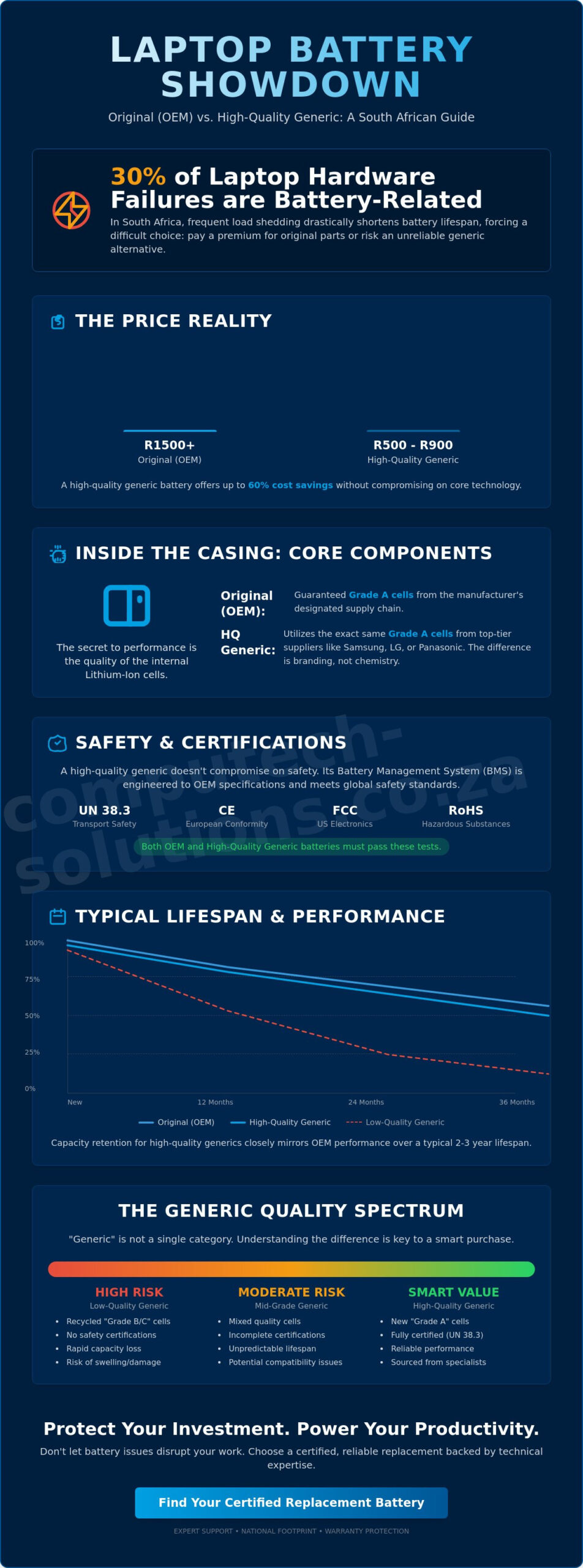
In the South African market, the cost of an OEM battery can frequently exceed R1500. Reliable generic alternatives typically range between R500 and R900, representing a significant saving for businesses managing multiple devices. This gap is widened by national import duties and the logistical costs associated with brand-specific parts. Many organizations pay the “peace of mind” premium for original parts because they fear the hardware damage associated with bottom-tier, uncertified generics. However, when you source from a technical specialist, you’re receiving a component that has passed mandatory UN 38.3 safety testing. This provides the reliability your business needs at a price point that makes long-term IT maintenance sustainable.
The Quality Spectrum: Why Not All Generic Batteries Are Equal
Discussions regarding generic vs original laptop battery quality often treat third-party parts as a single, uniform category. This is a mistake. The market actually operates on a broad spectrum ranging from premium replacements that mirror OEM standards to dangerous, unbranded units that risk your hardware. High-quality generic batteries utilize Grade A new cells, which provide the stable voltage and capacity retention required for modern business applications. In contrast, low-end alternatives often rely on recycled lithium cells salvaged from old packs. These “Grade B” or “Grade C” components are the primary cause of the rapid capacity loss and swelling issues that frustrate users.
Safety is the most critical differentiator in this spectrum. While many users fear “exploding” batteries, modern lithium-ion technology is remarkably safe when paired with a robust Battery Management System (BMS). Professional generic units include redundant safety circuit protections that prevent overcharging and short circuits. To verify this, look for international safety certifications like CE, FCC, and RoHS compliance. These marks indicate that the manufacturer has adhered to strict environmental and electrical safety standards. While there are clear Benefits of Original Laptop Batteries in terms of guaranteed factory testing, premium generics that meet UN 38.3 standards offer a comparable level of security for your device.
Identifying High-Quality Replacement Units
You can often identify a superior battery through physical inspection and technical specifications. High-quality cells have a specific density; if a replacement battery feels significantly lighter than the original, it’s likely using smaller, inferior cells with lower capacity. Ensure the milliampere-hour (mAh) rating matches your original hardware requirements. A reputable supplier will provide transparent data on their cell sourcing and thermal insulation materials, which are vital for longevity in South Africa’s high-ambient temperatures. If you’re looking for a reliable replacement battery, always prioritize vendors who provide detailed technical specifications over those offering the lowest price.
The Risk of Low-End Generic Parts
Unbranded batteries found on auction sites or through unverified social media sellers are a false economy. These units often feature poorly programmed firmware that can’t communicate correctly with your laptop’s power management software. This leads to “ghost” charging, where the system reports 100% power but shuts down unexpectedly. More importantly, these cheap parts often omit the thermal sensors required to shut down the battery if it begins to overheat during a fast-charge cycle. Using these components doesn’t just reduce your mobile runtime; it exposes your motherboard to potential voltage spikes that can lead to permanent hardware failure.
Performance and Lifespan: What the Data Says
Data from 2023 computer service center surveys indicates that battery failures represent nearly 30% of all laptop hardware issues. This high failure rate is often tied to the natural degradation of lithium-ion cells, but the gap in generic vs original laptop battery quality becomes most apparent when measuring total cycle life. Original manufacturer (OEM) batteries are engineered for longevity, typically supporting 300 to 500+ full charge cycles before capacity drops below 80%. In contrast, high-quality generic replacements are generally rated for 200 to 400 cycles. While the initial runtime may feel identical, the OEM unit is built to sustain that performance for a longer calendar period.
For South African businesses, the local power environment drastically changes the math on battery lifespan. Frequent load shedding cycles force laptops into battery mode multiple times a day, meaning a device might complete three or four charge cycles in a single 24-hour period. This accelerated cycling means a battery rated for 300 cycles could reach its effective end-of-life in less than a year. When you learn how to choose the right replacement battery, you must account for these environmental stressors. Choosing a unit with a robust Battery Management System (BMS) is essential to manage the heat generated when power returns and the device begins fast-charging from a near-zero state.
Cycle Life and Depth of Discharge
The Depth of Discharge (DoD) refers to how much of the battery’s capacity you use before recharging. Consistently draining a battery to 0% is significantly more stressful on the internal chemistry than keeping it between 20% and 80%. High-quality batteries use their BMS to enforce a “hard” shutdown at 5% to prevent deep discharge damage. Reliability standards for 2026 suggest that a battery maintaining 500+ cycles is the benchmark for enterprise-grade performance. Without these protections, cheap generic units often fail within 6 months of heavy load shedding use.
Real-World Capacity Comparison
While an OEM battery might provide 52Wh of energy, a high-quality generic replacement often delivers an identical 52Wh or 48Wh output, resulting in negligible runtime differences during standard office tasks. You can verify your specific unit’s health by following these steps:
- Run a Windows Battery Report by typing “powercfg /batteryreport” in the command prompt.
- Compare the “Design Capacity” against the “Full Charge Capacity” to see the current wear level.
- Check the cycle count log to track how quickly load shedding is depleting your hardware.
Expect a premium battery to retain at least 80% of its original capacity after 12 months of daily use. If your software tools show a drop to 50% capacity within the first year, the cell quality is likely inferior, regardless of what the label claims.
Strategic Buying Framework: When to Choose Generic vs. Original
Choosing between battery types requires a clear assessment of your hardware’s lifecycle. If your laptop is nearing the end of its projected four year lifespan, investing in an original manufacturer part that costs 120% more than a generic alternative rarely provides a positive return on investment. For standard business machines like the Dell Latitude or HP EliteBook series, high quality generic batteries represent a strategic sweet spot. These units deliver the necessary 2 to 3 years of service at a fraction of the cost, allowing you to allocate IT budgets toward more critical infrastructure upgrades.
Specialized workstations used for high end rendering or complex data analysis are the primary exception. These devices often have unique power draw requirements that necessitate the specific discharge curves found only in OEM firmware. However, for approximately 85% of corporate users, a premium generic battery that meets UN 38.3 safety standards is the most logical choice. Evaluating generic vs original laptop battery quality involves looking at the specific needs of the user rather than just the brand name. Many users worry that choosing a non branded part will void their device warranty. In reality, using a compatible, high quality replacement part for maintenance on out of warranty devices is a standard industry practice that does not inherently risk your hardware, provided the part meets the required technical specifications.
The ROI of Replacement Parts
Calculating the monthly cost of ownership helps clarify the value proposition. A quality generic battery priced between R500 and R900 that lasts 24 months costs significantly less per month than an OEM unit priced at R1500 or more. Replacing a battery is also a more sustainable choice than purchasing a new laptop, as it extends the utility of existing hardware by several years. You should match the battery’s expected lifespan to the remaining time you plan to keep the device. If you intend to replace the laptop in 18 months, a premium generic provides all the reliability you need without the unnecessary expense of a brand name part.
Warranty and Support Realities
Claiming an OEM warranty in South Africa can be a logistical challenge, often requiring you to deal with international manufacturer support structures that cause lengthy downtime. Local retailers often provide a more practical “no-hassle” replacement policy for their generic parts. This local support is invaluable when you need to maintain business continuity during power crises. To protect your investment, always document your battery’s initial performance and keep your purchase records for any potential claims. If you want to ensure your hardware remains operational with minimal financial strain, explore our range of premium replacement batteries designed for the South African market.
Sourcing Reliable Replacement Batteries in South Africa
Finding a replacement battery in South Africa requires more than a simple price comparison. While you can find unbranded units for as little as R400 on unverified marketplaces, these parts often lack the necessary safety certifications and technical backing to protect your hardware. When navigating the choice of generic vs original laptop battery quality, your most valuable asset is a supplier that acts as a technical gatekeeper. A specialist retailer doesn’t just move boxes; they vet the internal chemistry and firmware of every unit to ensure it meets the rigorous demands of the South African power grid.
Computech-Solutions positions itself as a reliable partner by assuming the burden of quality control. We analyze the technical specifications of our Acer, Dell, and HP replacement batteries to ensure they align with the January 1, 2026, air transport regulations, which mandate a 30% State of Charge for all lithium-ion shipments. This attention to detail ensures that the battery you receive hasn’t been sitting in a warehouse at a voltage level that compromises its long-term health. By focusing on high-performance generic cells that rival OEM standards, we provide a cost-effective maintenance path for your IT infrastructure without the 120% brand markup.
The Computech-Solutions Advantage
Our approach centers on a one-stop-shop philosophy that eliminates the complexity of hardware procurement. Whether you need a battery for a legacy Sony laptop or a modern Lenovo workstation, our technical team provides the expert support needed to match the correct part to your device. We maintain a national delivery footprint, ensuring that businesses from Johannesburg to Cape Town receive their components with rhythmic efficiency. This streamlined process reduces technical downtime and provides the stability your operations require. Our commitment to high-quality generic cells ensures that your replacement part performs reliably for the expected 2 to 3-year lifecycle.
A Final Checklist for Your Purchase
Before finalizing your order, follow this technical checklist to ensure a perfect match for your hardware. Precision at this stage prevents the frustration of incorrect parts and unnecessary shipping delays:
- Verify the Part Number: Locate the specific alphanumeric code on your original battery casing, such as J60J5 for Dell or AL12A32 for Acer.
- Check Physical Compatibility: Ensure the connector type and screw hole alignments match your device’s internal chassis perfectly.
- Match the Voltage: Confirm the voltage (e.g., 11.1V vs 14.8V) matches your original unit to prevent motherboard damage.
- Confirm Warranty Terms: Only purchase from suppliers who offer a minimum 6 to 12-month warranty with a clear, local return policy.
By adhering to these standards, you move beyond the stress of hardware failure and toward a proactive maintenance strategy. Our commitment to quality ensures that your choice in generic vs original laptop battery quality results in a device that remains a productive asset for your business.
Securing Your Device’s Future Through Strategic Power Choices
Choosing between battery types shouldn’t be a gamble. We’ve established that the debate over generic vs original laptop battery quality ultimately depends on the integrity of the supplier and the grade of the lithium cells. For the 85% of users operating standard business hardware, a premium generic unit provides the necessary stability to withstand daily load shedding cycles without the excessive brand premium. This strategic choice extends your device’s utility by 2 to 3 years while maintaining strict adherence to the 2026 safety standards.
Computech-Solutions streamlines this procurement process by vetting every component for technical precision. As specialists in replacement parts for Acer, Dell, HP, and Apple, we offer the expert support and nationwide South African delivery required to keep your business operational. Our high-quality cells are rigorously tested to ensure they rival the performance of factory-installed units, providing the stability your IT infrastructure demands.
Find high-quality replacement batteries for your laptop model at Computech-Solutions and invest in a reliable power solution today. You can maintain your hardware with confidence when you have a trusted technical partner by your side.
Frequently Asked Questions
Is it safe to use a generic laptop battery?
Yes, it is safe to use a generic battery provided the unit meets UN 38.3 safety standards and possesses CE or RoHS certifications. High quality generics use the same Grade A cells from suppliers like Samsung or LG that are found in OEM packs. These units include redundant safety circuits that prevent thermal runaway and overcharging during daily use.
Will a generic battery damage my laptop motherboard?
A properly engineered generic battery won’t damage your motherboard because it adheres to the exact voltage and amperage specifications of your hardware. Damage only occurs with low end, unbranded parts that lack a functional Battery Management System (BMS). Professional replacements ensure the firmware communicates correctly with the system to prevent dangerous voltage spikes.
How long does a generic laptop battery typically last?
A premium generic battery typically lasts between 200 and 400 charge cycles, which equates to roughly 18 to 24 months of standard use. While this is slightly lower than the 300 to 500+ cycles of an OEM unit, the lower cost provides a better return on investment for devices older than three years. Performance remains stable until the battery reaches its final 20% of cycle life.
Why is there such a large price difference between original and generic batteries?
The price gap exists primarily due to brand licensing fees, international marketing costs, and multi-layered supply chain markups. OEM batteries can cost 120% more than generics because you’re paying for the manufacturer’s logo and global support infrastructure. Generic manufacturers avoid these overheads by selling directly through technical specialists who vet the hardware for the local market.
Can I mix a generic battery with an original laptop charger?
Yes, you can safely use an original charger with a generic battery as long as the charger’s voltage and wattage match the laptop’s requirements. The battery’s internal BMS regulates the incoming current to ensure safe charging regardless of the brand on the adapter. Using a high quality replacement doesn’t require you to change your existing Acer, Dell, or HP power adapter.
How do I know if a generic battery is of high quality?
High quality units are identified by their physical weight, specific part number matching, and the presence of international safety marks. When evaluating generic vs original laptop battery quality, look for a 6 to 12-month local warranty. A reputable supplier will always provide a detailed technical datasheet and specific cell information rather than just a low price point.
Does using a third-party battery void my laptop manufacturer warranty?
Using a third-party battery doesn’t legally void your entire laptop warranty in most jurisdictions, though the manufacturer won’t cover the battery itself. For devices already past their initial 12 or 24-month factory warranty, using a certified generic is a standard, cost-effective maintenance practice. It’s a reliable way to extend the utility of your existing IT assets without unnecessary expenditure.
How does load shedding affect my laptop battery lifespan?
Load shedding accelerates chemical aging by forcing the battery through multiple deep discharge cycles per day. According to 2023 hardware surveys, frequent power outages can reduce a battery’s effective lifespan from 3 years to under 12 months. This environmental stress makes the generic vs original laptop battery quality debate even more relevant for South African businesses seeking sustainable hardware maintenance strategies.
