
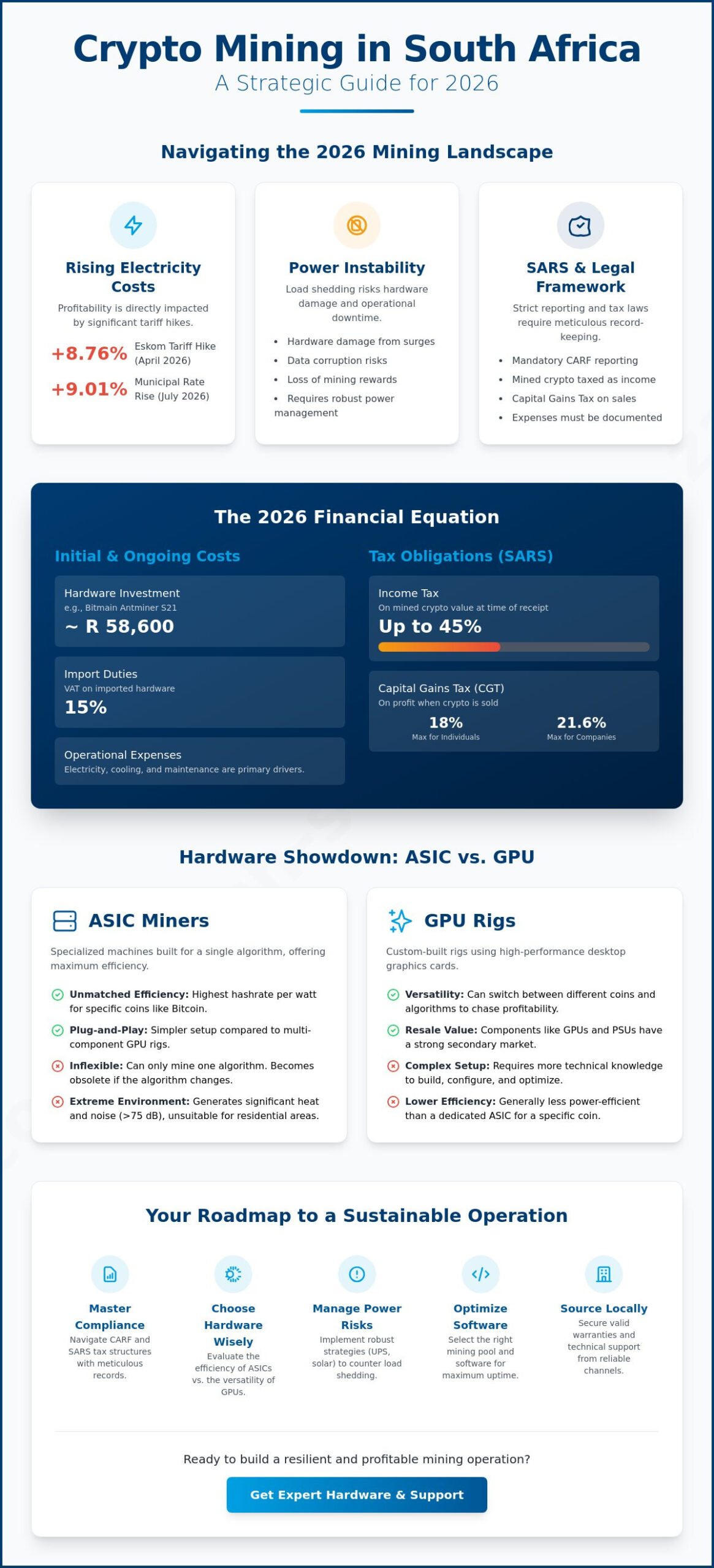
With Eskom’s 8.76% tariff hike implemented in April 2026 and municipal rates rising by 9.01% in July, is the dream of a profitable local mining rig still viable? The reality is that getting started with crypto mining in South Africa now requires a shift from chasing raw hashrate to mastering strategic power resilience and strict regulatory compliance. While a Bitmain Antminer S21 costs approximately R 58,600, your long term success depends on how you manage the 15% VAT on imports and the new SARS reporting requirements under the Crypto-Asset Reporting Framework (CARF).
It’s understandable to feel pressured by load shedding risks or the complexity of a 45% marginal tax rate on mined income. We recognize that operational stability is your primary concern when investing in high performance desktops and hardware. This guide provides the technical and legal roadmap you need to launch a sustainable operation. You’ll gain a definitive hardware shopping list, a strategy to maintain uptime during power outages, and a clear breakdown of the 2026 tax landscape to ensure your venture remains both profitable and professional.
Key Takeaways
- Navigate the 2026 CARF reporting requirements and SARS tax structures to ensure your mining operation remains fully compliant and avoids legal complications.
- Evaluate the operational efficiency of specialized ASIC hardware against the versatility of high-performance desktop computers to maximize your initial investment.
- Implement robust power-management strategies to protect your hardware from the physical and data-corruption risks associated with frequent load shedding.
- Master the technical essentials for getting started with crypto mining in South Africa, from choosing the right mining pool to optimizing your software for maximum uptime.
- Identify the critical advantages of sourcing components through reliable local channels to secure technical support and valid hardware warranties.
Understanding the Landscape of Crypto Mining in South Africa
Cryptocurrency mining isn’t just a method for generating digital assets; it’s the decentralized backbone of blockchain security. By solving complex mathematical puzzles, miners verify transactions and prevent double-spending on the network. Learning how cryptocurrency mining works is the first step toward building a resilient operation. For those getting started with crypto mining in South Africa in 2026, the environment is defined by clear regulations and a shift toward high-performance hardware efficiency.
The local ecosystem relies on three main components. First, the miners are the physical machines, often specialized ASICs or high-end desktop computers equipped with powerful GPUs. Second, mining pools allow local operators to combine their computational power with others globally to secure more frequent rewards. Finally, secure wallets store your earnings. Success in this sector requires a reliable partner for hardware, as technical downtime or component failure directly erodes your profit margins.
Legal and Tax Considerations with SARS
SARS has significantly increased its oversight of the crypto sector. Since the implementation of the Crypto-Asset Reporting Framework (CARF) on March 1, 2026, transparency is mandatory. SARS treats crypto earned through mining as taxable income, which can be taxed at your marginal rate of up to 45%. If you hold your rewards and sell them later for a profit, Capital Gains Tax (CGT) applies. Effective CGT rates are currently capped at 18% for individuals and 21.6% for companies. You must keep meticulous records of all hardware purchases, including desktop computers or laptops, and track every kilowatt-hour used to claim these as legitimate business expenses.
Mining Profitability Factors in 2026
Electricity costs remain the primary hurdle for local operators. With Eskom’s 8.76% tariff increase in April 2026 and municipal hikes of 9.01% in July, your cost per megahash is a critical metric for sustainability. Profitability also fluctuates with the Rand/Dollar exchange rate because rewards are denominated in crypto while operational expenses are paid in ZAR. Network difficulty, which adjusts based on total global hashing power, means your hardware must remain efficient to stay competitive. Investing in modern, energy-efficient components is no longer optional; it’s a requirement for survival in the 2026 South African market.
Selecting Your Mining Hardware: ASICs vs. GPU Rigs
Choosing your hardware is the most critical decision when getting started with crypto mining in South Africa. This choice dictates your initial capital expenditure (CAPEX) and your long-term operational costs (OPEX). In 2026, the market is split between two primary technologies: Application-Specific Integrated Circuits (ASICs) and Graphics Processing Units (GPUs). Each path offers distinct advantages depending on your technical expertise and your tolerance for operational noise and heat.
Stability is paramount for a profitable operation. High-quality Power Supply Units (PSUs) serve as the foundation of your rig, protecting sensitive components from voltage fluctuations. In a local context where power consistency is a challenge, a failure in your PSU can lead to catastrophic hardware damage. For those managing multiple rigs, using reliable desktop computers as dedicated management nodes ensures your monitoring software remains active and responsive without the overhead of a full mining load.
Hardware lifecycles in 2026 typically span three to four years. As network difficulty increases, older units become less efficient, eventually costing more in electricity than they generate in rewards. You must plan for this depreciation by calculating your break-even point against the current Eskom tariffs. Success requires a balance between raw hashing power and the physical resilience of your components.
The ASIC Advantage for Specific Algorithms
ASICs are specialized machines designed to mine one specific algorithm, such as SHA-256 for Bitcoin. They offer unmatched efficiency and high hashrates, making them the standard for industrial-scale operations. However, ASICs generate extreme heat and noise levels, often exceeding 75 decibels. This makes them difficult to run in residential areas without significant investment in soundproofing and cooling infrastructure. You also face the risk of total hardware obsolescence if the network difficulty spikes or if the coin’s algorithm changes.
Building a Versatile GPU Mining Rig
A GPU rig consists of standard components including a motherboard, CPU, RAM, and multiple graphics cards. The primary benefit of this setup is flexibility; you can easily switch between different altcoins as market conditions change. A PCIe riser is a specialized cable that extends the connection between the GPU and the motherboard, enabling the physical spacing required for effective heat dissipation in multi-card setups. Unlike ASICs, GPU components retain significant resale value in the gaming and professional workstation markets, providing an exit strategy if you decide to wind down your operation.
Setting Up Your Mining Infrastructure and Software
Establishing a robust software foundation is the next critical phase in getting started with crypto mining in South Africa. Once your physical components are assembled, you must choose an Operating System (OS) that balances performance with stability. While Windows is familiar, many professional miners prefer specialized Linux-based distributions like HiveOS or RaveOS. These platforms are designed specifically for mining, offering remote management tools and optimized drivers that maximize the efficiency of your hardware. Using a dedicated laptop or one of our high-performance desktop computers as a management node allows you to monitor hashrates and temperatures without taxing the mining rig itself.
Network stability is often overlooked but remains a vital component of your infrastructure. Mining doesn’t require massive bandwidth, but it demands exceptionally low latency. High ping times to international servers result in “stale shares,” which are solutions submitted too late to be counted for rewards. You should prioritize a wired Ethernet connection over Wi-Fi to ensure a consistent link to the blockchain; specialized suppliers such as Netwerkkabels en Netwerkproducten – Netwerkkabelshop illustrate the standard of professional-grade connectivity components required for such setups. Stability is everything in this industry. Your internet connection must be reliable. A single dropped packet can interrupt hours of productive hashing.
Choosing the Right Mining Pool
Mining pools aggregate the computational power of thousands of operators to secure rewards more frequently than a solo miner could. For beginners, the choice often comes down to the payout structure. Pay-Per-Share (PPS) offers a guaranteed payout for every valid share contributed, providing a steady and predictable income stream. Alternatively, Pay-Per-Last-N-Shares (PPLNS) rewards long-term loyalty and uptime, which can yield higher returns if your rig remains online consistently. Always select pools with server locations that minimize latency for South African users. Most pools charge a fee between 1% and 3%, so factor this into your daily net profit calculations to maintain a clear view of your margins.
Securing Your Rewards with Digital Wallets
Digital security is the final layer of your mining infrastructure. Hot wallets are software-based and convenient for frequent transactions, but they’re inherently more vulnerable to online threats. Cold wallets, or hardware wallets, store your private keys offline and provide the highest level of protection for your accumulated rewards. You must implement two-factor authentication (2FA) on all accounts and never store your seed phrase in a digital format. To convert your crypto into ZAR, you’ll need to use a local exchange for off-ramping. This involves transferring your earnings to the exchange, selling them for Rand, and withdrawing the balance to your South African bank account while ensuring all transactions are recorded for SARS compliance.
Overcoming the South African Power Challenge: Load Shedding and Solar
Load shedding is the primary threat to hardware longevity for anyone getting started with crypto mining in South Africa. Sudden power interruptions don’t just stop your hashing; they cause physical wear on Power Supply Units (PSUs) and can lead to data corruption in your mining OS. When electricity is abruptly cut, the sudden drop and subsequent surge when power returns can fry sensitive capacitors. Smart inverters and Uninterruptible Power Supplies (UPS) are essential tools to bridge the gap between grid failure and backup activation, ensuring your components shut down gracefully or continue running without interruption.
Managing these power transitions requires reliable hardware that stays online when the grid fails. If you’re using desktop computers or high-end laptops to manage your rig’s software and monitor pool performance, ensuring their batteries and chargers are in peak condition is vital for maintaining control during an outage.
Mitigating Load Shedding Risks
Protecting your investment starts with high-quality surge protectors. A standard power strip isn’t enough to handle the voltage spikes common in the South African grid. You should also utilize remote management tools to monitor Eskom’s schedule and proactively shut down your rigs ten minutes before a scheduled outage. This prevents the OS from crashing during a write cycle. Many local operators now adopt a “mining during the day” strategy. By aligning your most intensive hashing periods with peak solar production hours, you reduce reliance on the unstable grid and minimize the cycles on your battery backup system.
Integrating Solar Energy for “Green” Mining
Solar energy has transformed from a luxury to a necessity for profitable mining in 2026. To offset a standard GPU rig drawing 1.2kW, you would typically need a 5kW to 8kW solar array, depending on your geographic location and sun exposure. Hybrid inverters are the heart of this setup. They intelligently manage the transition between solar, battery, and grid power, prioritizing the cheapest or most stable source. Integrating solar allows you to “lock in” your electricity costs for the next decade, shielding your margins from the annual NERSA-approved tariff hikes. While the initial capital expenditure is high, the reduction in operational risk and the elimination of downtime during daylight hours make it a definitive solution for serious miners.
Sourcing Mining Components and Support Nationally
Sourcing reliable hardware is the final, critical step for anyone getting started with crypto mining in South Africa. While the temptation to purchase used components from unverified local sellers is high, the risks often outweigh the initial savings. Hardware sold on secondary markets may have been operated in sub-optimal conditions, leading to degraded silicon or imminent fan failure. In the high-stakes environment of 2026, where profit margins are tightly linked to uptime, a single component failure can halt your entire operation. Choosing a reputable national supplier ensures you receive hardware that meets professional standards and includes valid local warranties.
Local support is a significant advantage for South African miners. If an international import fails, the cost and time associated with shipping parts back overseas for repair can be devastating. A local partner provides a safety net, offering quicker turnaround times and technical advice that considers local challenges like heat and power fluctuations. For miners located outside major metropolitan hubs, a supplier with a robust nationwide delivery network is essential. Reliable door-to-door logistics ensure that critical replacements reach your site quickly, regardless of your province.
The Importance of Reliable Replacement Parts
Mining rigs require significantly more maintenance than standard office PCs because they operate at high temperatures 24 hours a day. This constant thermal load eventually wears down cooling fans and degrades thermal pads. Common failure points often include the peripheral components that support your operation. Computech-Solutions provides the foundational hardware needed for a professional setup, including high-performance desktop computers and laptops used to run management software and monitor pool statistics. Their inventory of laptop chargers and replacement batteries ensures your control station remains active and responsive, even when you are managing your rigs remotely during travel.
Expert Technical Support and Nationwide Delivery
Accessing expert advice is invaluable when troubleshooting complex hardware bottlenecks or driver conflicts. A professional supplier acts as a partner in your growth, helping you identify the right components to scale your hashing power efficiently. Whether you need a new desktop computer to act as a dedicated mining node or a replacement laptop charger to keep your mobile monitoring station powered, having a single, reliable source simplifies your supply chain. This stability allows you to focus on optimizing your hashrate rather than hunting for obscure parts. Getting started with crypto mining in South Africa is a significant investment; protecting that investment with premium local support is the smartest way to ensure long-term profitability.
Ensure your mining rig stays operational with premium components from Computech-Solutions.
Secure Your Mining Future in South Africa
Success in the 2026 crypto market depends on your ability to adapt to shifting regulations and energy constraints. You’ve learned that mastering the technical setup is only half the battle. Long-term profitability requires a rigorous approach to SARS compliance and a robust strategy to bypass the risks of load shedding through solar integration. Getting started with crypto mining in South Africa is a complex but rewarding venture when you prioritize hardware stability and local support.
Protecting your investment means choosing components that withstand the rigors of 24/7 operation. We provide the technical foundation your rig needs, backed by expert technical support based in South Africa and reliable nationwide delivery for all hardware. Our specialized solar and power backup solutions address load shedding directly, ensuring your uptime remains consistent. Browse our range of high-performance mining components and power solutions to build a sustainable operation. We look forward to supporting your growth in this specialized sector.
Frequently Asked Questions
Is cryptocurrency mining still profitable in South Africa in 2026?
Profitability remains viable for operators who prioritize energy efficiency and hardware resilience. While Eskom and municipal tariff hikes have increased operational costs, using high-efficiency ASICs or optimized GPU rigs can still yield a positive return. Success depends on your ability to manage the cost per megahash and leverage renewable energy sources to offset rising electricity prices.
How much electricity does a standard mining rig consume?
Electricity consumption depends heavily on your chosen hardware. A professional-grade ASIC miner like the Antminer S21 draws approximately 3,500 watts during continuous operation. In contrast, a versatile six-card GPU rig typically consumes between 800 and 1,200 watts. You must calculate these requirements against your local municipal tariff to determine your daily overhead and ensure your electrical infrastructure can handle the load.
Does load shedding damage mining hardware?
Sudden power interruptions are the primary cause of hardware failure in the local market. These cuts can lead to voltage spikes that damage sensitive Power Supply Units and cause data corruption within your mining operating system. Implementing a hybrid power solution with surge protection and a smart inverter is the most effective way to safeguard your investment from the physical risks of the grid.
What is the best cryptocurrency to mine for beginners in South Africa?
Beginners often find more success starting with altcoins that utilize GPU-friendly algorithms. This approach offers greater flexibility than ASIC mining, as it allows you to switch between different digital assets as network difficulty fluctuates. Using a reliable laptop or desktop computer to monitor these market shifts ensures you can pivot your hashing power to the most profitable coin at any given time.
Do I need a special permit to mine crypto in South Africa?
You don’t currently need a specific permit or license to mine cryptocurrency for personal or business use. However, the industry is becoming more regulated. If you operate as a Crypto Asset Service Provider (CASP) by exchanging assets for others, you must be licensed by the Financial Sector Conduct Authority (FSCA). Always ensure your operation complies with the latest National Treasury capital flow regulations.
Can I mine crypto using solar power alone?
Mining exclusively on solar power is possible but requires a significant initial investment in panels and battery storage to maintain 24/7 uptime. Most local miners adopt a hybrid strategy, using solar energy during peak daylight hours to reduce costs and switching to grid or battery power at night. This method significantly improves your margins by “locking in” a portion of your electricity costs.
How do I pay tax on my mining earnings to SARS?
SARS treats crypto earned through mining as taxable income, which you must declare in your annual tax return. Under the Crypto-Asset Reporting Framework (CARF) implemented in March 2026, transactions are more transparent to authorities. You’re taxed at your marginal income tax rate, but you can often deduct legitimate business expenses, such as hardware depreciation and electricity costs, to optimize your tax position.
Where can I buy reliable mining hardware in South Africa?
You should always buy hardware from established local suppliers that offer valid warranties and technical support. Getting started with crypto mining in South Africa is a high-CAPEX venture, and sourcing from unverified sellers increases the risk of receiving degraded equipment. Partnering with a national provider ensures you have access to the necessary replacement parts and professional advice to keep your operation running smoothly.
