
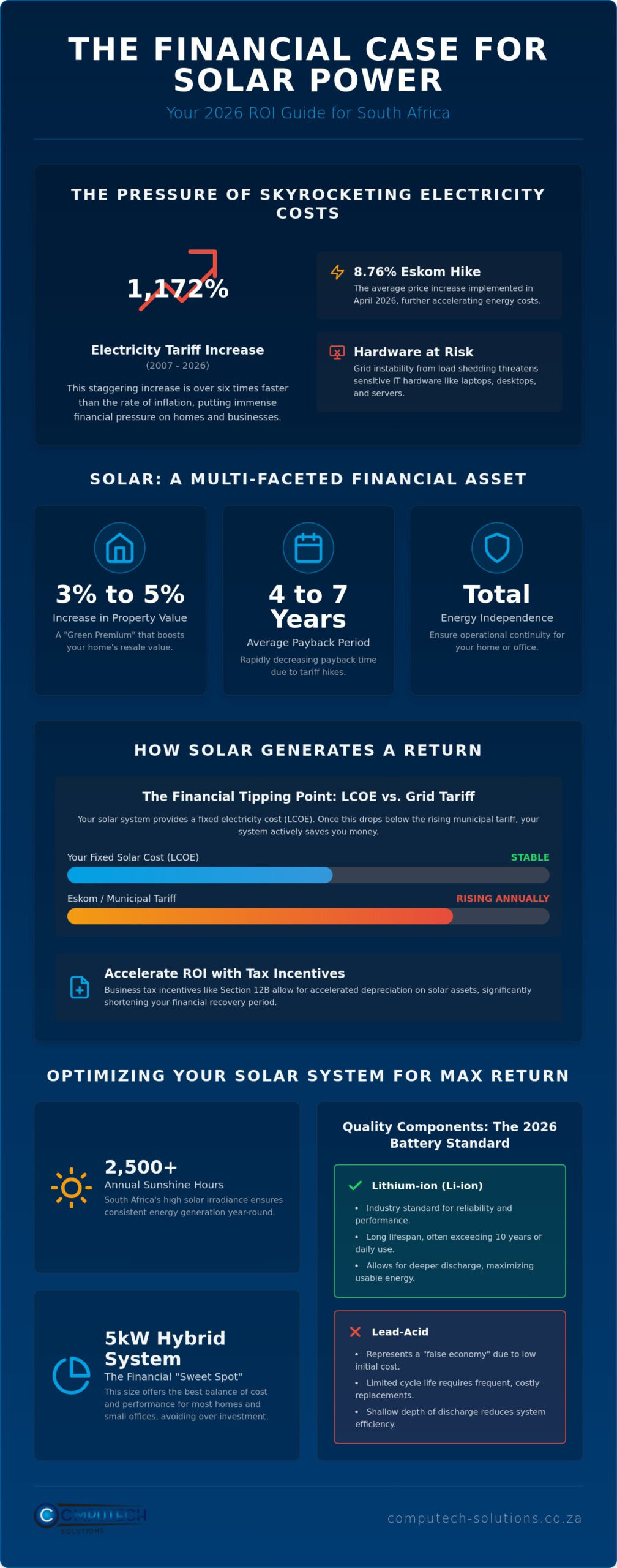
Between 2007 and 2026, South African electricity tariffs skyrocketed by 1,172%, rising more than six times faster than the rate of inflation. This staggering data point explains why calculating the ROI on solar panel installation South Africa is no longer just an environmental choice but a critical strategy for financial survival. You’re likely feeling the pressure of the 8.76% Eskom price hike implemented in April 2026, alongside the ongoing risk of localized power disruptions that threaten your laptops, desktops, and digital productivity.
It’s understandable to feel frustrated by complex hardware specifications and the initial cost of transition. However, by securing your own energy source, you aren’t just cutting monthly bills; you’re adding 3% to 5% to your property value and ensuring operational continuity. This guide outlines the exact timeline for solar profitability in 2026, helping you determine your break-even point with precision. We’ll examine the current 4 to 7 year payback period and show you how professional commissioning transforms a complex technical setup into a reliable, high-yield asset for your home or office.
Key Takeaways
- Determine your expected break-even point by analyzing the 2026 tariff hikes against the current average 4 to 7-year payback period for residential systems.
- Protect your high-end IT hardware, including laptops and desktops, from the operational risks and technical disruptions caused by localized grid instability.
- Quantify the “shadow costs” of load shedding to understand how energy independence directly supports long-term business continuity and professional productivity.
- Evaluate how expert technical commissioning and the use of Tier-1 components maximize the total ROI on solar panel installation South Africa.
- Identify how to leverage property value appreciation and active business tax incentives like Section 12B to accelerate your financial recovery.
Understanding Solar ROI in the South African Context (2026)
Solar ROI isn’t a single figure. It represents the intersection of immediate energy savings, available tax incentives, and the long-term appreciation of your physical property. In 2026, this calculation has changed significantly. While previous years focused almost exclusively on avoiding load shedding, the current financial model prioritizes hedging against hyper-inflationary utility costs. Calculating the ROI on solar panel installation South Africa now requires a sophisticated look at how your system functions as a financial asset that protects your productivity and your hardware.
The National Energy Regulator of South Africa (NERSA) remains the primary architect of these returns. By approving consistent tariff hikes that outpace inflation, NERSA has effectively shortened the payback period for private energy investments. The growth of solar power in South Africa reflects a nationwide shift toward decentralized energy where the consumer becomes the producer. Your specific return depends heavily on your system model. Off-grid systems offer total independence but require higher capital for massive battery banks. Grid-tied systems are the most affordable but leave you vulnerable during outages. Hybrid models have become the 2026 standard, balancing cost-efficiency with the ability to keep your desktops and servers running during localized grid failures.
The 2026 Tariff Landscape
For the 2026/2027 financial year, NERSA approved an average electricity price increase of 8.76% for Eskom direct customers and 9.01% for municipal purchasers. These figures are critical because they trigger “bracket creep.” As base rates rise, households and small offices find themselves pushed into higher-cost billing tiers much faster than in previous years. To measure this accurately, you must understand your Levelized Cost of Energy (LCOE). The Levelized Cost of Energy for SA households is the total lifetime cost of your solar system divided by the total kilowatt-hours it produces, providing a fixed price per unit of electricity that remains immune to Eskom’s annual hikes. When your LCOE drops below the municipal tariff, your system effectively starts “printing” money.
Property Value Appreciation
Energy independence has become a top-tier priority for South African homebuyers. Current market data indicates that homes equipped with certified solar installations fetch premiums between 3% and 5% higher than non-solar equivalents. This “Green Premium” is driven by buyer psychology in 2026; people aren’t just buying a house; they’re buying a guaranteed operational environment. Unlike a kitchen renovation, which may only return a portion of its cost, a solar system provides an immediate reduction in monthly liabilities while simultaneously increasing the asset’s resale value. This dual-benefit structure makes the ROI on solar panel installation South Africa one of the most stable investments available in the current property market.
Key Factors Influencing Your Payback Period
South Africa’s geographic position provides some of the highest solar irradiance levels in the world, averaging over 2,500 hours of sunshine annually. This natural abundance is the primary driver for the ROI on solar panel installation South Africa, as it ensures consistent generation even during winter months. However, simply having panels isn’t enough to guarantee a short payback period. Your return is dictated by how effectively you capture and store that energy. Efficient consumption profiling involves shifting heavy loads, like geysers or machinery, to peak daylight hours to reduce reliance on battery storage.
System configuration plays a decisive role in long-term profitability. While lead-acid batteries appear cost-effective at purchase, they represent a false economy due to their limited cycle life and shallow depth of discharge. In contrast, Lithium-ion technology has become the 2026 industry standard. These batteries allow for deeper discharge and last significantly longer, often exceeding ten years of daily use. To accurately calculate your solar power ROI, you must factor in these replacement cycles. Choosing high-quality components ensures your system remains operational without premature failure or technical disruptions.
Optimizing System Size for Maximum Return
A common mistake is over-sizing the battery bank, which inflates initial capital expenditure without providing proportional savings. For most South African homes and small offices, a 5kW hybrid system remains the financial “sweet spot.” This configuration provides enough capacity to run essential services and protect sensitive laptops and desktops while keeping the initial investment manageable. Balancing your upfront costs with your actual consumption profile ensures you don’t pay for capacity you never use. Professional commissioning is vital here to ensure your hardware is configured for maximum efficiency from day one.
The Impact of Feed-in Tariffs (SSEG)
Small-Scale Embedded Generation (SSEG) is gaining traction across various South African municipalities. Where available, feed-in tariffs allow you to sell excess power back to the grid, effectively turning your meter backward. While administrative hurdles remain, these incentives can shave twelve to eighteen months off your break-even point. Even without feed-in options, the primary value lies in self-consumption. Using your solar power during peak municipal billing hours maximizes every cent of your investment and mitigates the impact of the 9.01% municipal tariff hikes seen in 2026.
The Cost of Inaction: Load Shedding vs. Solar Investment
Postponing a solar transition often creates a financial leak that exceeds the cost of the system itself. This “shadow cost” of load shedding includes lost billable hours, missed project deadlines, and the physical degradation of your technical assets. When the grid fluctuates or returns after an outage, the resulting voltage spikes can be catastrophic for sensitive electronics. Factoring in these operational risks is essential when evaluating the total ROI on solar panel installation South Africa. You aren’t just paying for panels; you’re paying to stop the erosion of your professional productivity.
Traditional alternatives like petrol or diesel generators present a poor long-term financial model in 2026. Over a five-year period, the cumulative cost of fuel, oil changes, and mechanical repairs for a generator often rivals the initial investment of a solar setup. Unlike generators, which produce disruptive noise and ongoing expenses, solar systems provide silent, reliable power with minimal maintenance requirements. This shift from variable operational costs to a fixed capital investment provides the stability needed for accurate financial planning. It’s a move from reacting to a crisis to managing a predictable asset.
Protecting IT Infrastructure
Unstable grid power is the leading cause of premature failure in high-end computer hardware. Frequent power cycling shortens the lifespan of laptop batteries and can permanently damage delicate laptop chargers and internal circuitry. A Pure Sine Wave inverter provides the clean, stable electricity required to prevent these technical disruptions and ensure your IT equipment operates within its designed parameters. By isolating your desktops and servers from grid instability, you effectively extend the replacement cycle of your most expensive professional tools. This preservation of hardware longevity is a direct, measurable component of your system’s return.
Productivity and Opportunity Cost
For remote workers and digital professionals, connectivity is the lifeline of their income. A two-hour outage doesn’t just mean two hours of lost work; it often results in lost momentum and missed opportunities to respond to time-sensitive national business tenders. Calculating your hourly rate against the frequency of outages reveals that a solar system can pay for itself through avoided downtime alone. Solar acts as business continuity insurance, ensuring your operations remain seamless regardless of the state of the municipal grid. In the digital economy, the ROI on solar panel installation South Africa is increasingly measured by your ability to stay online while your competitors are in the dark.
Calculating Your Estimated Return (Step-by-Step)
Moving from theoretical savings to a concrete financial forecast requires a structured mathematical approach. To accurately determine the ROI on solar panel installation South Africa, you must look beyond the initial price tag and account for the total cost of ownership over two decades. This process transforms an equipment purchase into a predictable yield-bearing asset. Follow these five steps to find your specific break-even point in the 2026 economic environment.
- Step 1: Determine Total Initial Investment. Collate the costs of all hardware, including Tier-1 panels, hybrid inverters, and lithium storage. You must include professional commissioning fees, as expert setup is the only way to ensure your warranties remain valid and your system operates at peak efficiency.
- Step 2: Calculate Annual Avoided Costs. Review your current municipal or Eskom bill. Factor in the 2026 tariff increases of 8.76% to 9.01% to estimate what you would have paid without solar. This figure represents your gross annual “dividend” from the system.
- Step 3: Factor in Maintenance. While solar is low-maintenance, it’s not “no-maintenance.” Allocate a small annual percentage for panel cleaning and a technical health check. If you’ve chosen high-quality lithium batteries, you won’t need to budget for replacement for at least 10 to 12 years.
- Step 4: Apply Tax Incentives. For businesses, the Section 12B incentive remains a powerful tool, allowing for a 100% upfront deduction of the system cost in the first year. Residential users should note that the Section 6C rebate ended in 2024, so your ROI will rely primarily on bill savings and property value growth.
- Step 5: Find the Payback Year. Divide your net initial investment (after tax claims) by your net annual savings. Most South African installations currently reach this point within 4 to 7 years.
A 2026 ROI Example Scenario
Consider a standard 8kW residential system equipped with 4.4kW of panels and 14kWh of battery storage. In 2026, a system of this scale typically offsets a significant portion of a medium-to-large home’s energy usage. To see how these components work together, find out more about Retail of Solar Power Hardware and Combo Kits that provide the necessary foundation for energy independence. By avoiding the highest municipal billing tiers, the owner can reach a break-even point in approximately 5.5 years. Since quality panels are rated to produce at least 80% of their original output after 25 years, the “Profit Phase” lasts for nearly two decades. During this period, the electricity generated is effectively free, providing a massive hedge against future utility inflation.
Financing vs. Outright Purchase
Your choice of funding significantly impacts the total ROI on solar panel installation South Africa. Cash purchases offer the fastest payback period because they avoid interest costs. However, bond re-advances or specialized solar loans remain popular for preserving liquidity. While interest rates affect the total cost, the consistent 9% annual tariff hikes often outpace loan interest, meaning the system still pays for itself through avoided costs. Inflation further strengthens the case for solar; as the Rand’s purchasing power fluctuates, the value of the energy you produce in-house continues to rise. To ensure your investment is protected from the start, contact Computech-Solutions for expert commissioning and nationwide delivery of high-end components.
Strategic Solar Implementation with Computech-Solutions
Maximizing the ROI on solar panel installation South Africa requires more than just high-quality hardware. It demands a specialized understanding of how power systems interact with sensitive digital infrastructure. Computech-Solutions bridges this gap by providing a comprehensive, all-encompassing service model that integrates Tier-1 solar components with high-end IT hardware. Whether you’re running professional laptops or desktops, our focus remains on operational efficiency and the elimination of technical disruptions that threaten your bottom line.
Nationwide delivery ensures that decision-makers across South Africa have access to the same level of sophisticated expert support. By choosing a partner that understands the specific power requirements of servers and office equipment, you ensure your system is future-proof for the 2030 energy landscape. This strategic approach moves beyond basic backup power, positioning your installation as a definitive, total solution for long-term energy independence.
Expert Commissioning and Support
Technical commissioning is the final, critical step in securing your investment. A common pitfall is falling into the “cheap installer” trap, where poor configuration leads to inefficient energy conversion and voided hardware warranties. Our expert technical support team ensures that every component is commissioned for maximum compatibility and performance. This professional oversight is vital for maintaining the 4 to 7-year payback period discussed earlier. Reliable national service means you’re never left to manage operational risks alone, providing the stability and confidence needed to scale your operations.
Next Steps for Your Energy Transition
Before committing to a purchase, conducting a thorough home or office energy audit is essential. You need to select an inverter that handles your specific IT load without stressing the battery bank. Matching the right charger and power management settings to your Dell or HP systems prevents the hardware degradation caused by inconsistent voltage. Taking these steps now ensures your ROI on solar panel installation South Africa remains on track from day one. View our professional solar solutions and commissioning services to begin your transition with a reliable partner.
Secure Your Energy Independence and Operational Growth
Transitioning to solar is a strategic shift from managing a utility liability to owning a high-yield asset. As utility rates continue to outpace inflation, the ROI on solar panel installation South Africa is solidified by immediate bill reductions and long-term property appreciation. By protecting your sensitive laptops and desktops from grid instability, you eliminate the shadow costs of digital downtime and hardware failure while ensuring your operations remain seamless.
Success depends on professional execution. Computech-Solutions provides the technical bridge between power backup and high-end IT infrastructure. With nationwide South African delivery and specialized technical support for IT-integrated power, we ensure your system is commissioned for maximum efficiency from day one. Secure your energy future with Computech-Solutions solar power systems. Take control of your energy landscape today and build a resilient foundation for your home or office.
Frequently Asked Questions
What is the average payback period for solar in South Africa in 2026?
The typical payback period for a residential solar system currently ranges between 4 and 7 years. This timeline is heavily influenced by your specific energy consumption patterns and the 2026 municipal tariff increases of 9.01%. Systems that prioritize self-consumption during peak billing hours generally reach their break-even point faster than those relying solely on battery storage for nighttime use.
Do solar panels actually increase my property value nationally?
Yes, solar installations currently increase South African property values by an average of 3% to 5%. Homebuyers in 2026 view energy independence as a premium feature that reduces future monthly liabilities. A certified, professionally commissioned system is often more attractive to buyers than traditional home improvements like kitchen or bathroom renovations because it offers immediate operational savings.
Are there still government tax incentives for solar installation in 2026?
Business owners can still utilize the Section 12B tax incentive, which allows for a 100% upfront deduction of the solar system’s cost in the first year. This applies to panels, inverters, and batteries used for taxable business activities. However, the Section 6C rebate for individuals expired after the 2024 tax year; residential users now find their ROI on solar panel installation South Africa primarily through avoided utility costs and asset appreciation.
How does load shedding affect the ROI of my solar system?
Load shedding accelerates your ROI by eliminating the “shadow costs” of digital downtime and hardware damage. While the direct bill savings are significant, the value of avoided productivity loss for remote workers and the protection of expensive laptops or desktops provides a critical financial hedge. Solar acts as a business continuity insurance policy that pays for itself through consistent operational uptime.
Is it better to go off-grid or stay grid-tied for the best ROI?
A hybrid system generally offers the best ROI for most South African users in 2026. Grid-tied systems have the lowest initial cost but offer no protection during outages, while fully off-grid systems require massive, expensive battery banks that can extend the payback period. Hybrid configurations provide the “sweet spot” by balancing lower capital expenditure with the ability to maintain power during localized grid failures.
What maintenance costs should I factor into my solar ROI calculation?
You should allocate a small annual percentage of your initial investment for professional cleaning and a technical health check. Dust and debris can reduce panel efficiency by as much as 25% if left unmanaged. Factoring in these minor costs ensures your system continues to generate the maximum possible kilowatt-hours, protecting your long-term ROI on solar panel installation South Africa.
How long do solar batteries last before they need to be replaced?
Modern Lithium-ion batteries used in 2026 installations typically last between 10 and 15 years, depending on their cycle depth and temperature management. This is a significant improvement over older lead-acid technology, which often required replacement every 3 years. Choosing high-quality lithium storage ensures that your battery replacement cycle falls well outside your initial 4 to 7-year payback window.
Can I install solar panels myself to improve my ROI?
DIY installation is generally discouraged because it often voids equipment warranties and can lead to dangerous technical disruptions. Professional commissioning is vital to ensure your system safely integrates with your existing electrical board and protects sensitive IT hardware. Expert installers ensure the system is optimized for maximum yield, which is the only reliable way to secure your financial return and ensure long-term safety.
