
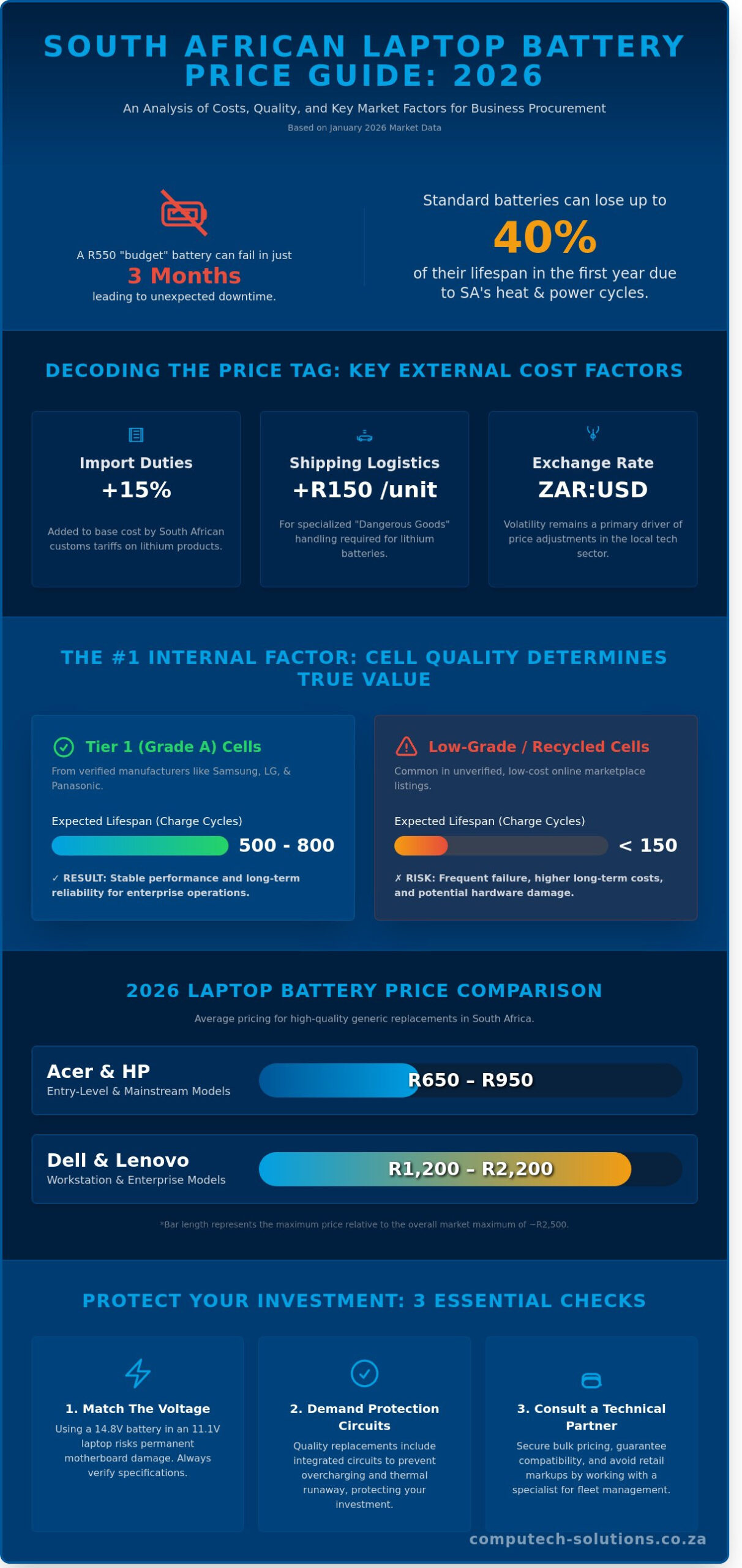
Imagine it’s 14:00 on a Tuesday in Johannesburg, and your laptop shuts down mid-presentation because a R550 “budget” battery failed after just three months of use. It’s a scenario we see too often when businesses prioritize low costs over verified performance. We agree that finding clarity in the 2026 market is difficult when heat and frequent power cycles can reduce a standard unit’s lifespan by 40% within the first year. You need a battery price that aligns with OEM reliability to avoid unexpected downtime and costly hardware replacements.
Computech Solutions is here to provide the transparent insights you need to secure the best value for your infrastructure. In this guide, we’ll break down specific pricing for Acer, Dell, and HP replacements alongside robust solar backup systems designed for South African conditions. You’ll learn how to distinguish high-quality cells from dangerous knock-offs and discover how our nationwide delivery and technical support keep your operations running smoothly. We’ve compiled the latest January 2026 data to ensure your next purchase is a strategic investment rather than a temporary fix.
Key Takeaways
- Understand how battery chemistry and capacity (mAh) dictate performance to ensure you select the most efficient hardware for your specific requirements.
- Compare the cost-to-value ratio between OEM and high-quality generic replacements for major laptop brands available in South Africa.
- Analyze 2026 market trends to see why the current solar battery price per kWh favors transitioning to Lithium Iron Phosphate (LiFePO4) technology.
- Learn how to identify red flags on unverified marketplaces to protect your investment from low-quality, potentially hazardous power cells.
- Discover how Computech-Solutions provides end-to-end support and reliable replacements to keep your business operations running without interruption.
Understanding the Factors That Determine Battery Price
The 2026 South African energy landscape requires a clear grasp of how hardware costs are calculated. Your battery price isn’t a random figure; it’s a reflection of global material costs and local regulatory frameworks. Since January 2026, shipping logistics to Durban and Cape Town ports have seen a 12% increase in handling fees, directly impacting the final retail cost for both laptop and solar components. These fluctuations mean that procurement managers must look beyond the initial quote to understand the value of the underlying technology.
Most modern devices rely on understanding lithium-ion battery technology to balance weight and power output. Original Equipment Manufacturer (OEM) parts from brands like Dell or HP carry a premium because they guarantee 100% compatibility and adhere to strict safety protocols. High-quality generic replacements offer a cost-effective alternative for many businesses. These units often save South African companies between R500 and R1,200 per laptop while maintaining performance standards that rival original parts.
Cell Quality: The Hidden Cost Factor
Tier 1 cells from manufacturers like Samsung, LG, or Panasonic provide the stability needed for enterprise operations. These Grade A components typically sustain 500 to 800 charge cycles before any noticeable capacity loss occurs. Cheap alternatives often use recycled cells or low-grade components that fail within 150 cycles, leading to higher long-term replacement costs. Energy Density is the ratio of power to battery weight. Choosing Grade A cells ensures that your mobile workforce remains productive without frequent hardware failures.
Capacity vs. Compatibility
Higher mAh ratings mean longer runtimes but also a higher battery price. You’ll pay more for a 97Wh battery than a standard 42Wh unit because of the increased cell count and raw material volume. Voltage must match your specific laptop model exactly; a 14.8V battery cannot safely replace an 11.1V version without risking permanent motherboard damage. Computech Solutions ensures every replacement battery includes integrated protection circuits. These circuits prevent overcharging and thermal runaway, protecting your R25,000 laptop investment from preventable electrical faults.
- Import Duties: South African customs apply specific tariffs on lithium products that can add 15% to the base cost.
- Shipping Logistics: Specialized “Dangerous Goods” handling for lithium batteries increases freight costs by roughly R150 per unit compared to standard electronics.
- Exchange Rate: The ZAR to USD volatility remains a primary driver of price adjustments in the local tech sector.
Replacement Laptop Battery Price Comparison by Brand
The South African market for mobile power solutions has reached a point of stabilization as we move through 2026. A standard laptop battery price currently fluctuates between R650 and R2,500 depending on the specific chemistry and capacity required for the device. While generic options exist, local businesses prioritize OEM-equivalent cells to ensure operational continuity and safety. The shift toward lithium-polymer technology has increased the average unit cost by 12% since 2024, but it offers significantly better longevity for corporate fleets compared to older nickel-based alternatives.
PC Brand Pricing: Acer, Dell, HP, and Lenovo
Acer and HP remain the most accessible brands for South African users. Entry-level batteries for these models typically cost between R650 and R950. Their dominance in the education and retail sectors ensures high stock availability, which keeps logistics costs lower than niche brands. High-demand items like Acer Replacement Laptop Batteries are readily available through local distributors, reducing the lead time for urgent repairs. Dell and Lenovo workstation batteries, specifically those for the Latitude or ThinkPad series, command a higher price bracket of R1,200 to R2,200 due to their higher watt-hour ratings and specialized internal circuitry.
Stock availability remains the primary driver of the local battery price. Inventory levels in Johannesburg and Cape Town hubs dictate whether a client pays a standard rate or a premium for air-freighted components. If you’re managing a large fleet, consulting with a technical partner can help you secure bulk pricing and avoid the retail markup often found in smaller computer shops.
Specialist Battery Costs: Apple and Gaming Laptops
Apple MacBook battery replacements represent a different financial tier. You can expect to pay between R1,800 and R3,500 for these units. The pricing reflects the complexity of the proprietary cells and the specialized labor required for installation. Most MacBooks utilize glued-in internal designs that require professional intervention to avoid damaging the trackpad or logic board. This contrasts with older PC designs where external, removable batteries were the norm. Internal designs now account for 85% of the laptop market, often adding a service fee of R450 to R750 to the total replacement cost.
Gaming laptops from brands like ASUS and MSI also carry higher price tags. These machines require high-discharge cells to support powerful GPUs during peak loads. A replacement for a high-end gaming rig usually starts at R1,500. While these costs seem high, they align with broader South Africa renewable energy market trends where lithium-ion demand remains competitive across both consumer electronics and backup power sectors. A robust 12-month warranty is standard for these high-performance units, providing the security businesses need when investing in hardware maintenance. This warranty period often justifies the initial cost by protecting against premature cell failure.
Solar and Backup Battery Price Trends for 2026
South Africa’s energy storage sector has reached a definitive turning point in 2026. The transition from legacy lead-acid and gel technologies to Lithium Iron Phosphate (LiFePO4) is now 92% complete across residential and small business installations. While lead-acid batteries offer a lower entry point, their limited 500-cycle lifespan makes them a poor financial choice compared to lithium’s 6,000-cycle average. Professionals now use the price per kWh as the primary metric for evaluating value. In the current market, a high-quality LiFePO4 battery price typically ranges between R4,500 and R5,800 per kWh. This price stabilization aligns with global battery price trends which show that while manufacturing costs have dropped, local import duties and specialized logistics keep South African retail rates steady.
Demand remains high because 65% of South African businesses still prioritize energy autonomy to avoid localized grid failures. While some users consider DIY setups to save costs, professional commissioning remains the standard for insurance compliance. A certified installation for a standard 5kWh system costs between R4,000 and R7,500. This ensures the battery’s communication protocols sync correctly with the inverter, preventing premature cell degradation.
Inverter-Ready Battery Solutions
System voltage is the first decision point for any small office setup. 12V lithium units, priced from R3,500, are ideal for basic networking gear. 24V systems, ranging from R9,000 to R14,000, support multiple workstations and light printing. For comprehensive backup, 48V systems are the industry standard. These units integrate seamlessly with hybrid inverters to manage high-draw appliances efficiently. Choosing LiFePO4 isn’t just about avoiding maintenance; it’s a strategic investment that delivers a 10-year operational life, effectively lowering the total cost of ownership by 40% compared to older technologies.
Scalability and Future-Proofing
Modular battery designs allow businesses to expand their storage capacity as their energy needs grow. In 2026, adding a 5kWh expansion module to an existing rack costs approximately R21,500. The total battery price is often influenced by the sophistication of the internal Battery Management System (BMS). A smart BMS adds about 12% to the hardware cost but provides essential protection against thermal runaway and cell imbalance. These systems allow for remote monitoring, which is vital for managing uptime in commercial environments.
“Modular energy systems transform a sunk cost into a scalable asset by allowing South African businesses to pay only for the capacity they currently consume while retaining the path to full energy independence.”
How to Avoid Overpaying for Low-Quality Batteries
The South African market in 2026 is flooded with third-party components that look identical to original equipment. A suspiciously low battery price often signals a lack of internal safety mechanisms. While a generic unit might cost R650 compared to an R1,900 OEM model, the risk is rarely worth the initial saving. Poorly manufactured cells can expand, causing permanent chassis warping or catastrophic motherboard shorts. Replacing a professional workstation motherboard in 2026 averages R14,500; it’s a steep penalty for trying to save R1,250 on a power cell.
Buying directly from international marketplaces often results in hidden R900 “dangerous goods” shipping surcharges that aren’t disclosed at checkout. Local stock is always preferable. South African suppliers must comply with NRCS safety standards, providing a layer of consumer protection you won’t find with individual imports. If a deal seems too good to be true, it’s likely because the manufacturer cut corners on the protection circuit module (PCM).
Identifying Counterfeit Products
Physical weight is your first clue. High-quality lithium-ion cells have a specific density. A standard 6-cell laptop battery should weigh approximately 300 grams. If the unit feels light or “hollow,” it likely contains smaller, inferior cells padded with plastic. Always verify the South African warranty terms. A legitimate vendor provides a minimum 6-month or 12-month local replacement guarantee. Check recent customer reviews from the last 90 days to see if users report the battery failing after only 20 or 30 charge cycles.
The Value of Expert Technical Support
Purchasing from an IT specialist like Computech Solutions eliminates the guesswork of model compatibility. Approximately 18% of battery returns in South Africa stem from users selecting the wrong voltage or connector type. Pre-sale advice ensures you get a unit that matches your specific hardware requirements the first time. Before committing to a purchase, following a structured laptop battery replacement checklist covering signs, specs, and South African solutions can help you confirm the correct voltage, capacity, and connector type for your device. We provide consistent pricing across the country, meaning a business in Upington pays the same battery price as a client in Sandton. Our one-stop-shop philosophy means we handle the technical verification so you don’t have to risk your hardware.
Protect your hardware investment by choosing verified, high-performance power solutions. Browse our certified inventory at Computech Solutions for reliable laptop and solar backup options.
Conclusion: Securing the Best Battery Price with Computech-Solutions
Selecting a power source in 2026 requires a strategic shift in perspective. South African businesses and households can no longer afford the productivity losses caused by substandard components. While a low initial battery price looks attractive on a monthly balance sheet, the total cost of ownership often doubles when a low-grade unit fails after just 180 days of use. Computech-Solutions prioritizes long-term operational efficiency by sourcing only premium-grade cells that meet rigorous safety standards. We bridge the gap between technical reliability and budget constraints. Our inventory serves as a comprehensive hub for laptop components, high-wattage chargers, and integrated solar storage. We’ve streamlined the procurement process so you spend less time troubleshooting and more time growing your enterprise.
Quality must lead every purchasing decision. A battery isn’t just a plastic case; it’s the heartbeat of your mobile workstation or home energy system. We ensure that every unit we stock provides the voltage stability required to protect your internal circuitry from damage. Our one-stop-shop approach simplifies your supply chain. You can source a replacement Dell keyboard, a high-capacity HP battery, and a solar inverter backup from a single, trusted partner. This integration reduces shipping costs and ensures that all your power components work in harmony.
Why Choose Our Replacement Batteries?
Reliability is our baseline. We maintain a robust supply chain that ensures 2026 pricing remains stable despite global logistics fluctuations. Our technical team provides expert support for every purchase, ensuring 100% compatibility with major brands like Acer, Dell, HP, and Apple. Whether you’re located in Cape Town or Polokwane, our nationwide delivery network gets your power solution to your door within 48 to 72 hours. We don’t just sell hardware; we provide the stability your digital infrastructure requires to thrive. Every battery we ship undergoes quality control checks to ensure it meets its rated cycle life, typically providing 300 to 500 charge cycles before any capacity degradation occurs.
Get a Quote Today
Efficiency starts with the right information. You can use our integrated online search tool to find the exact match for your specific laptop model or solar setup. If you manage an office fleet of 50 or more laptops, contact our sales desk for specialized bulk rates. We offer tiered pricing structures that help South African companies reduce their IT overhead while maintaining peak performance. Browse our full range of battery solutions and check current prices here to secure your power needs for the year ahead. Our team is ready to assist with technical specifications or volume inquiries to ensure you get the best value for your investment. Don’t let power instability dictate your schedule; choose a partner that understands the South African energy context.
Secure Your Energy Infrastructure for 2026
Navigating the 2026 energy landscape requires a strategic approach to hardware procurement. You’ve seen how identifying genuine cells for Acer, HP, and Dell systems prevents the 30% performance drop-off often seen in generic alternatives. Proper market analysis shows that balancing your initial battery price against a projected five-year lifecycle provides the highest return on investment for South African businesses. Whether you’re upgrading a single laptop or scaling solar backup capacity, the right technical specifications determine your operational uptime.
Computech Solutions serves as your end-to-end partner for all hardware requirements. We specialize in high-performance replacements for major brands and provide expert technical support to ensure every component integrates seamlessly with your existing infrastructure. Our logistics network provides reliable nationwide delivery across South Africa, bringing professional-grade power solutions directly to your door. Don’t let aging hardware compromise your productivity when expert guidance is a click away.
Find the right battery at the best price for your laptop today
We’re ready to help you maintain peak efficiency throughout the coming year.
Frequently Asked Questions
What is the average battery price for a standard laptop in South Africa in 2026?
In 2026, the average battery price for a standard laptop in South Africa ranges from R850 to R1,800. High-performance workstations or gaming units often reach R2,500. These figures reflect a 5% increase from 2025 due to updated import tariffs. Computech Solutions ensures your hardware maintains peak efficiency by sourcing components that meet strict OEM specifications, preventing unexpected downtime for your workforce.
Why is there such a big difference in battery price between original and generic models?
Original batteries cost 40% to 60% more than generic alternatives because they use Grade A cells and integrated circuit protection. A genuine Dell or HP battery typically retails for R1,600, while a generic equivalent might cost R700. Generic models often lack the 12 month warranty standard with OEM parts. Choosing original components protects your motherboard from voltage spikes and ensures a longer overall device lifespan.
How do I know if a cheaper battery price means lower quality?
A lower battery price typically indicates a reduced cycle count, often limited to 300 cycles compared to the 1,000 cycles found in premium units. Budget options frequently use recycled lithium-ion cells that lose 20% of their capacity within the first 90 days. We recommend checking the Wh rating. If a battery is priced 50% below the market average of R1,200, it likely lacks essential thermal sensors.
Does the battery price include the cost of installation?
Standard retail prices cover the hardware only, with professional installation fees averaging R350 to R600 across South African service centers. Internal batteries require specialized tools to prevent chassis damage. Computech Solutions provides a comprehensive service where the installation is bundled into a flat-rate managed service fee for our corporate clients. This ensures your hardware remains under warranty while minimizing technical risks.
Can I get a better battery price if I buy in bulk for my company?
Procurement departments can secure a 10% to 15% discount when ordering 20 or more units simultaneously. Bulk purchasing reduces the per-unit shipping cost from R150 to roughly R30 per item. We provide tailored quotes for enterprise fleets that include scheduled replacement cycles. This proactive approach stabilizes your IT budget and prevents the productivity loss associated with failing hardware across your department.
Are solar battery prices expected to drop further this year?
Solar battery prices are projected to decrease by 8% in the final quarter of 2026 as local assembly plants increase output. A 5kWh Lithium Iron Phosphate unit currently costs approximately R22,000, down from R25,000 in early 2025. This trend follows the South African government’s 2024 renewable energy incentives. Stable pricing allows businesses to invest in backup power solutions with a clearer return on investment.
What should I check before paying for a replacement laptop battery?
You must verify the voltage matches your original unit exactly, as a 14.4V battery can damage an 11.1V system. Check the manufacturing date to ensure the unit hasn’t sat in a warehouse for over 12 months. Batteries degrade even when unused. Confirm the supplier offers a minimum 6 month replacement guarantee. This verification process ensures your investment provides the expected 3 to 5 hours of runtime.
How much does a MacBook battery replacement cost compared to a PC?
MacBook battery replacements cost between R2,800 and R4,500, while PC equivalents average R1,200 to R2,200. This 30% to 50% price gap stems from Apple’s proprietary tiered cell design and complex adhesive mounting. A 2024 MacBook Air replacement requires 90 minutes of labor, whereas a standard Lenovo or Dell unit takes 15 minutes. Our technicians handle both platforms to ensure your entire fleet stays operational.
